Expert Flooring Guide · 2020 Flooring · DC, Maryland & Virginia Since 1993
Choosing hardwood flooring is one of the most impactful decisions you'll make for your home — the right species, construction, and finish can deliver decades of beauty and add real resale value. This guide covers everything you need to decide with confidence.
6 Key Factors for Choosing Hardwood Flooring
Before comparing species, evaluate these six key factors to narrow your options and find the hardwood floor that matches your home, lifestyle, and budget.
Room & Location
Above-grade rooms work with any hardwood. Below-grade or concrete slabs need engineered construction.
Foot Traffic Level
High-traffic areas demand species rated 1,300+ on the Janka scale. Hickory and Oak are top performers.
Pets & Kids
Harder species with textured or matte finishes hide scratches better than soft, high-gloss options.
Design & Color Goals
Lighter species (Maple, Birch) suit modern interiors. Darker woods (Walnut, Mahogany) add warmth and drama.
Plank Width & Thickness
Wider planks look contemporary but require stable species or engineered construction for best results.
Budget & Long-Term Value
Solid hardwood costs more upfront but lasts decades longer. Engineered offers savings on installations over concrete.
How to Choose Hardwood Flooring Color
Color is the most visible decision you'll make. Our designers have helped thousands of DMV homeowners find the right hardwood color for their space — here's what we've learned over 30 years.
Assess Your Room's Natural Light
Rooms with large south-facing windows can handle darker stains like espresso or ebony without feeling closed in. North-facing rooms with limited light benefit from lighter tones — natural White Oak, Maple, or light Ash — to keep the space feeling open. Always test samples in your actual room at multiple times of day, because hardwood color shifts dramatically between morning sun and evening lamplight.
Match Undertones, Not Just Color
Every wood species has an undertone — warm (red, gold, honey) or cool (gray, taupe, brown). Red Oak carries pink-red undertones that clash with cool-gray cabinetry. White Oak has neutral-to-warm undertones that pair with almost anything. Walnut runs chocolate-cool. Matching your floor's undertone to your cabinets, trim, and countertops is more important than matching the exact shade.
Consider Lifestyle and Maintenance
Very dark floors (espresso, jacobean stains) show every speck of dust, pet hair, and micro-scratch. Very light floors show stains and water marks more readily. Mid-tones — natural White Oak, honey Hickory, light Walnut — are the most forgiving in homes with kids and pets. Wire-brushed and matte finishes hide wear far better than high-gloss.
Room Size and Flow
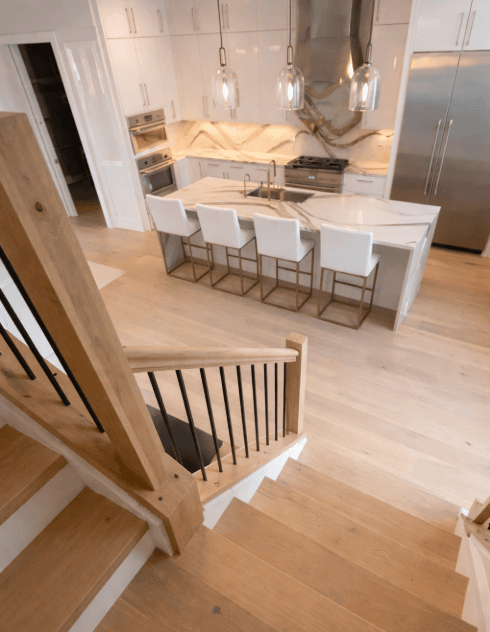
Lighter floors make smaller rooms feel larger and more open. Darker floors create warmth and intimacy in oversized spaces. If your hardwood runs through multiple rooms (which we recommend for visual flow), choose a mid-tone neutral that transitions well between different lighting conditions and adjacent wall colors.
Test Full-Size Samples in Your Home
Showroom lighting is nothing like your home. We provide take-home samples so you can place them on your actual subfloor, next to your cabinets, and under your lighting for 48 hours before committing. This is the single most important step — we've seen countless homeowners change their mind after seeing a sample in their own space.
Popular colors in 2025: Natural White Oak remains the top choice across Maryland, DC, and Virginia for its versatility. Warm honey tones are surging in popularity, while cool grays have plateaued. Dark-stained White Oak (jacobean or ebony) still commands attention in formal dining rooms and studies. Visit our showroom to see 100+ color and finish samples in person.
What Is the 60/30/10 Rule for Flooring?
This classic interior design principle helps you create a balanced, cohesive room. Here's how professional designers apply it when selecting hardwood flooring.
Dominant Color
Your flooring and walls together form the dominant 60%. Since hardwood covers the entire floor plane, it anchors the room's color palette. Choose a floor color that sets the foundation — neutral tones (natural oak, light maple, warm hickory) give you the most flexibility. Your wall color should complement, not compete with, your floor.
Secondary Color
Furniture, cabinetry, and large textiles make up the secondary 30%. This is where you introduce contrast. If your hardwood is light, your sofa and dining table might be darker wood or rich upholstery. If your floor is dark walnut, lighter furniture prevents the room from feeling heavy. The secondary palette should harmonize with your floor's undertone.
Accent Color
Throw pillows, artwork, decorative objects, and area rugs provide the 10% accent. These are the easiest to change seasonally and should add energy or visual interest. A natural White Oak floor with gray walls (60%), navy upholstered furniture (30%), and brass-and-mustard accents (10%) is a timeless combination we see frequently in DMV homes.
Pro tip from our design team: The 60/30/10 rule is a starting point, not a rigid formula. In open floor plans — which are extremely common in DC, Maryland, and Virginia homes — your hardwood floor is the one constant that flows through every connected space. That makes choosing a versatile, neutral-toned floor even more critical. When your floor color works everywhere, you can vary wall colors, furniture, and accents room by room without losing visual cohesion.
Solid Hardwood vs. Engineered Hardwood
Understanding the difference between solid and engineered hardwood is the first decision in choosing the right floor for your home. Both options are available at our Rockville showroom serving the DC metro area.
| Feature | Solid Hardwood | Engineered Hardwood |
|---|---|---|
| Construction | Single piece of hardwood (3/4" thick) | Hardwood veneer over plywood cross-layers |
| Refinishing | Can be sanded and refinished 3-5+ times | Limited to 1-2 refinishes depending on veneer |
| Moisture Stability | Expands and contracts with humidity changes | Cross-ply core resists warping and cupping |
| Installation Areas | Above-grade only (not basements or over concrete) | All levels including basements and concrete |
| Installation Methods | Nail-down or staple-down over plywood subfloor | Nail, glue, or floating installation |
| Longevity | 50-100+ years with proper maintenance | 25-50+ years depending on veneer thickness |
| Cost Range | $6-$15+ per sq ft installed | $5-$14+ per sq ft installed |
| Best For | Living rooms, bedrooms, dining rooms, hallways | Basements, kitchens, over radiant heat |
Expert tip from our design team: In the DC, Maryland, and Virginia climate — where humidity swings between dry winters and humid summers — engineered hardwood offers superior dimensional stability for below-grade and concrete-slab installations. For above-grade living spaces, solid hardwood remains the gold standard for longevity and refinishing flexibility. Learn more about our hardwood installation process or refinishing services.
Where to Install Hardwood Flooring: Room-by-Room Guide
Not every room in your home is suitable for every type of hardwood. Use this room-by-room guide to choose the right construction type for each space.
| Room | Solid | Engineered | Notes |
|---|---|---|---|
| Living Room | ✓ | ✓ | Ideal for both — highest-visibility area, prioritize appearance |
| Bedroom | ✓ | ✓ | Low traffic allows softer species like Cherry or Walnut |
| Dining Room | ✓ | ✓ | Use area rugs under furniture to prevent dents |
| Kitchen | ✗ | ✓ | Spill risk — engineered preferred; wipe up water quickly |
| Hallway | ✓ | ✓ | High traffic — choose Janka 1,300+ (Oak, Hickory, Maple) |
| Basement | ✗ | ✓ | Below grade — engineered only due to moisture |
| Bathroom | ✗ | ✗ | Not recommended — consider waterproof flooring instead |
For bathrooms and laundry rooms, explore our waterproof flooring options. Looking for basement-specific solutions? See our basement flooring guide.
Janka Hardness Comparison Chart
The Janka hardness test measures a wood species' resistance to denting and wear. Higher ratings indicate harder, more durable flooring — critical for high-traffic areas in DC, Maryland, and Virginia homes.
| Species | Origin | Janka Rating (lbf) | Rating |
|---|---|---|---|
| Brazilian Cherry (Jatoba) | Exotic | 2,820 | |
| Santos Mahogany | Exotic | 2,200 | |
| Tigerwood | Exotic | 2,160 | |
| Amendoim (Brazilian Oak) | Exotic | 1,912 | |
| Hickory | Domestic | 1,820 | |
| Kempas | Exotic | 1,710 | |
| Maple | Domestic | 1,450 | |
| White Oak | Domestic | 1,360 | |
| Ash | Domestic | 1,320 | |
| Beech | Domestic | 1,300 | |
| Red Oak | Domestic | 1,290 | |
| Birch | Domestic | 1,260 | |
| Walnut | Domestic | 1,010 | |
| American Cherry | Domestic | 950 | |
| Yellow Pine | Domestic | 870 |
Not sure which species is right for your home? Bring your room photos to our showroom or schedule a free in-home design consultation. Our experts will evaluate your space, lighting, subfloor conditions, and lifestyle to recommend the ideal hardwood flooring species, width, and finish.
Hardwood Flooring Species Guide: Interactive Comparison Tool
Compare 20 American hardwood species side by side. Filter by Janka hardness rating, price range, availability, and primary use to find the perfect species for your home in the DC, Maryland, and Virginia area.
Hickory / Pecan
Carya spp.
The hardest and heaviest commercially available American hardwood. Dramatic color variation from creamy white sapwood to rich brown heartwood creates a rustic, one-of-a-kind look. Requires pre-boring for nailing.
Janka Hardness (lbf)
Heartwood Color
Pale to reddish brown heartwood; white sapwood tinged with brown
Grain & Texture
Heaviest American hardwood; bold, rustic character with dramatic color variation
Distribution
Eastern U.S.; Central and Southern states
Working Properties
Main Uses
Tool handles, furniture, cabinetry, flooring, wooden ladders, dowels, sporting goods
White Oak
Quercus spp. — ~8 commercial species
Harder and more moisture-resistant than Red Oak thanks to its closed grain structure. The most popular species for contemporary and farmhouse-style flooring. Longer ray flecks create more visual figure.
Janka Hardness (lbf)
Heartwood Color
Light-to-dark brown heartwood; light-colored sapwood; more figure than Red Oak
Grain & Texture
Mostly straight-grained; medium-to-coarse texture; great wear resistance
Distribution
Throughout Eastern U.S.
Working Properties
Main Uses
Furniture, flooring, architectural millwork, moulding, doors, kitchen cabinets, paneling, barrel staves, caskets
Red Oak
Quercus spp. — ~8 commercial species
The most widely used American hardwood species, making up over 30% of all hardwood volume. Warm pinkish-red tones with bold grain character. Excellent value, readily available, and takes stain beautifully.
Janka Hardness (lbf)
Heartwood Color
Pinkish-reddish brown heartwood; white to light brown sapwood
Grain & Texture
Mostly straight-grained; coarse texture; prominent cathedral grain
Distribution
Throughout Eastern U.S. (>30% of all hardwood volume)
Working Properties
Main Uses
Furniture, flooring, architectural millwork, moulding, doors, kitchen cabinets, paneling, caskets
Birch
Betula alleghaniensis
A hard, strong wood that takes stain exceptionally well — often used as a more affordable substitute for cherry or walnut. Fine, uniform texture with occasional curly figure that adds visual interest.
Janka Hardness (lbf)
Heartwood Color
Light reddish brown heartwood; white sapwood
Grain & Texture
Generally straight-grained; fine, uniform texture; plain, often curly or wavy pattern
Distribution
Eastern U.S.; Northern and Lake states
Working Properties
Main Uses
Furniture, millwork, paneling, doors, flooring, kitchen cabinets, turnings, toys
Hard Maple
Acer saccharum / Acer nigrum — Sugar maple, black maple
The gold standard for light-colored hardwood flooring. Exceptional abrasion resistance makes it the go-to for high-traffic areas, gym floors, and bowling alleys. Clean, contemporary look with minimal grain.
Janka Hardness (lbf)
Heartwood Color
Light to dark reddish brown heartwood; creamy white sapwood with slight reddish brown tinge
Grain & Texture
Close, fine texture; generally straight-grained; high abrasion resistance
Distribution
Eastern U.S.; Mid-Atlantic and Lake states
Working Properties
Main Uses
Flooring, furniture, paneling, gym/ballroom floors, kitchen cabinets, worktops, butcher blocks, kitchenware, toys, stairs, handrails
Ash
Fraxinus spp.
A strong, shock-resistant hardwood with bold grain similar to oak but in lighter, more neutral tones. Excellent value for flooring and furniture. Its flexibility makes it ideal for steam bending and sporting equipment.
Janka Hardness (lbf)
Heartwood Color
Grayish or light brown to pale yellow streaked with brown
Grain & Texture
Generally straight-grained; coarse uniform texture
Distribution
Throughout Eastern U.S.
Working Properties
Main Uses
Furniture, flooring, doors, millwork, kitchen cabinets, paneling, tool handles, baseball bats, sporting equipment
Elm
Ulmus rubra
A tough, shock-resistant wood with interlocked grain that makes it nearly impossible to split. Attractive reddish-brown tones work well for furniture and flooring where character and durability matter.
Janka Hardness (lbf)
Heartwood Color
Reddish brown to dark brown heartwood; grayish white to light brown narrow sapwood
Grain & Texture
Straight to often interlocked grain; coarse texture; difficult to split
Distribution
Eastern to Midwest U.S.
Working Properties
Main Uses
Furniture, cabinet making, flooring, millwork, paneling, caskets
Walnut
Juglans nigra
America's premier dark hardwood. Rich chocolate-brown tones with occasional purplish cast — naturally beautiful without staining. Excellent dimensional stability and a silky finish that polishes to a high sheen.
Janka Hardness (lbf)
Heartwood Color
Light brown to dark chocolate brown; occasionally purplish cast; creamy white sapwood
Grain & Texture
Generally straight-grained; sometimes wavy or curly for decorative figure; good dimensional stability
Distribution
Eastern U.S.; principally Central states
Working Properties
Main Uses
Furniture, cabinets, architectural millwork, doors, flooring, paneling, gun stocks; favored for contrast with lighter species
Cherry
Prunus serotina
One of America's most prized cabinet woods. Rich red tones deepen beautifully with age and light exposure, developing a warm patina. Satiny smooth texture machines to an excellent finish without heavy sanding.
Janka Hardness (lbf)
Heartwood Color
Rich red to reddish brown; darkens with age and light exposure; creamy white sapwood
Grain & Texture
Straight-grain; fine, uniform, satiny and smooth texture; may have brown pith flecks
Distribution
Midwestern & Eastern U.S.; principally PA, VA, WV, NY
Working Properties
Main Uses
Fine furniture, cabinet making, moulding, millwork, kitchen cabinets, paneling, flooring, doors, boat interiors, musical instruments
Soft Maple
Acer rubrum / Acer saccharinum — Red maple, silver maple, box elder
A readily available, more affordable alternative to Hard Maple. About 25% softer but still strong enough for most furniture and cabinetry. Finishes beautifully and often sold unselected for color.
Janka Hardness (lbf)
Heartwood Color
Light-to-dark reddish brown heartwood; greyish-white sapwood; may have pith flecks
Grain & Texture
Usually straight-grained; 25% less hard than Hard Maple; good steam-bending
Distribution
Throughout Eastern U.S.
Working Properties
Main Uses
Furniture, paneling, millwork, kitchen cabinets, moulding, doors, musical instruments, turnings
Hackberry
Celtis occidentalis — Sugarberry
An underappreciated hardwood with good shock resistance and steam-bending properties. Fine, uniform texture planes and turns nicely. Best available in cut stock; susceptible to blue staining if not dried properly.
Janka Hardness (lbf)
Heartwood Color
Yellowish grey to light brown with yellow streaks; little sapwood/heartwood contrast
Grain & Texture
Irregular grain, occasionally straight but sometimes interlocked; fine, uniform texture
Distribution
Eastern U.S.
Working Properties
Main Uses
Furniture, kitchen cabinets, millwork, doors, moulding
Gum (Sweetgum)
Liquidambar styraciflua — Redgum, sapgum
An affordable hardwood that mimics walnut beautifully when stained. Reddish-brown heartwood with attractive dark streaks and a fine, uniform texture. Widely available and one of the best-value domestic species.
Janka Hardness (lbf)
Heartwood Color
Reddish brown heartwood with darker streaks; white to light pink sapwood
Grain & Texture
Irregular, usually interlocked grain; produces attractive figure; fine, uniform texture
Distribution
Throughout Southeastern U.S.
Working Properties
Main Uses
Cabinet making, furniture parts, doors, millwork, strips, moulding, turnings, rail ties
Pacific Coast Maple
Acer macrophyllum — Big leaf maple
A West Coast alternative to Hard Maple with a softer, more workable character. Fine grain similar to birch and cherry, with good stability once dried. Excellent for turnings and carved details.
Janka Hardness (lbf)
Heartwood Color
Pale pinkish-brown to almost white; minimal sapwood/heartwood contrast
Grain & Texture
Fine grain similar to birch and cherry; good dimensional stability after drying
Distribution
Pacific Northwest
Working Properties
Main Uses
Furniture, kitchen cabinets, doors, shutters, moulding, panel stock, turnings, carvings, kitchen utensils
Sycamore
Platanus occidentalis — Buttonwood
A distinctive species with fine, close texture and interlocked grain that resists splitting. Contrasts well with other species in mixed designs. Requires high-speed cutters and care during drying to prevent warping.
Janka Hardness (lbf)
Heartwood Color
Light-to-dark brown heartwood; white to light yellow sapwood
Grain & Texture
Fine, close texture with interlocked grain; resistant to splitting
Distribution
Throughout Eastern U.S.
Working Properties
Main Uses
Furniture, furniture parts (drawer sides), millwork, paneling, moulding, flooring, kitchenware, butcher blocks, toys, fruit crates
Alder
Alnus rubra
The most abundant commercial hardwood of the Pacific Northwest. Uniform texture and excellent machinability make it a go-to for cabinets and furniture. Takes stain and finish beautifully despite its modest hardness.
Janka Hardness (lbf)
Heartwood Color
Light brown with yellow or reddish tinge; almost white when freshly cut
Grain & Texture
Fairly straight-grained; uniform texture; no visible sap/heartwood boundary
Distribution
Pacific Northwest
Working Properties
Main Uses
Furniture, kitchen cabinets, doors, shutters, moulding, turnings, carvings, kitchen utensils
Poplar
Liriodendron tulipifera — Yellow poplar, tulip wood
One of the most widely available and affordable domestic hardwoods. Easy to machine and finishes well with paint, enamel, or stain. Ideal for painted cabinetry and millwork where a smooth surface matters more than hardness.
Janka Hardness (lbf)
Heartwood Color
Pale yellowish-brown to olive green; darkens to brown with light; creamy white sapwood
Grain & Texture
Medium-to-fine texture; straight-grained; versatile and easy to machine
Distribution
Throughout Eastern U.S.
Working Properties
Main Uses
Light construction, furniture, kitchen cabinets, doors, paneling, moulding, millwork, edge-glued panels, turnings, carvings
Cypress
Taxodium distichum — Bald cypress, red cypress, yellow cypress
A naturally rot-resistant wood that excels in exterior applications. Straight grain resists warping, making it a top choice for siding, shutters, and trim. Also used for interior flooring and paneling.
Janka Hardness (lbf)
Heartwood Color
Light to dark reddish brown heartwood; pale yellow-white sapwood
Grain & Texture
Straight-grained; resists warping; technically a softwood but grouped with hardwoods
Distribution
Southern U.S.; Atlantic Coastal Plain, Gulf Coast, Mississippi Valley
Working Properties
Main Uses
Exterior siding, shutters, shingles, trim, fence posts, interior paneling, moulding, millwork, cabinetry, flooring, furniture, beams, columns
Cottonwood
Populus deltoides
A widely available, soft hardwood with a neutral pale tone. Easy to nail, screw, and glue. Best for interior furniture parts, millwork, and painted applications where extreme hardness isn't required.
Janka Hardness (lbf)
Heartwood Color
Pale-to-light brown heartwood; white sapwood with possible brown streaks
Grain & Texture
Generally straight-grained; coarse texture; diffuse, porous wood
Distribution
Eastern U.S.; Middle and Southern states
Working Properties
Main Uses
Furniture, furniture arts, millwork, moulding, toys, kitchen utensils, Venetian blinds, shutters, caskets
Basswood
Tilia americana — Linden
Considered the premier American carving wood due to its fine, even texture and ease of working. Very soft, so not suitable for flooring, but unmatched for hand-carved details, turnings, and musical instruments.
Janka Hardness (lbf)
Heartwood Color
Pale to reddish brown; creamy white sapwood — minimal contrast
Grain & Texture
Indistinct, straight grain; fine, uniform texture
Distribution
Northern and Lake states
Working Properties
Main Uses
Carvings, turnings, furniture, pattern-making, moulding, millwork, musical instruments, Venetian blinds, shutters
Aspen
Populus tremuloides — Popple
A very soft, lightweight hardwood with fine uniform texture. Best suited for interior furniture parts and specialty items. Rarely available in thick stock but works well for moulding, frames, and turned goods.
Janka Hardness (lbf)
Heartwood Color
White sapwood blending to light brown heartwood; minimal contrast
Grain & Texture
Straight-grained; fine, uniform texture
Distribution
Northeast U.S.
Working Properties
Main Uses
Furniture parts (drawer sides), doors, moulding, picture frames, millwork, toys, sauna laths, chopsticks
Janka hardness values represent Side Hardness at 12% moisture content (lbf). Data sourced from the American Hardwoods Collection Species Guide and USDA Forest Service Wood Handbook.
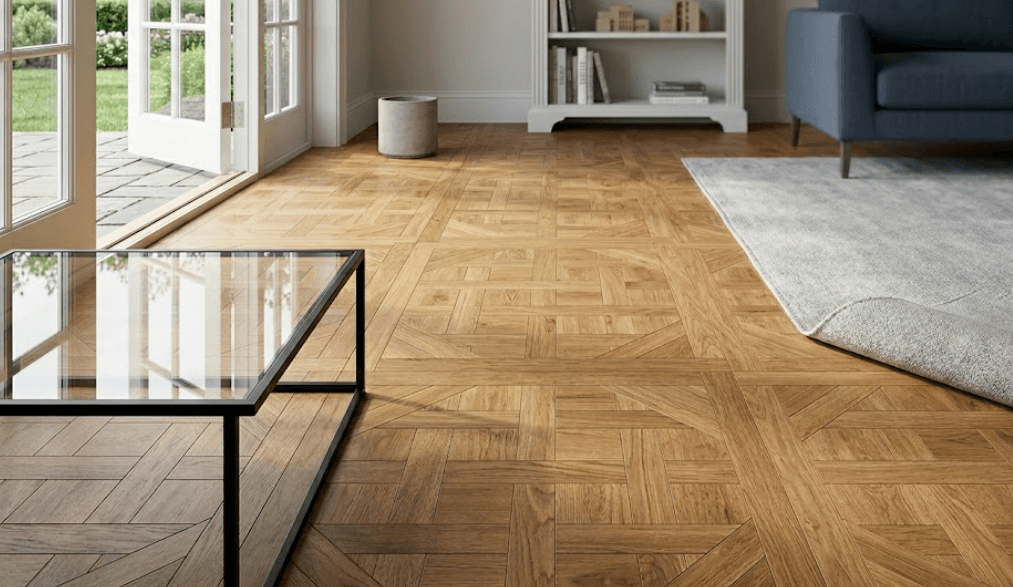
Interested in a patterned layout? Beyond straight-lay planks, hardwood can be installed in geometric arrangements — herringbone, chevron, basket weave, and other classic parquet patterns. These are especially popular in formal dining rooms, entryways, and historic-style homes across the DMV. Read our complete parquet flooring guide to learn about formats, subfloor requirements, and what parquet installation costs in Maryland, DC, and Virginia.
How to Care for Hardwood Floors
Proper care extends the lifespan of your hardwood floors by decades. Follow these expert maintenance practices recommended by our installation team.
Sweep or dust mop to remove grit and debris that cause micro-scratches. Avoid vacuums with beater bars on unfinished or delicate species.
Damp mop with a hardwood-specific cleaner. Never use excessive water, vinegar, or steam cleaners on hardwood flooring — moisture is the number one enemy of solid wood floors.
Maintain indoor humidity between 35-55% using humidifiers in winter and dehumidifiers in summer. This is especially important in the DC/Maryland/Virginia climate where seasonal swings can cause gaps or cupping.
Screen and recoat the polyurethane finish to restore sheen and add a protective layer. This is far less expensive than a full sand-and-refinish and keeps your floors looking new.
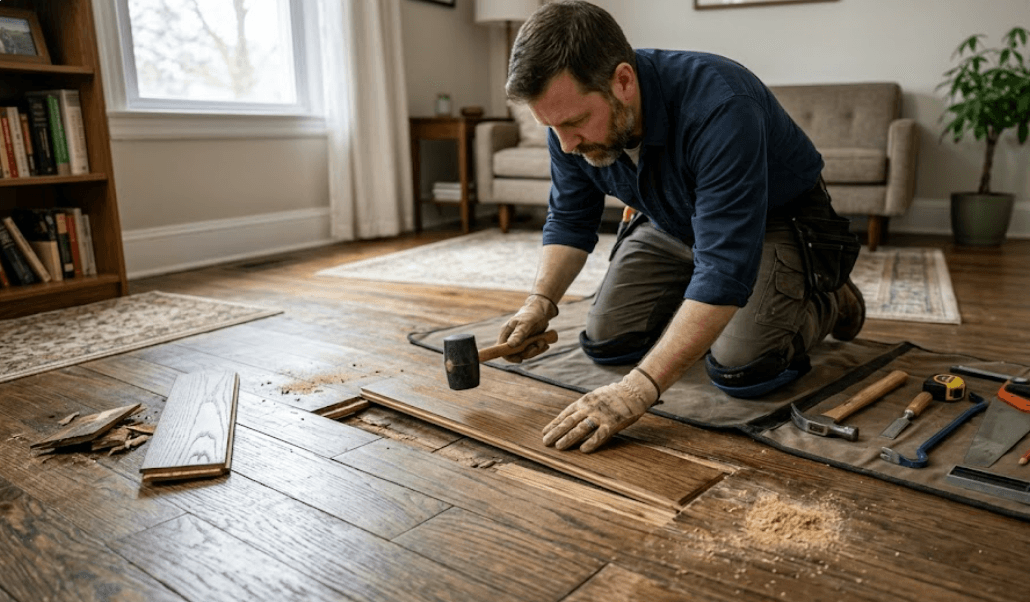
Full sand and refinish when wear patterns become visible. Solid hardwood floors can be refinished 3-5+ times, extending their life well beyond 50 years.
Need professional refinishing? Learn about our hardwood refinishing services or flooring repair options.
Installing hardwood in Silver Spring, MD?
Silver Spring's housing stock — from the pre-war colonials in Woodside and Four Corners to the newer townhomes near downtown — is well-suited to solid hardwood on above-grade floors. White Oak and Red Oak are our most-requested species in the area: both hold up to the foot traffic typical of busy family homes and photograph well for listings in Silver Spring's competitive real estate market. Our team handles full hardwood floor installation in Silver Spring — from subfloor prep through final finish — and can usually schedule an in-home estimate within a few days. Call (301) 881-1115 or use the quote form above.
Frequently Asked Questions About Hardwood Flooring
Answers to the most common questions our flooring experts hear from homeowners across the DC, Maryland, and Virginia area.

Written by
Jason Brown
Flooring Specialist
Jason Brown has 14 years of flooring sales and installation experience across the DC, Maryland, and Virginia area.