


Basement Flooring Installation in Maryland, DC, and Northern Virginia
Turn your basement into real living space. We install luxury vinyl plank, carpet and carpet tile, porcelain tile, laminate, engineered hardwood, epoxy coatings, and rubber — and help you pick the right product for how each part of the basement gets used.
A Finished Basement Is the Best Square Footage in the House
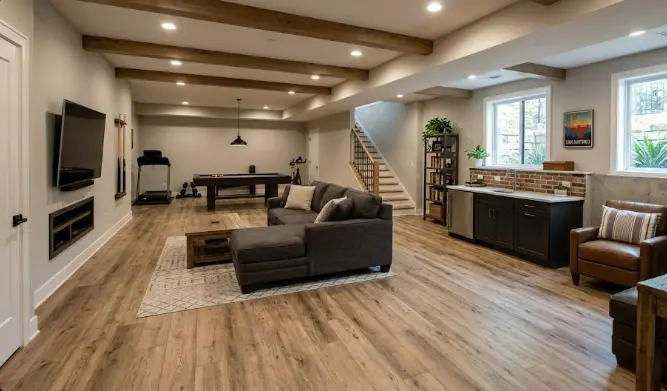
It is also the cheapest space to convert — the walls, the roof, and the slab are already there. Whether you are building out a media room, a guest suite, a home gym, or all three, the flooring sets the tone. We carry the full range of basement-suitable products at our North Bethesda showroom, and our installers have been finishing below-grade spaces across the DMV since 1997. Finishing the basement as part of a wider home renovation? We fold the flooring into your overall project timeline and coordinate with your other trades.
Basement Flooring Products We Install
Six product families cover almost every basement we finish. Most homeowners end up combining two or three of them by zone.
Luxury Vinyl Plank & Tile (LVP / LVT)
The most-installed basement floor we lay in the DMV. Rigid-core planks click together over concrete with no adhesive, come in convincing wood and stone visuals, and give a finished basement the same look as the main level for a fraction of hardwood pricing. Available in wide plank, herringbone, and large-format tile formats.
Carpet & Modular Carpet Tile
Warm and quiet underfoot for basement playrooms, media rooms, and guest suites. Below grade we specify modular carpet tile far more often than broadloom — individual squares can be lifted and replaced, and the closed-cell backing behaves very differently from a traditional foam pad. Solution-dyed nylon in commercial-grade constructions holds up to real family traffic.
Porcelain & Ceramic Tile
The most permanent basement floor there is. Large-format porcelain, wood-look plank tile, and stone visuals all work below grade, and porcelain is the natural choice for a basement bathroom, wet bar, laundry, or mudroom. Pair it with electric radiant mats and the coldest room in the house becomes the warmest.
Laminate Flooring
High-definition laminate delivers a hard, scratch-resistant wear surface at a friendly price, and it is a legitimate option in a dry, dehumidified basement used as an office, hobby room, or guest space. We check the manufacturer warranty for below-grade coverage before recommending it, and we will show you the matching rigid-core vinyl alongside it so you can compare.
Engineered Hardwood
Real wood veneer over a dimensionally stable plywood core. Engineered hardwood is the only wood product we will consider below grade, and only in a basement that tests dry with year-round humidity control. When the conditions are right, it is the way to carry a true hardwood floor down from the main level without a visual break at the stairs.
Epoxy & Concrete Coatings
For workshops, home gyms, storage rooms, wine cellars, and the unfinished half of a basement, a resinous coating turns bare concrete into a finished surface with no height gain at all. Solid colors, decorative flake, and metallic finishes are all available, and the seamless surface sweeps and mops in minutes.
Flooring by Basement Zone
A basement is rarely one room. Zoning the floor by use gets you a better result than running a single product wall to wall — and flush transition strips keep it looking deliberate.
Family & media room
Rigid-core LVP or carpet tile
Warm underfoot, quiet, and forgiving of a spilled drink during movie night.
Home gym
Rubber tile or flake epoxy
Impact absorption for free weights and a surface that shrugs off sweat and rolling equipment.
Playroom
Modular carpet tile
Soft and quiet, and a damaged square is a $6 swap rather than a room replacement.
Basement bathroom or wet bar
Porcelain tile
The right product for a plumbed space, and it takes radiant heat beautifully.
Guest suite or office
LVP, engineered wood, or laminate
A quiet, finished feel that matches the upstairs when the space tests dry.
Storage, laundry & utility
Epoxy coating or sheet vinyl
Sweeps clean, adds no height, and nothing to damage around the mechanicals.
Basement stairs
Carpet runner or matching plank treads
Traction and noise control coming down, or a continuous look from the main level.
Workshop
Epoxy or interlocking tile
Tolerates dropped tools, solvents, and equipment on casters.
Every Basement Job Starts at the Slab
Below-grade concrete behaves differently from a plywood subfloor upstairs, so we test and prepare it before any material is ordered. Moisture testing, flatness correction, crack repair, and — where the readings call for it — a vapor retarder or mitigation coating. Product choice comes second. Replacing damp or musty basement carpet? Start with carpet removal — the odor is usually coming from the slab underneath, not the carpet itself.
Moisture Testing
ASTM in-situ relative humidity or calcium chloride testing on the slab, with the reading given to you in writing before we recommend a product.
Flatness & Crack Repair
Grinding high spots, chasing and filling cracks, and self-leveling low areas so floating floors do not click apart at the seams.
Vapor Strategy
A vapor retarder or roll-on mitigation coating specified from the test result — never applied by default, never skipped when the number says otherwise.
Guide · Waterproof basement flooring
Worried About Water? Read Our Waterproof Basement Flooring Guide
Steady summer humidity, an occasional damp corner after a storm, and a basement that genuinely floods are three different problems with three different answers. Our installer's guide ranks every waterproof option, explains the difference between waterproof and water-resistant flooring, covers cheap waterproof options worth installing, and shows what actually survives a flood — with 2026 DMV installed costs throughout.
Read: Best Waterproof Flooring for a BasementBasement Flooring FAQs
What flooring options do you install in a basement?
Luxury vinyl plank and tile, carpet and modular carpet tile, porcelain and ceramic tile, laminate, engineered hardwood, sheet vinyl, epoxy and concrete coatings, and rubber tile. Most finished basements end up with rigid-core LVP through the main living area, tile in a bathroom or wet bar, and carpet tile or a coating in the playroom, gym or storage zone — though we are happy to run one product wall to wall instead.
How much does basement flooring cost in Maryland?
Basement flooring costs in Maryland typically range from $2,000 to $8,000+ for a 500–1,000 sq ft basement, depending on the product and how much subfloor preparation the slab needs. Carpet tile and sheet vinyl start around $2,000–$3,500. Luxury vinyl plank generally runs $4,000–$6,000. Porcelain tile and premium coatings can exceed $7,000. Slab grinding, crack repair, and self-leveling add $1.50–$4 per square foot when needed, and removing existing flooring adds $1–$3 per square foot. Every estimate we write breaks those items out separately so you can see exactly what you are paying for.
How long does a basement flooring installation take?
A typical 800 sq ft basement takes two to four working days once the slab is ready. Floating luxury vinyl plank or laminate is usually one to two days, carpet tile one day, and porcelain tile three to five days including the mortar and grout cure. Slab preparation adds time: self-leveling compound needs 24 hours before anything goes on top of it, and a moisture mitigation coating adds another day. If the basement is being finished as part of a larger renovation, we schedule flooring after drywall and the first coat of paint, and before trim.
Can you install carpet in a basement?
Yes, and it is still one of the most popular finishes for playrooms, media rooms and guest suites. Below grade we recommend modular carpet tile over broadloom: squares lift out individually, so one incident does not cost you the whole room. We will still install broadloom in a basement that tests dry and is humidity-controlled year round. Replacing musty basement carpet? The odour usually lives in the pad and the slab rather than the carpet face, so the estimate normally starts with removal and a slab cleaning.
Can hardwood or laminate go in a basement?
Solid hardwood should not go below grade — it cups, crowns and gaps as humidity swings through a DMV year. Engineered hardwood is a genuine option in a basement that tests dry and is dehumidified year round, because its plywood core is far more dimensionally stable. Laminate sits in between: the HDF core is still wood, and several manufacturers exclude below-grade installation from the warranty. We check the specific warranty before recommending either, and will show you the matching rigid-core vinyl alongside it.
Which basement flooring is waterproof?
Rigid-core luxury vinyl plank, sheet vinyl, porcelain tile, epoxy and polyaspartic coatings, and rubber are all genuinely waterproof materials. Laminate and engineered wood are water-resistant at best. Which one belongs in your basement depends on how water has actually behaved in the space — steady humidity, occasional seepage, or real flooding are three different problems with three different answers. Our full guide to the best waterproof flooring for a basement covers the comparison, the costs, and what survives a flood in detail.
Do you prepare the concrete slab before installing?
Always. Slab preparation is the difference between a basement floor that lasts twenty years and one that fails in two. We test slab moisture, check flatness against the manufacturer tolerance (usually 3/16" over 10 feet for resilient products), grind high spots, chase and fill cracks, and apply self-leveling compound where the slab needs it. Any vapor retarder or moisture mitigation is specified from the test result rather than by default. The prep line appears separately on every estimate we write.
What are some basement flooring ideas for a finished basement?
Zone the space rather than running one product everywhere. Wood-look rigid-core plank through the family and media area; large-format porcelain in a wet bar or basement bathroom; modular carpet tile in the playroom so a damaged square is a cheap fix; flake epoxy or interlocking rubber in the gym corner; a carpet runner on the stairs for traction and quiet. Flush transition strips between zones keep it reading as a designed space rather than a patchwork. Wood-look porcelain plank is worth a look if you want the appearance of hardwood with tile durability.
More questions about moisture, flooding, and waterproof products are answered in our guide to the best waterproof flooring for a basement.
Prepare Basement Floors for Wet Fall Weather
Seasonal rain can expose dampness, seepage, or slab moisture in DMV basements. Evaluate the source and test conditions before installing carpet, vinyl, tile, or another finish. A moisture-tolerant flooring plan can make the lower level more comfortable without hiding an unresolved problem.
Expert Tips From Our Installers
Always test your concrete slab for moisture before choosing basement flooring. Tape a 2x2 piece of plastic to the concrete for 48 hours — if condensation forms underneath, you need a vapor barrier or moisture mitigation before flooring.
For basements with low ceilings, choose thinner flooring options. LVP at 5–6mm adds minimal height compared to tile over cement board (3/4") or engineered hardwood over plywood (1"+).
Current Pricing
Starting at $4 per sq ft installed
Basement flooring costs depend on moisture remediation needs, subfloor prep, and product choice. LVP is the most cost-effective waterproof option. Tile and engineered hardwood run higher.
Pricing updated March 2026
More Basement Flooring FAQs
What flooring is best for basements with moisture issues?
Luxury vinyl plank (LVP) and porcelain tile are the best options for basements with moisture concerns — both are 100% waterproof. If your basement has active water intrusion, address the waterproofing first, then install flooring. Avoid solid hardwood and standard laminate below grade.
Can I install flooring over a concrete basement floor?
Yes, many flooring types install directly over concrete: LVP (floating or glue-down), tile (thinset), engineered hardwood (floating or glue-down), and carpet (stretch-in with pad). A moisture test is always recommended first.
Do I need a vapor barrier for basement flooring?
In most DMV basements, yes. A 6-mil polyethylene vapor barrier or an integrated moisture-barrier underlayment prevents moisture from migrating through the concrete slab into your flooring. We test moisture levels and recommend the right barrier for your situation.
How do I keep my basement floor warm?
Floating floors with built-in underlayment (LVP, engineered hardwood) feel warmer than tile over bare concrete. For maximum warmth, consider radiant heat mats under tile or LVP. Carpet over pad is the warmest option but not ideal if moisture is a concern.
Explore Related Flooring Services
A finished basement is one room in a bigger home. See how we floor the rest of the house and larger projects.
Residential Flooring
Whole-home flooring packages with coordinated materials and volume savings across every room.
Kitchen Flooring
Durable, waterproof, and stylish floors built for the busiest room in the house.
Bathroom Flooring
Waterproof tile, luxury vinyl, and heated floor systems built for wet, high-moisture rooms.
Waterproof Flooring
100% waterproof options engineered for below-grade moisture and the risk of flooding.
Renovation Flooring
Finishing your basement? We fold flooring into your renovation timeline and coordinate trades.
New Construction Flooring
Flooring packages for new homes, including below-grade spaces, from builder-grade to premium.
Unlock Your Basement's Potential
A finished basement adds valuable living space and increases your home's value. Let us help you choose the right flooring for every zone in your below-grade space.
2020 Flooring Showroom
2020 Flooring
5550-F Nicholson Lane, North Bethesda, MD 20852
Mon–Wed 10–7 · Thu–Sat 10–6 · Sun 11–5
Can't Come in Person?
We'll bring the showroom to you! Request a free in-home consultation and browse samples in the comfort of your own home.
Request Free In-Home ConsultTrusted by the DMV Community
For over 25 years, residential and commercial members of the DC, Maryland, and Virginia community have trusted 2020 Flooring. Check out what our customers have to say!
5.0on Google“We had a last minute major issue in the flooring we selected from another flooring installer on our kitchen renovation and addition. We had initially loved another flooring choice that we saw at 2020 Flooring. Unfortunately we found out it had been discontinued. Carol from 2020 Flooring went above and beyond to help us locate the amount of LVP flooring we needed by scouring the country. She found just the right amount and was able to get the order expedited so we could continue on the time schedule with our general contractor. Bobby from 2020 Flooring was great in helping us remedy an issue with the subfloor. We now have the exact flooring we wanted which has made our new kitchen and addition complete. Can't thank them enough!”
“As an architect, from the moment we walked into 2020 Flooring, upon seeing a standout recommendation on NextDoor, I was immediately impressed with Bobby and Carol's technical expertise, friendliness and professionalism. They asked the right questions, took their time to weigh flooring options for us without pressure and worked hard to meet our budget for new floors for our townhome. They committed to a date for installation and made it work. Their crew, led by Mariano, was highly competent, discrete, meticulous and worked long hours to complete the job in time. They stand by their work proudly and their warranty is better than anyone else's. Our new floors are fabulous and we wholeheartedly recommend 2020 Flooring!”
“I spent many hours trying to select a quality vinyl floor with the right color combination for my house and Carol at IDESIGN made the job easy with a great selection that I am very satisfied with. In general IDESIGN carries a good selection of quality floors but the added value of Carol's design expertise made the difference and I greatly benefited from her help. Thanks Carol😊”
Reviews sourced from Google. 2020 Flooring was given permission to publish reviews on this site.