
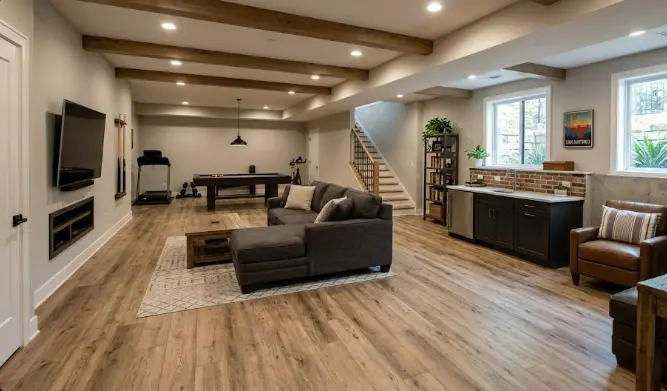



Luxury Vinyl Plank & Tile Installation in Maryland, DC & Northern Virginia
Luxury vinyl is the most forgiving flooring product sold and the easiest one to install badly. The plank is waterproof no matter who puts it down; whether the seams stay tight, the slab stays dry underneath and the floor still looks flat in five years is decided by the preparation nobody sees.
This page covers how we install LVP and LVT in homes across the DMV — subfloor assessment, slab moisture testing, floating versus glue-down, stairs, transitions and trim. Shopping for the floor itself? Browse the luxury vinyl we carry. Fitting out an office, clinic or retail space? See commercial vinyl flooring.
Residential LVP and LVT Installation, Room by Room or Whole House
We install luxury vinyl in single rooms, main levels, finished basements, rentals between tenants and whole-house renovations, across Montgomery County, Washington DC and Northern Virginia. Most jobs start the same way: a floor that has reached the end of its life, a room that keeps getting wet, or a house being made ready to sell.
Every installation includes the parts homeowners usually discover as extras elsewhere — moving standard furniture, removing and disposing of the old floor, subfloor correction within the scope we quoted, undercutting door jambs, transitions and trim, and a final clean. What is in the estimate is what happens on site.
Work in an office, medical suite, restaurant or multi-family common area follows different rules on wear layer, adhesive, slip resistance and scheduling around a working building. That work lives on our commercial vinyl and LVT page, and multi-tenant turns on the commercial flooring side.
Subfloor Preparation — Where a Luxury Vinyl Job Is Won or Lost
Rigid-core vinyl hides small imperfections, which is exactly why cut-rate installers skip this step. It hides them for about two years. We check three things before any material is opened.
Flatness
Rigid-core luxury vinyl bridges more subfloor variation than laminate does, but it does not fix a floor. We work to the manufacturer tolerance, generally 3/16 inch over 10 feet, and we check it with a straightedge rather than by eye. A dip left in place shows up later as a hollow spot underfoot and a stressed seam above it.
Slab moisture
Below-grade rooms and slab-on-grade ranches are where this matters most. We take relative humidity or calcium chloride readings on concrete before installation and match the underlayment or adhesive to the result. Vinyl is waterproof; the adhesive and the trim around it are not.
Structural soundness
Loose panels, soft spots, protruding fasteners and old water damage all get addressed before a plank goes down. In a 1950s Bethesda rambler or a Silver Spring bungalow, this step is usually where the surprises live, and it is far cheaper to find them now than under a finished floor.
The Prep Work Itself
- Grinding high spots and filling low spots in concrete with a cementitious patch or self-leveler
- Re-screwing loose plywood or OSB panels to stop movement and squeaks before the new floor traps them
- Replacing deteriorated subfloor panels around former leaks, tubs and dishwashers
- Installing a vapor retarder over concrete where moisture readings call for one
- Pulling every staple and tack strip after a carpet tear-out — a missed staple telegraphs through a floating plank as a visible bump
- Undercutting door jambs and casings so the floor runs beneath them rather than being scribed around them
We do not charge for prep a floor does not need, and we do not quietly skip prep it does. If an inspection turns up work beyond the estimate, you hear about it with a price before we proceed, not on the invoice afterwards.
Not Sure What Your Subfloor Needs?
We will measure the room, check flatness, take moisture readings on any slab, and tell you exactly what your luxury vinyl installation requires before anything is ordered.
Taking Out the Old Floor
Most luxury vinyl installations replace something. What is coming out determines how the first day goes and how much of the schedule it takes.
Carpet and pad
The most common thing we take out before an LVP install. The carpet and pad come up quickly; the staples and tack strip are the actual work, and they matter more here than they would under new carpet.
Carpet removal and disposalCeramic tile and stone
Tile removal is dusty, heavy demolition, and what is left behind — thinset ridges, a cracked mud bed, a lower floor height at the doorway — has to be resolved before vinyl goes down.
Tile and stone removalOld sheet vinyl or VCT
A single layer of well-bonded sheet vinyl can often stay as an underlayment. A cushioned layer, a loose layer, or two layers stacked cannot. In houses built before 1985 we treat old resilient flooring and its adhesive as presumed asbestos-containing and handle it accordingly rather than sanding it.
Floating or Glue-Down — How We Decide
Luxury vinyl installs two ways, and the choice belongs to the room and the product rather than to installer preference.
Floating click-lock
Planks lock edge to edge and the floor rests on the subfloor without fasteners or adhesive, held in place by its own weight and the perimeter trim. It is the right answer for most bedrooms, living rooms, kitchens and basements: no cure time, walk on it the same day, and an individual damaged plank can be lifted and swapped years later. Most of the ADURA APEX planks and 18 x 36 tiles we install float, with the pad already attached to the board.
Full-spread glue-down
Each piece is set into a trowelled adhesive over the whole floor. It feels more solid underfoot, has no perimeter movement to accommodate, adds almost nothing to the floor height at a doorway, and handles heavy rolling loads. It is what the 5mm ADURA APEX hexagons require, and what we recommend for very long uninterrupted runs and for sunrooms that see wide temperature swings. It needs a flatter subfloor and it needs cure time before furniture returns.
Acclimation and Underlayment
Material is staged flat in the installation room for 48 hours before we start. In this climate the swing between a humid Maryland August and a heated January interior is large enough that a floor installed straight off a cold truck will move once it settles in.
Underlayment is a smaller question here than it is with laminate, because most of the rigid-core products we install already carry an attached pad. When a product has one, we do not add a second cushion under it — a double cushion lets the locking joints work against each other. Over concrete we add a vapor retarder beneath, and nothing else. Comparing the two products? Laminate installation handles underlayment very differently.
Which Method Suits Your Room?
Bring us the room and we will tell you whether it wants a floating floor or a glue-down, and what that decision does to the timeline and the cost.
Layout Planning
Everything here is decided before the first plank locks in. Once a run has started, the decisions are already made.
Plank direction
We run planks along the length of the longest sightline or toward the main light source, and down the length of a hallway. In an open plan we pick one direction and carry it through every connected room so the floor reads as one surface.
Starting wall and final row
We measure the room first so the last row does not land as a two-inch sliver against the most visible wall. Where the room is out of square, which in older DMV housing stock it usually is, the cut row goes where a piece of furniture or the least-seen wall will absorb it.
Stagger and seam pattern
End joints are offset by at least the manufacturer minimum, and we pull from several cartons at once so the printed visuals shuffle. ADURA APEX planks carry 10 or more unique boards per pattern; working from one carton at a time is how installers accidentally line up the same board three rows apart.
Expansion gaps
A consistent gap goes around the entire perimeter and at every fixed object — door jambs, cabinet toe kicks, hearths, pipe penetrations. Nothing gets fastened through a floating floor, including the transition strips, which are anchored to the subfloor beside the floor rather than through it.
Installation Details That Change by Room
The plank is the same throughout the house. What we do at the edges is not.
Kitchens
The floor runs to the face of the cabinets, not under them, and appliances need a path back in that does not drag a rigid plank out of lock. We set the dishwasher opening height so the unit can come out later without the floor trapping it — a detail that gets missed constantly and costs a homeowner a cabinet panel five years on.
Basements over slab
Moisture readings first, vapor retarder where required, then a floating install that can move with the slab. Rigid-core vinyl goes directly over concrete without a plywood layer, which keeps the finished height low enough to clear a basement door and a bottom stair riser.
Bathrooms and laundry
Waterproof planks still need a waterproof perimeter. We seal the edge at the tub, the toilet flange and the shower base with the manufacturer-approved sealant so standing water cannot reach the subfloor through the expansion gap.
Stairs
Stairs are never floated. Each tread and riser is cut individually and adhered, with a matching stair nose at every leading edge. It is the most labor-intensive part of any luxury vinyl job and the part where a cut-rate install shows first.
Radiant heat
Luxury vinyl works over most in-floor systems, provided the product is rated for it and the surface temperature stays within the manufacturer limit. We bring the system to temperature gradually before and after installation rather than switching it back on all at once.
Long open-plan runs
Every floating floor has a maximum uninterrupted span. Past it, the floor needs an expansion break or it needs to be glued down. We plan those breaks at doorways and natural transitions where a T-molding belongs anyway, rather than putting one in the middle of a great room.
Planning a whole lower level rather than one room? Our basement flooring page covers the moisture strategy in more depth, and kitchen and bathroom flooring cover how vinyl sits alongside the other options for those rooms.
Transitions and Trim — The Part You Actually See
Nobody inspects the middle of a floor. Everyone looks at the doorway.
Undercut jambs and casings
We cut the bottom of every door jamb and casing to the height of the new floor so the plank slides underneath. The alternative — scribing the plank around the moulding — leaves a gap that has to be caulked, and caulk on a floating floor is a repair waiting to happen.
Transitions between rooms
T-moldings where two floating floors meet, reducers where the vinyl steps down to a lower surface, end caps at sliding doors and carpet transitions at a bedroom threshold. Each is fixed to the subfloor beside the floor, never pinned through it.
Baseboard and quarter round
The perimeter expansion gap gets covered by reinstalled baseboard, new baseboard, or quarter round nailed to the wall rather than to the floor. We finish this before we leave; a floor with the gap still showing is not a finished floor.
What Installation Day Looks Like
Before we arrive
Material is delivered and acclimating in the room for 48 hours. We confirm the schedule, the parking situation and, in a Bethesda or Arlington condo, the building move-in window and elevator reservation.
Protection and prep
We move furniture, protect the path in with runners, and set up dust control at the work area. Old flooring comes out, the subfloor gets its final check, and any corrections happen before the first plank.
Installation
Layout is snapped and dry-fit at the start of the run, then the floor goes in row by row with cuts made on site around vents, jambs and cabinet returns. We inspect boards as we go rather than after they are locked in.
Trim, clean and walkthrough
Transitions, baseboard and quarter round go on, the floor is cleaned, the old material leaves with us, and we walk the job with you before the crew packs up.
Ready to Put a Date on It?
Tell us the rooms and we will come measure, check the subfloor, and send a written estimate with a realistic day count — not a placeholder.
After the Install
The first 48 hours
A floated floor is walkable immediately. A glue-down floor needs the adhesive to cure before heavy furniture returns, and we will tell you how long for the specific adhesive used. Use felt pads under furniture legs and wide floor protectors under anything on castors.
Living with it
Sweep or vacuum on a hard-floor setting, damp mop with a cleaner the manufacturer approves, and skip anything abrasive or wax-based. Most ADURA APEX patterns are steam mop approved; the 5mm hexagons are not, so those get cleaned damp.
Our workmanship warranty
Our labor is warranted separately from the product. If a seam, a transition or a piece of trim we installed is not performing, call us and we come back out — you are not routed to a manufacturer claims line for something we did.
Installing Vinyl in a Commercial Space?
Commercial vinyl is a different specification and a different install. Wear layers run heavier, glue-down is the norm rather than the exception, sheet vinyl may be heat-welded for a seamless surface, slip resistance and moisture mitigation are held to written standards, and the work is usually scheduled around a building that has to open in the morning.
We handle that work too — offices, clinics, retail, restaurants, gyms, schools and multi-family turns across the DMV — on the pages built for it.
Schedule Your Luxury Vinyl Installation
Call (301) 881-1115 or visit the showroom at 5550-F Nicholson Lane, North Bethesda. We will measure the space, check the subfloor, and give you a complete written estimate covering material, labor, removal, transitions and trim.
Want to see the products before you book? Browse our luxury vinyl collection, or run the numbers with the LVP cost calculator and the waste calculator.
Luxury Vinyl Installation FAQs
How long does luxury vinyl plank installation take?
A single room is usually a one-day job. A main level of 800 to 1,200 square feet typically runs two to three days, and a whole house four to five. Add a day when the old floor has to come out, when a slab needs leveling compound that has to cure, or when the layout involves stairs. We give you the day count in writing with the estimate, not on the morning of the install.
How much does LVP installation cost per square foot in the DMV?
Labor for a straightforward floating LVP installation generally runs $2 to $4 per square foot in Maryland, DC and Northern Virginia, with material on top of that. Glue-down installations, stairs, extensive subfloor leveling, old-floor removal and detailed trim work all move the number. Our written estimate breaks labor, material, underlayment, transitions and disposal into separate lines so you can see what each part costs.
Does luxury vinyl need to acclimate before installation?
Yes. Rigid-core planks and tiles are dimensionally stable, but they are not inert. We stage the cartons flat in the room where they will be installed for 48 hours so the material reaches the temperature and humidity of the house. Skipping acclimation is one of the most common causes of gapping and peaking in a floor that was installed in a hurry.
Can LVP be installed over an existing floor?
Often, yes. A floating luxury vinyl floor can go over tile, sheet vinyl, well-bonded existing LVP or a concrete slab as long as the surface is flat, sound, clean and dry. It cannot go over carpet, over a cushioned sheet vinyl that flexes, or over anything loose or hollow. We check flatness and adhesion before we commit to going over rather than taking the old floor out.
Do you test the concrete slab before installing over a basement floor?
Always. Below-grade and slab-on-grade concrete is the single biggest variable in a DMV luxury vinyl installation. We take moisture readings before the material comes off the truck, and where the reading is high we install a vapor retarder or move to an adhesive rated for that moisture level rather than proceeding and hoping.
Should my floor be glued down or floated?
Most residential installations float, which is faster, needs no cure time and lets a single damaged plank be replaced later. We glue down where the run is very long without a break, where a doorway height will not tolerate the extra build, where heavy rolling loads are involved, or where the product itself is a glue-down format — the 5mm ADURA APEX hexagons, for example, are glue-down only. We choose based on the room and the product, not on which is quicker for us.
Do you move furniture and haul away the old floor?
Yes on both. We move standard furniture as part of the job and take the old flooring and packaging with us at the end. Items that need a specialist — a piano, a full-size aquarium, wall-mounted electronics — are the one thing we ask you to arrange separately, and we will flag those at the estimate.
Why do installers leave a gap around the edge of the room?
A floating floor expands and contracts with the seasonal humidity swing, which in this region is substantial between a humid August and a heated January. The perimeter expansion gap gives it room to do that. If the gap is missing or pinched by a nailed-through transition, the floor has nowhere to go and it peaks at the seams. Baseboard and quarter round cover the gap when we are done, so you never see it.
Is there a warranty on the installation itself?
Yes. Every 2020 Flooring installation carries a workmanship warranty on our labor, separate from the manufacturer warranty that covers the product. If something we installed is not right, we come back.
Fall LVP and LVT for Busy, Easy-Care Rooms
Luxury vinyl plank and tile offer water resistance and straightforward cleanup when rain, leaves, pets, and guests increase. They are practical for DMV kitchens, basements, mudrooms, rentals, and whole-home updates. Install before winter for a resilient floor that captures wood or stone style without demanding upkeep.
Related Installation Services
Other flooring we install across Maryland, DC and Northern Virginia.
Shop Luxury Vinyl Plank & Tile
The products themselves — patterns, colours, wear layers and specs for the LVP and LVT we carry.
Laminate Installation
The other floating floor. Different underlayment rules, different moisture limits.
Carpet Removal
What tear-out involves and costs when carpet is coming up before the vinyl goes down.
Commercial Vinyl & LVT
Heavy-duty vinyl, sheet goods and VCT for offices, clinics, retail and multi-family.
LVP & LVT Installation — Service Areas
We provide lvp & lvt installation services throughout the DMV region.
Maryland
Washington, DC
- LVP & LVT Installation Washington DC
- LVP & LVT Installation Georgetown
- LVP & LVT Installation Capitol Hill
Get Your Luxury Vinyl Installed Right the First Time
Free in-home measure, honest subfloor assessment, and a written estimate with the labor itemized. Serving Maryland, Washington DC and Northern Virginia.
2020 Flooring Showroom
2020 Flooring
5550-F Nicholson Lane, North Bethesda, MD 20852
Mon–Wed 10–7 · Thu–Sat 10–6 · Sun 11–5
Can't Come in Person?
We'll bring the showroom to you! Request a free in-home consultation and browse samples in the comfort of your own home.
Request Free In-Home ConsultTrusted by the DMV Community
For over 25 years, residential and commercial members of the DC, Maryland, and Virginia community have trusted 2020 Flooring. Check out what our customers have to say!
5.0on Google“We had a last minute major issue in the flooring we selected from another flooring installer on our kitchen renovation and addition. We had initially loved another flooring choice that we saw at 2020 Flooring. Unfortunately we found out it had been discontinued. Carol from 2020 Flooring went above and beyond to help us locate the amount of LVP flooring we needed by scouring the country. She found just the right amount and was able to get the order expedited so we could continue on the time schedule with our general contractor. Bobby from 2020 Flooring was great in helping us remedy an issue with the subfloor. We now have the exact flooring we wanted which has made our new kitchen and addition complete. Can't thank them enough!”
“As an architect, from the moment we walked into 2020 Flooring, upon seeing a standout recommendation on NextDoor, I was immediately impressed with Bobby and Carol's technical expertise, friendliness and professionalism. They asked the right questions, took their time to weigh flooring options for us without pressure and worked hard to meet our budget for new floors for our townhome. They committed to a date for installation and made it work. Their crew, led by Mariano, was highly competent, discrete, meticulous and worked long hours to complete the job in time. They stand by their work proudly and their warranty is better than anyone else's. Our new floors are fabulous and we wholeheartedly recommend 2020 Flooring!”
“I spent many hours trying to select a quality vinyl floor with the right color combination for my house and Carol at IDESIGN made the job easy with a great selection that I am very satisfied with. In general IDESIGN carries a good selection of quality floors but the added value of Carol's design expertise made the difference and I greatly benefited from her help. Thanks Carol😊”
Reviews sourced from Google. 2020 Flooring was given permission to publish reviews on this site.