The Look
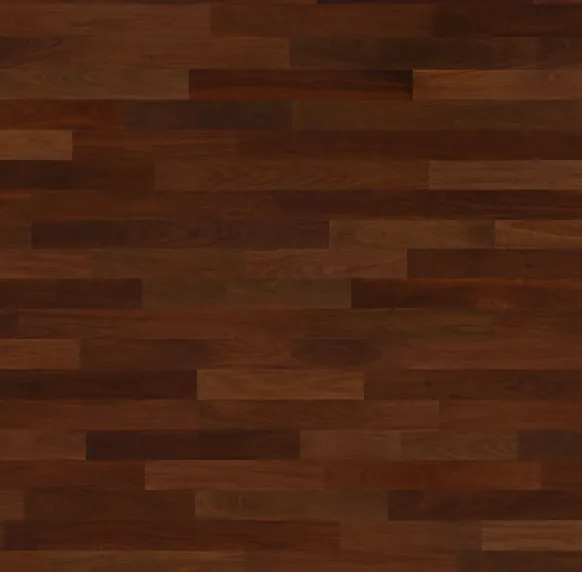
True Mahogany presents a colour palette that shifts from a rich reddish brown to a deep, dark auburn. It is typically more uniform in colour than Brazilian Cherry, offering a cleaner, more formal visual line. The grain is usually straight and fine, occasionally displaying a beautiful ribbon stripe figure that catches the light.
Mahogany darkens with age, developing a patina that adds immense value and character to historic homes and modern luxury builds alike.
Performance and Technical Data
Mahogany is often misunderstood by consumers who assume all exotic woods are rock hard. In reality, true Mahogany species used for flooring vary significantly. Genuine Santos Mahogany, often sold simply as Mahogany, rates around 2,200 on the Janka scale, making it comparable to Brazilian Cherry for durability. African Mahogany, however, rates closer to 1,100, which is softer than Red Oak. This is why we always specify the exact species and provide a hardness report before you buy.
The value of genuine Mahogany lies not just in hardness but in stability. Mahogany has an excellent dimensional stability rating, meaning it moves very little with changes in humidity. For the Washington DC area, where our indoor humidity can swing from 25 percent in January to 70 percent in August, this is a massive advantage. A stable wood means fewer gaps in winter and less risk of cupping in summer.
Installation and Refinishing Expertise
Because Mahogany is relatively easy to work with compared to other exotics, it installs cleanly and quickly when done by professionals. However, the fine grain and natural oils require careful sanding. We use a multi step sanding process with progressively finer grits to avoid burnishing the wood, which can close the pores and prevent stain from penetrating evenly.
For refinishing, we typically avoid dark stains that hide the natural red undertones. Instead, we use a clear or lightly tinted finish that enhances the wood’s depth. If you have an older Mahogany floor that has faded or scratched, our refinishing team can restore the rich colour without sanding through the wear layer.
Mahogany in the DMV Climate
Mahogany is the exotic we recommend most often for houses that run dry in winter and humid in summer without much help from the HVAC system. Its stability rating means fewer winter gaps and less summer cupping than a comparable Jatoba floor, which matters in older DC and Arlington homes that were never built around a humidifier.
That protocol is the same whether the floor is going into a Bethesda colonial, a Washington DC rowhouse, or a new build in Arlington. It is described in full on our hardwood installation page.
Solid or Engineered Mahogany?
Every species on this page is sold both ways, and the choice is usually made by the room rather than by the wood. Solid hardwood is 3/4 inch of mahogany through its full thickness, nailed down above grade, and sandable six to eight times over its life. It is the floor you buy once for a main level.
Engineered hardwood puts a real mahogany wear layer over a cross-ply core that holds flat where an exotic solid would move. It goes over concrete, below grade, and over radiant heat, and for imported species with a wide seasonal swing it is very often the more sensible specification in this region. Most of the mahogany we stock is engineered for exactly that reason.