The Look
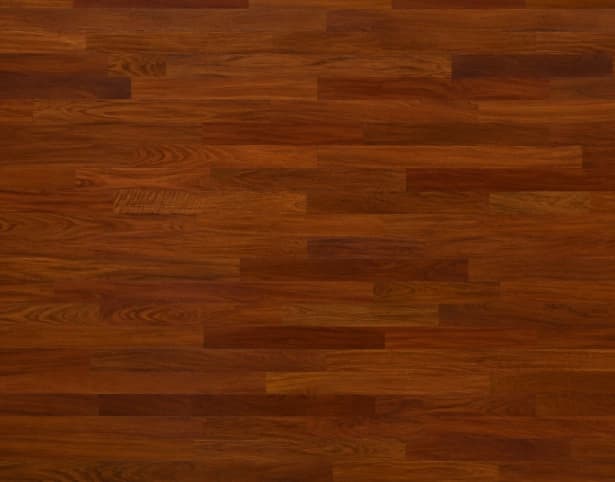
Brazilian Cherry is famous for its dramatic colour variation. Freshly milled, it ranges from a warm honey orange to a deep, reddish cinnamon brown. Over time, exposure to natural light deepens this colour into a rich, dark burgundy with striking black streaks and interlocking grain patterns.
It is a lively floor with movement and character that hides the evidence of a busy household beautifully. A floor laid today is not quite the floor you live with in two years, which is part of the appeal, and the reason we lay boards out across the room before a single one is fastened.
Performance and Technical Data
Here is where Brazilian Cherry separates itself from almost every domestic species. On the Janka hardness scale, which measures the force required to embed a steel ball into the wood, Brazilian Cherry rates approximately 2,350 pounds of force. For comparison, Red Oak rates 1,290. That means Jatoba is nearly twice as hard as the most common flooring wood in America. This extreme density translates directly into dent resistance from high heels, pet claws, and dropped cookware.
However, density cuts both ways. Brazilian Cherry is highly sensitive to moisture changes. Its dimensional stability coefficient is lower than many domestic species, meaning it will expand and contract noticeably with the humid summers and dry winters we experience in the DMV. If installed without proper acclimation and spacing, you will see gapping or cupping. Our full service approach includes precise moisture metering of both the subfloor and the wood itself before a single plank is nailed down.
Installation and Refinishing Expertise
Because of its extreme hardness and interlocking grain, Brazilian Cherry dulls standard saw blades and nail guns quickly. We use carbide tipped blades and high pressure pneumatic nailers designed specifically for exotic hardwoods.
Sanding Jatoba requires a methodical sequence of grits because the wood is so dense that aggressive sanding can create deep scratches that are nearly impossible to remove. We also account for the wood’s natural oils by using solvent based sealers or high adhesion water based finishes that prevent peeling. For clients who love the durability but prefer a more contemporary look, we often recommend a matte finish to reduce glare and emphasize the deep colour.
Brazilian Cherry in the DMV Climate
Indoor humidity in the Washington DC area swings from roughly 25 percent in January to 70 percent in August. Brazilian Cherry feels that swing more than oak does, which is why we meter the subfloor and the wood, acclimate for several days in the room it will live in, and set expansion gaps for the widest, not the average, condition.
That protocol is the same whether the floor is going into a Bethesda colonial, a Washington DC rowhouse, or a new build in Arlington. It is described in full on our hardwood installation page.
Solid or Engineered Brazilian Cherry?
Every species on this page is sold both ways, and the choice is usually made by the room rather than by the wood. Solid hardwood is 3/4 inch of brazilian cherry through its full thickness, nailed down above grade, and sandable six to eight times over its life. It is the floor you buy once for a main level.
Engineered hardwood puts a real brazilian cherry wear layer over a cross-ply core that holds flat where an exotic solid would move. It goes over concrete, below grade, and over radiant heat, and for imported species with a wide seasonal swing it is very often the more sensible specification in this region. Most of the brazilian cherry we stock is engineered for exactly that reason.