Installer’s Guide · 2020 Flooring · Maryland, DC & Northern Virginia
We have installed floors in a few thousand DMV basements — Bethesda split-levels with 1954 block foundations, Silver Spring bungalows with a sump that runs every spring, Arlington garden condos on slab, Alexandria houses that have taken water more than once. This guide is what we tell those homeowners before we open a sample box.
The Short Answer: Best Waterproof Flooring for a Basement
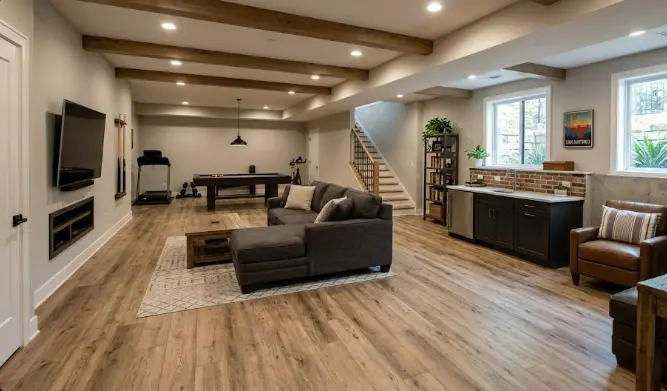
For most finished DMV basements, rigid-core waterproof vinyl plank (SPC) is the best waterproof flooring for a basement — roughly $5–$10 per square foot installed, unaffected by moisture, floating over concrete with no adhesive, and repairable one plank at a time. If your basement has actually flooded, porcelain tile or an epoxy coating is the better choice because neither leaves a cavity for water to sit in. For gyms and workshops, rubber or epoxy. For soft underfoot, modular carpet tile — never wall-to-wall broadloom over a pad. The cheapest genuinely waterproof option is loose-lay sheet vinyl at $3.50–$7 installed.
And the part nobody puts in the headline: the product matters less than the slab under it. Test the concrete first, decide second.
Waterproof vs. Water-Resistant Flooring for a Basement
The most expensive misunderstanding in basement flooring — and the reason two floors with identical marketing behave completely differently after a wet weekend.
Manufacturers use three words and mean three different things. Getting them straight is worth more than any product comparison, because the label describes the plank — not the floor, and definitely not the room.
| Term | What it actually means | Products | Basement verdict |
|---|---|---|---|
| Water-resistant | Tolerates surface water for a stated window — usually 24–72 hours — then damage begins | Waterproof-branded laminate, sealed engineered wood | Tier 1 basements only, and check the warranty |
| Waterproof | The material itself is permanently unaffected by water; seams and the cavity below are not | Rigid-core SPC/WPC vinyl, sheet vinyl, carpet tile backing, rubber | Tiers 1–2, and the workhorse of DMV basements |
| Impervious | Under 0.5% absorption, no cavity, nothing organic anywhere in the assembly | Porcelain tile on membrane, epoxy and polyaspartic coatings | Tiers 1–3, including basements that flood |
There is a fourth category worth naming, because homeowners search for it constantly: water-resistant flooring for a basement that is being used as a dry storage or hobby space, dehumidified year round, with no history of water. That basement genuinely can take a waterproof-branded laminate or even engineered wood. But read the warranty before you buy — a large share of laminate warranties exclude below-grade installation outright, which means the product may perform fine and still leave you with no recourse if it does not. When a client wants that look, we show them the matching rigid-core luxury vinyl instead. Our laminate vs. LVP comparison walks through the construction difference in detail.
Why DMV Basements Are a Different Problem
Basements here fail in specific, predictable ways. National flooring advice misses most of them.
Four regional facts drive nearly every basement flooring decision we make in Maryland, DC, and Northern Virginia. None of them show up in a national buying guide.
01
Piedmont clay holds water against the foundation
Much of the DMV sits on dense clay soils that drain slowly. After a summer thunderstorm dumps two inches in an hour, that water does not percolate away — it perches against the foundation wall and footing for days, pushing on the slab the whole time. That is why so many basements here are dry for weeks and then damp for a week after one storm.
02
Most older slabs have no vapor barrier under them
Polyethylene sheeting under a slab did not become common practice until the late 1960s–70s. Bethesda, Chevy Chase, Takoma Park, Silver Spring, and most DC rowhouse basements predate that. Their slabs wick ground moisture continuously — not as a leak, as a permanent, low-grade condition your floor has to live with.
03
Our summer dew points beat the slab every August
DMV dew points routinely climb into the low 70s from June through September while the basement slab holds 60–68°F. Warm humid air meeting a cold slab produces liquid water on the floor with no leak involved. Opening the basement windows on a muggy day is the single most common way homeowners make it worse.
04
Radon mitigation and flooring share the same slab
Much of Maryland falls in the EPA's highest-priority radon zone, and radon testing is a routine part of Montgomery County home sales. If a sub-slab depressurization system is installed or planned, plan the floor around it: keep the suction point accessible, seal slab cracks before finishing, and core-drill before the finished floor goes down rather than after.
The August test we give every homeowner
Tape a two-foot square of clear plastic sheeting tightly to the bare slab, all four edges sealed, and leave it for 48 hours in July or August. Water droplets on the underside of the plastic mean the slab is pushing vapor and the floor needs a vapor strategy. Droplets on the top mean your room air is condensing on the cold concrete and you need a dehumidifier before you need a floor. It is not a substitute for an ASTM test, but it tells you which conversation you are about to have.
The 7 Best Waterproof Flooring Options for a Basement, Ranked
Ranked the way we actually specify them on a DMV basement walk-through — by how the material behaves when the slab is damp, not by how it photographs in a showroom.
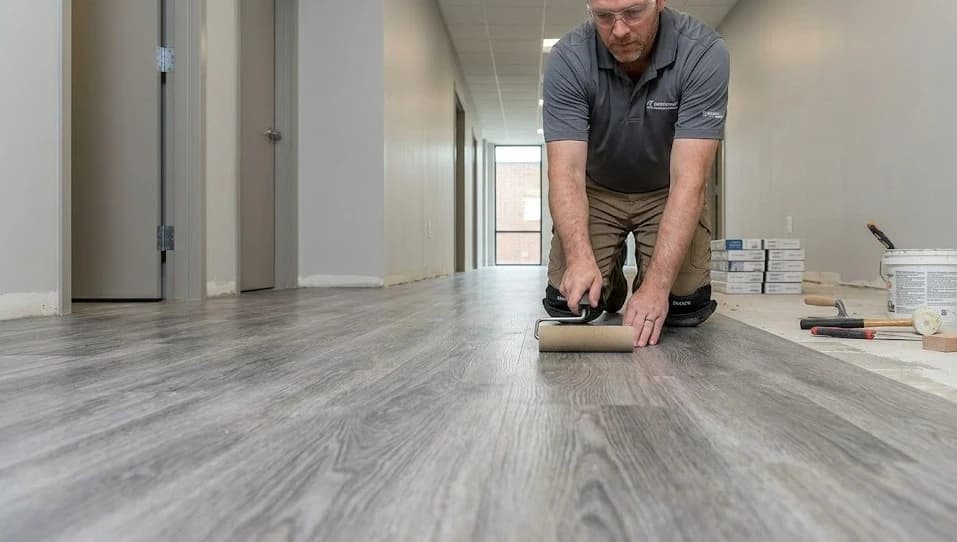
This is the default answer for waterproof vinyl flooring for basements, and it deserves to be. A stone-plastic-composite (SPC) core contains no wood flour and no paper — it cannot swell, cup, or delaminate from moisture, and it stays dimensionally stable through the 40-degree swing between a February and an August basement. Floating click installation means no adhesive that a damp slab can debond, and a damaged plank can be lifted and swapped without touching the rest of the room. Look for a 20-mil wear layer if the space will take real traffic, and an attached IXPE or cork pad rather than a separate foam sheet — the attached pad does not hold a puddle the way loose foam does.
Why it works below grade
- Core is unaffected by water, humidity, or a wet slab
- Floating install needs no adhesive bond to the concrete
- Individual planks are replaceable after damage
- Warmest-feeling of the true waterproof hard surfaces
Where it bites you
- Water still travels the seams and sits underneath
- Cheap 6-mil wear layers scuff fast under gym gear and chairs
- Needs a flat slab — most DMV slabs need some grinding or leveling
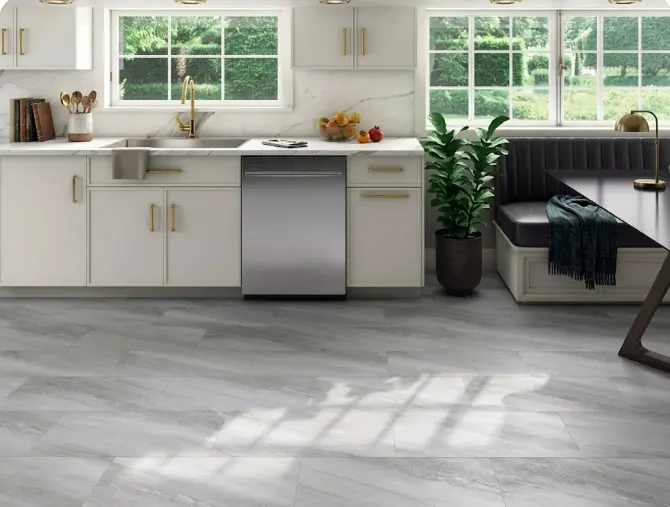
Porcelain absorbs less than 0.5% of its weight in water — it is the only common floor finish that is honestly indifferent to standing water. Thin-set directly to the slab (over a bonded waterproof membrane where the moisture test justifies it) and there is no cavity, no underlayment, and nothing organic for water to ruin. When a Tier 3 basement takes six inches of water, a porcelain floor gets pumped out, disinfected, and used again the same week. Pair it with radiant mats if the cold underfoot bothers you — a basement slab is the ideal candidate for electric radiant because it never wants to warm up on its own.
Why it works below grade
- Near-zero absorption; survives full submersion
- No cavity underneath for water to occupy
- Compatible with electric radiant heat
- Effectively permanent — outlives the finished basement around it
Where it bites you
- Highest installed cost of the practical options
- Cold and hard without radiant heat or rugs
- Slab cracks can telegraph without an uncoupling membrane
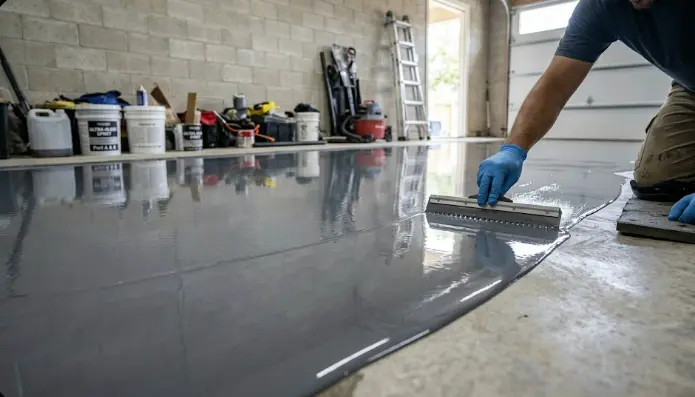
A resinous coating is not flooring laid on the slab — it becomes the slab surface. Seamless, no joints for water to find, no cavity, and no material to remove after a flood. For a home gym, a workshop, a wine cellar, or the unfinished half of a basement that stores everything, it is often the smartest money in the room. The critical caveat is moisture: coatings bond to concrete, and a slab pushing vapor will blister or delaminate a coating within a year. This is the product where the ASTM test is non-negotiable, and where a moisture-tolerant primer earns its cost.
Why it works below grade
- Completely seamless — no edges, no cavity, nothing to lift
- Chemical, salt, and stain resistant
- Adds no height at all — no headroom penalty
- Flake and metallic finishes hide slab imperfections
Where it bites you
- Bond failure if the slab moisture test is skipped
- Hard and loud underfoot; reads utilitarian, not residential
- Needs real prep — diamond grinding, crack chasing, patching
Wall-to-wall broadloom over a foam pad is the single worst thing you can put in a DMV basement — the pad holds moisture against the slab and the whole room becomes one unsalvageable unit after a single incident. Carpet tile solves both problems. Commercial-grade tiles with a closed-cell PVC or cushion-back and solution-dyed nylon face come up individually, dry out, and go back down; a ruined tile is a $6 problem, not a $3,000 one. Order 5–8% extra at install and store the attic stock in the utility room. This is what we put in basement playrooms and media rooms where somebody insists on soft.
Why it works below grade
- Individually replaceable after a spill or a seep
- Warm and quiet — the only soft option we will spec below grade
- Backing does not wick like a foam-padded broadloom
- Cheapest way to make a cold slab feel finished
Where it bites you
- The face fiber still holds odor if it stays wet
- Not a true waterproof floor — a system that tolerates water
- Seams are visible in raking light from a basement window well
Sheet vinyl gets dismissed as a builder-grade compromise, and in a basement that reputation is wrong. A 12-foot-wide sheet run into a typical basement leaves you with one or two seams instead of six hundred plank joints, which is exactly the property you want when water is on the floor. Modern fiberglass-backed sheet is loose-laid with perimeter adhesive only, so it does not depend on a bond to a damp slab, and the visuals have improved enormously. If your budget is the binding constraint and the room is a Tier 2 basement, this is the honest answer.
Why it works below grade
- Fewest seams of any resilient floor
- Loose-lay does not depend on adhesive bonding to concrete
- Lowest installed cost of any true waterproof surface
- Comfortable and quiet underfoot
Where it bites you
- Visible seams in wide or irregular basements
- Telegraphs every bump in the slab — prep is mandatory
- Damage means replacing the whole sheet, not one plank
Vulcanized rubber does not care about water at all, and it forgives a dropped dumbbell in a way that nothing else on this list does. Interlocking tiles are the practical form for a basement — they come up in ten minutes if the slab needs to dry, and a damaged tile is replaced individually. The aesthetics are unapologetically functional, so we usually spec it for the gym half of a basement and run rigid-core plank or carpet tile through the finished half, with a flush transition between.
Why it works below grade
- Completely unaffected by water, salt, or humidity
- Impact absorption nothing else matches
- Interlocking tiles lift for slab drying
- Slip-resistant even wet
Where it bites you
- Utilitarian look — gym, not family room
- Some products off-gas noticeably for the first few weeks
- Heavy; thick profiles cost real headroom
Modern waterproof-branded laminate is a genuinely improved product: sealed edges, treated HDF cores, and warranties covering 24 to 72 hours of surface water. Above grade, in a kitchen or a hallway, it is a legitimate choice. Below grade it is a compromise, and the warranty language usually says so — most manufacturers exclude below-grade installation, standing water, and hydrostatic pressure from the slab, which is precisely the exposure a basement produces. If a client loves a specific laminate visual, we will show them the matching rigid-core plank instead. The look is the same; the failure mode is not.
Why it works below grade
- Excellent photographic realism and hard wear surface
- Cheaper than premium rigid-core plank
- Handles spills and wet mopping fine above grade
Where it bites you
- HDF core is wood — it swells permanently once water reaches it
- Many warranties void below grade or over an untested slab
- Edge swell is not repairable, only replaceable
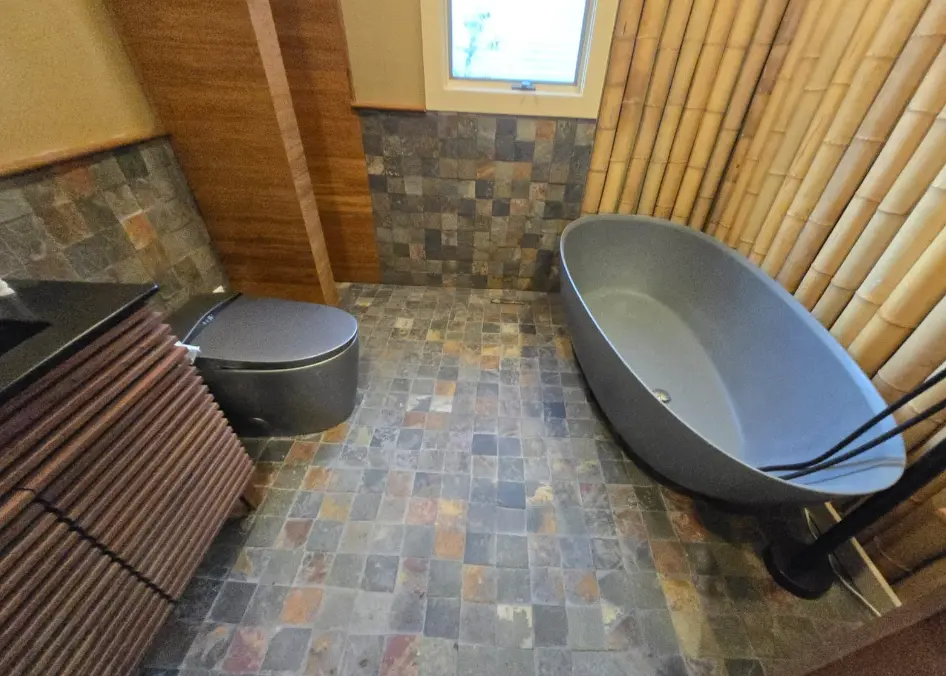
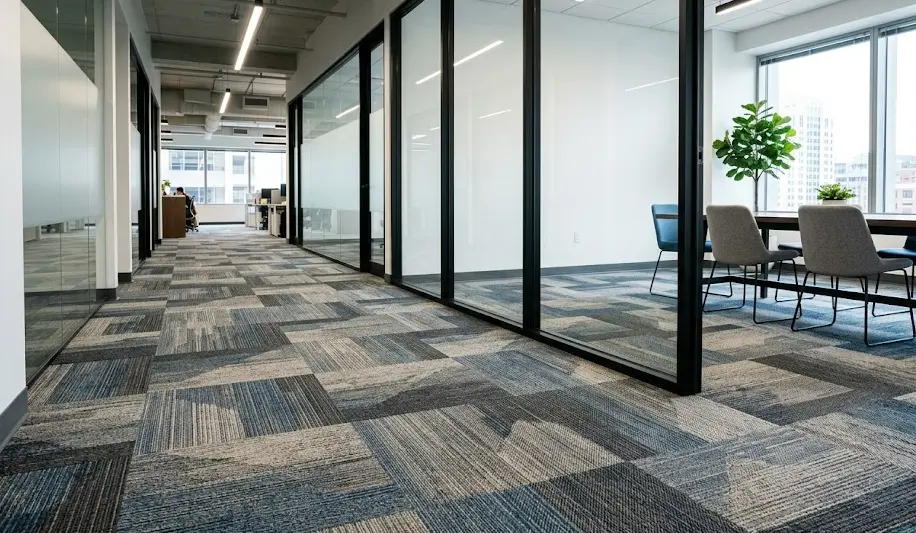
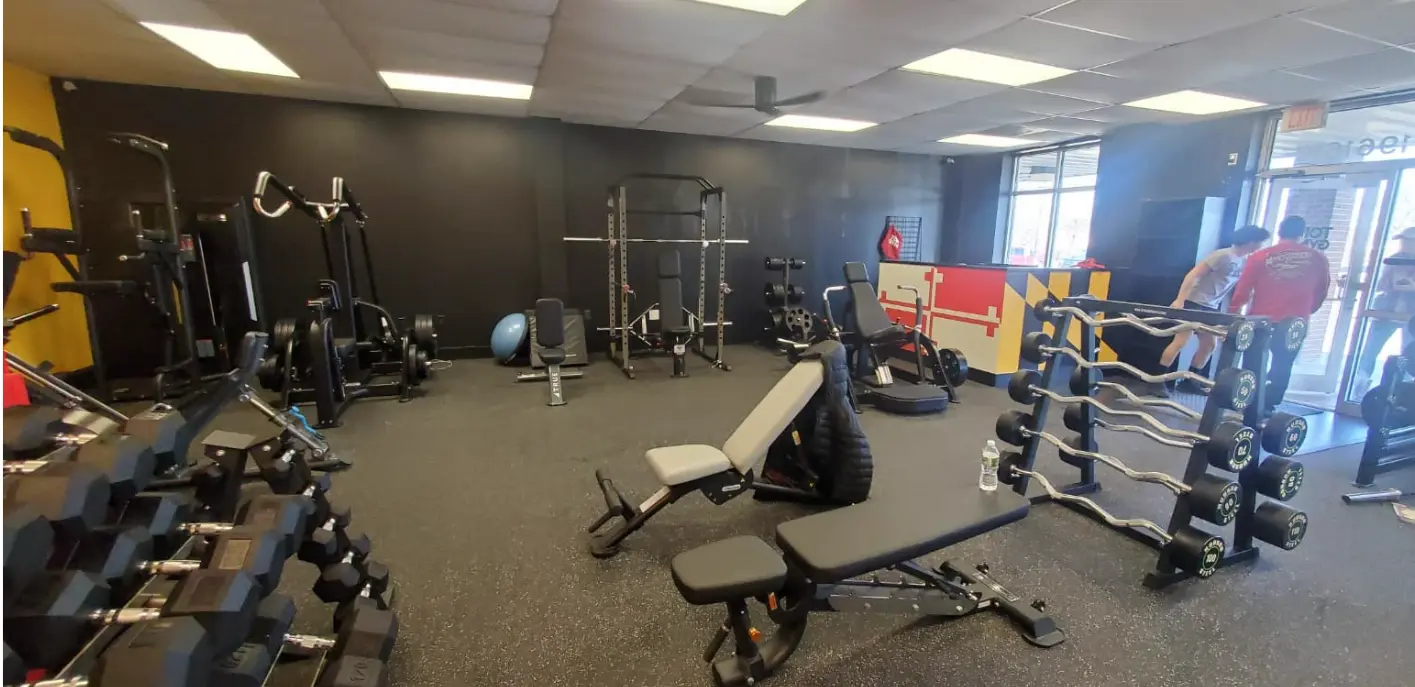
Not sure which tier your basement is in? We bring a moisture meter to every basement estimate and give you the reading in writing before we recommend a product. Book a free in-home measurement or see samples at our North Bethesda showroom.
Waterproof Flooring for Basements That Flood
If water has been on this floor before, the choice narrows fast — and the trim, the transitions, and the underlayment matter more than the plank.
“Waterproof” and “flood-ready” are not the same specification. A rigid-core plank floor genuinely survives being submerged — and it still has to come up after a flood, because water travels the seams, sits between the plank and the concrete, and will not dry through a vinyl floor. What separates a floor you can save from a floor you replace is whether there is a cavity and whether anything in the assembly is organic.
Specify these in a flood-prone basement
- Porcelain tile, thin-set to the slab — no cavity, no organic material, pumps out and gets reused.
- Epoxy or polyaspartic coating — the slab surface itself; nothing to remove.
- Loose-lay LVT or interlocking tile — lifts in sections so the slab can dry, then goes back down.
- PVC or vinyl baseboard — MDF base wicks and swells at exactly the height floodwater sits.
- Metal or vinyl transitions — wood reducers at a doorway are the first thing to fail.
Do not put these below a flood line
- Floating floors over loose foam underlayment — the foam becomes a reservoir held against the slab.
- OSB or plywood subfloor panels — organic, and they hold water long after the room looks dry.
- Wall-to-wall broadloom over a pad — one event and the entire room is landfill.
- Laminate of any branding — the HDF core swells permanently, and the warranty likely excludes it.
- Solid or engineered hardwood — below grade it cups and crowns before it ever gets flooded.
Two more details that only come from having done this: install with a full ¼″ expansion gap at every wall and column so a flooded floor can be lifted without breaking the locking edges, and keep 5–8% attic stock in the utility room. Dye lots change and product lines get discontinued in about three years — the box in the corner is what lets you repair a corner instead of replacing a room. If your basement has already taken water, our emergency floor repair team in Maryland handles drying, demo, and rebuild as one project, and our flooring repair crew handles the slab correction that usually comes with it.
A DMV-specific insurance note
Two different kinds of basement water get treated very differently by insurers. Groundwater intrusion and surface flooding are generally excluded from standard homeowners policies. Sewer and drain backup — the failure mode behind the notorious Bloomingdale and LeDroit Park basement floodings in DC, and a recurring problem in older combined-sewer neighborhoods — is usually only covered if you carry a specific rider. Communities near Cameron Run in Alexandria, Four Mile Run in Arlington, and the Sligo and Rock Creek corridors in Montgomery County are worth checking against the current FEMA map before you choose a floor. It is a five-minute check that can change the specification.
Cheap Waterproof Flooring Options That Still Last
Cheap waterproof flooring options that are actually worth installing — and the one line item you should never cut.
There is nothing wrong with a budget basement floor. Plenty of the basements we finish are storage, laundry, a workshop, or a teenager’s hangout, and spending porcelain money on them would be silly. These are the cheap waterproof flooring options we will genuinely install, in order of installed cost:
| Option | Installed cost | Truly waterproof? | Best use |
|---|---|---|---|
| Loose-lay sheet vinyl | $3.50 – $7 / sq ft | Yes | Whole finished basement on a budget |
| Modular carpet tile | $4 – $8 / sq ft | Backing yes, face no | Playroom, media room, office |
| Loose-lay / peel-and-stick LVT | $4 – $7 / sq ft | Yes | Flood-prone rooms, DIY-friendly zones |
| Single-color epoxy coating | $5 – $8 / sq ft | Yes | Storage, laundry, workshop, gym |
| Entry-level rigid-core SPC plank | $5 – $7 / sq ft | Yes | Finished living space, light traffic |
| Interlocking rubber tile | $5 – $10 / sq ft | Yes | Home gym, mechanical room |
| Sealed and stained concrete | $3 – $6 / sq ft | Surface only | Unfinished basements, cellars |
The one place cheap costs more: slab prep
Grinding, crack repair, patching, and self-leveling a 40-year-old basement slab runs $1.50–$4 per square foot, and that number is identical whether you put a $2 sheet vinyl or a $9 porcelain on top of it. Homeowners trying to hit a number almost always cut prep instead of material, and it is exactly backwards. A cheap floor over a properly prepared slab looks good for a decade. A premium floor over a hollow, cupped, untested slab telegraphs every defect, gaps at the seams, and gets replaced in two or three years. If the budget only stretches one way, buy the prep.
Running your own numbers? Our luxury vinyl cost calculator estimates material plus labor for a room of any size, and the flooring waste calculator adds the overage you need — 7–10% for a straight lay, more for a diagonal or herringbone pattern, and always at the top of that range in a basement where you want extra boxes on hand for repairs.
Waterproof Flooring Options for a Basement Remodel
Waterproof flooring options for a basement remodel — where the flooring decision collides with headroom, code, and the order the trades work in.
A remodel is a different problem from a floor replacement. You are choosing a finish, a substrate, and a height budget at the same time, and the third one quietly constrains the other two.
| Assembly | Height cost | Warmth | Flood behavior |
|---|---|---|---|
| Rigid-core plank direct to slab | ≈ ¼″ | Cool but tolerable | Lift, dry the slab, relay |
| Rigid-core plank on dimpled panel | ≈ ⅝″ – 1″ | Noticeably warmer | Panel channels water; both layers lift |
| Plank on OSB-faced subfloor panel | ≈ 1″ – 1½″ | Warmest | OSB is organic — replace after a flood |
| Porcelain thin-set to slab | ≈ ½″ | Cold without radiant | Nothing to remove |
| Porcelain over electric radiant | ≈ ⅝″ | Warmest of all | Nothing to remove; test the mat after |
| Epoxy coating | ≈ 1/16″ | Cold | Nothing to remove |
Headroom is the real constraint
Residential code across Maryland and Virginia generally wants 7 feet of finished ceiling height in a habitable basement, with limited allowances for beams and ducts. Plenty of DMV basements start at 7'2" under the joists. A 1½" subfloor panel plus finish can put you under before drywall is up — decide the floor assembly with the framer, not after.
Permits and egress come first
Finishing a basement in Montgomery County, Fairfax, Arlington, or DC means a building permit, and a basement bedroom needs a compliant emergency escape opening. Flooring itself rarely triggers a permit, but it is the last thing installed and the first thing damaged if inspections force framing changes. Get the permit set right before the material is ordered.
Sequence protects the investment
Slab moisture test at the very start of the project. Flooring after drywall, primer, and the first coat of paint. Trim and final paint after the floor. Appliances and heavy furniture last. Every out-of-order basement we have been called into has the same symptom: a beautiful floor with drywall compound ground into it.
Zoning the basement is almost always the right call in a remodel: rigid-core plank through the family and media space, porcelain in the wet bar and basement bathroom, rubber or flake epoxy in the gym corner, carpet tile in the playroom. Flush transitions between zones keep it reading as design rather than patchwork. We fold this into the wider project on our renovation flooring service, and the full product list lives on our basement flooring installation page.
How a Waterproof Basement Floor Is Installed Properly
What separates a basement floor that lasts twenty years from one that fails in two — none of it is the product.
- 1
Test the slab, in writing
ASTM F2170 in-situ relative humidity probes are the standard — drilled into the slab, sealed, and read after 72 hours. ASTM F1869 calcium chloride is the older surface test and still shows up on spec sheets. Most flooring manufacturers cap acceptable slab RH between 75% and 85%, and adhesives are stricter than floating systems. A contractor who will not give you a number is guessing.
- 2
Deal with what the number says
Under the limit: an attached-pad floating floor is usually enough. Over it: either a floating assembly with a 6-mil poly or manufacturer-approved retarder, or a roll-on moisture mitigation coating at $2–$5 per square foot with a warranty behind it. Do not let anyone tell you a vapor barrier is unnecessary because the floor is waterproof — the plank is not what fails.
- 3
Flatten the slab
Most resilient manufacturers want 3/16" over 10 feet. Basement slabs from the 1950s through the 1980s are rarely close. Grinding high spots, chasing and filling cracks, and self-leveling low areas is the least glamorous and most important day of the job. A floating floor over a wavy slab clicks apart at the seams within a season.
- 4
Acclimate, then leave the gap
48 hours in the room the material will live in — not the garage, not the hallway upstairs. Then a full ¼" expansion gap at every wall, column, stair stringer, and pipe penetration, hidden by the base. Basements swing further in temperature and humidity than any other room in a DMV house; a floor pinched under trim has nowhere to go and telescopes into a ridge.
- 5
Detail the edges for water, not just for looks
PVC or vinyl baseboard instead of MDF. Metal or vinyl transitions at doorways. Silicone rather than latex caulk at the slab line. These are cheap upgrades that decide whether a wet weekend costs you a mop or a demolition.
- 6
Control the air after the floor is in
A dehumidifier holding 45–55% relative humidity does more for a basement floor than any product upgrade. Keep basement windows closed on humid summer days. If the space has a sump, test it before the wet season, not during it.
One warning specific to older DMV basements
If your basement has 9″×9″ resilient tile, or a black tar-like cutback adhesive under an old floor, stop before anyone grinds or sands it. Flooring materials of that era can contain asbestos, and we find them regularly in homes built before the mid 1980s across Montgomery County, DC, and Arlington. The safe path is testing first and encapsulation or licensed abatement second — and in many cases a floating floor can go right over an intact, well-bonded old tile floor without disturbing it at all. Our floor removal estimates always call this out separately.
DMV Local Insights: What We Find, County by County
The same basement floor prices and performs differently across the region. Here is what we actually run into, by area.
Bethesda, Chevy Chase & Potomac
Mid-century split-levels and 1950s colonials with block foundations and no under-slab poly, frequently on clay with mature trees crowding the downspout lines. Slabs are often out of flat by half an inch across a room. These basements are usually Tier 1 or 2 and take rigid-core plank beautifully once the slab is ground and leveled — the budget line to expect is prep, not product.
Silver Spring & Takoma Park
Bungalows and 1920s–40s homes near the Sligo Creek corridor, many with sump pumps that run hard every spring. We see more Tier 2 basements here than anywhere else in the region. Carpet tile and rigid-core plank with an attached pad are the two specs we write most, and we almost always recommend a dedicated dehumidifier alongside.
Washington, DC rowhouses
English basements and cellars with low headroom, rubble or brick foundations, and combined sewer service in older neighborhoods — which means backup risk during heavy rain independent of the water table. Height budget is the binding constraint: thin assemblies only, usually plank direct to slab or porcelain, and PVC base as standard.
Arlington, Alexandria & Falls Church
A mix of post-war brick colonials and newer townhomes on slab. The Four Mile Run and Cameron Run corridors have real, documented flooding history, and homeowners near them are right to spec Tier 3 assemblies. HOA and condo rules also bite here — work-hour limits, elevator reservations, and sound-transmission requirements that push toward specific underlayments.
Rockville & Gaithersburg
1970s–90s construction, generally with under-slab poly in place and better drainage design. These are the basements most likely to test dry, which opens up the widest product range — including assemblies with a subfloor panel for warmth, since ceiling heights in that vintage are usually generous enough to afford it.
Alexandria & inner Fairfax
Older Del Ray and Rosemont houses with shallow basements, plus newer stock on slab. Where flooding history exists it is well known to the neighborhood, and the right answer is usually porcelain or a coating rather than a floating floor. Worth checking the current FEMA map before the material order goes in.
The through-line: vintage predicts moisture better than address does. A 1958 basement two blocks from a 1988 basement will test completely differently, and the older one nearly always needs a vapor strategy. That is why we will not quote a basement floor over the phone.
6 Basement Flooring Mistakes We Get Called to Fix
Every one of these is something we have been called in to fix, more than once.
Buying the floor before testing the slab
The material arrives, the test comes back over the limit, and now the schedule is driving the decision instead of the data. Test first — it costs a few hundred dollars and it changes the answer.
Loose foam underlayment below grade
It feels great in the showroom and it is a sponge held against a concrete slab. Specify an attached IXPE or cork pad, or a dimpled panel that keeps an air gap, and skip the roll of foam entirely.
Wall-to-wall broadloom over a pad
Still the most common thing we tear out of a wet DMV basement. It works for about four years and then the whole room smells. Carpet tile does the same job and survives.
MDF baseboard in a basement
The floor survives the water; the trim swells into a wavy mess at the exact height the water sat. PVC base costs slightly more and is invisible once painted.
Opening the windows to "air it out" in August
Bringing 74°F dew point air into a room with a 64°F slab is how you make it rain indoors. Close the windows, run a dehumidifier at 45–55%.
Skipping the expansion gap to save a trim run
A floating basement floor pinched under trim has nowhere to expand and ridges up in the middle of the room by the second summer. The gap is not optional below grade.
Keep reading
Waterproof Basement Flooring FAQs
The questions DMV homeowners ask us on basement walk-throughs, answered the way we answer them in person.
Free in-home measurement · No obligation
Get your basement slab tested before you pick a floor.
We have been finishing basements across Maryland, Washington DC, and Northern Virginia since 1997. Every basement estimate includes a moisture reading, a flatness check, and a written recommendation tied to what we actually find — not a single product pitched at every house.
Showroom: 5550-F Nicholson Lane, North Bethesda, MD 20852 · Mon–Sat 10–7, Sun 11–5 · See all basement flooring services

Written by
Jason Brown
Flooring Specialist
Jason Brown has 14 years of flooring sales and installation experience across the DC, Maryland, and Virginia area.