Expert Flooring Guide · 2020 Flooring · DC, Maryland & Virginia
Laminate and LVP both look like hardwood, float over existing subfloors, and cost far less than solid wood — but they perform very differently where it matters most. Here's everything you need to choose with confidence.
6 Key Factors: When to Choose Laminate vs. LVP
Before deciding, evaluate these six key factors for your specific home, lifestyle, and which rooms you're updating.
Moisture & Water Risk
LVP is fully waterproof. Laminate swells and warps — avoid anywhere near water.
Visual Realism
Laminate's photographic layer produces more convincing wood grain at lower cost.
Pets & Accidents
LVP cleans instantly with no lasting damage. Pet urine can permanently ruin laminate.
Subfloor Condition
Uneven subfloor? LVP's rigid-core SPC tolerates more variation than laminate.
Budget
Laminate wins upfront. Factor in risk of water damage before choosing based on price alone.
Indoor Air Quality
Check CARB-2 or FloorScore certification for both. Some laminate off-gasses formaldehyde.
Laminate vs. LVP: Head-to-Head Comparison
Direct comparison across durability, moisture resistance, appearance, cost, and suitability for Maryland, DC, and Virginia homes.
| Feature | Laminate | Luxury Vinyl Plank (LVP) |
|---|---|---|
| Lifespan | 10-25 years (AC-rated; susceptible to moisture damage)~ Tie | 15-25 years with minimal care~ Tie |
| Water Resistance | NOT waterproof — swells and warps with moisture | Fully waterproof at plank level✓ Winner |
| Hardwood Appearance | More realistic wood grain; greater texture depth✓ Winner | Improving rapidly; wider pattern variety |
| Comfort Underfoot | Slightly warmer; can feel hollow without underlayment✓ Winner | Firmer; cooler without underlayment |
| Sound Absorption | Decent with attached pad; can be noisy without it~ Tie | Similar — add underlayment for best results~ Tie |
| Scratch Resistance | Good (AC3-AC5); harder surface than vinyl✓ Winner | Good; wear-layer thickness determines performance |
| Pet-Friendly | Odors and urine can permanently damage the core | Waterproof; cleans instantly; no odor absorption✓ Winner |
| Installation Cost | $3-$10 per sq ft installed✓ Winner | $4-$16 per sq ft installed |
| Subfloor Tolerance | Requires a near-perfect, flat subfloor (≤3/16″ over 10 ft) | Rigid-core SPC handles more subfloor variation✓ Winner |
| Indoor Air Quality | Some boards off-gas formaldehyde (check CARB-2 / FloorScore cert) | Generally low VOC; FloorScore-certified options available✓ Winner |
| Resale Value | Viewed as mid-range by buyers; dated in some markets | Increasingly preferred; seen as modern, durable✓ Winner |
| Best for DMV Climate | Upstairs dry areas only; avoid basements | Basements, kitchens, humid & below-grade spaces✓ Winner |
Pro tip from 2020 Flooring: In the DMV's humid climate, LVP's waterproof core makes it the safer choice for below-grade and moisture-prone spaces. Laminate's superior visual realism shines in dry, upper-level rooms where aesthetics matter most.
Laminate vs. LVP Pros and Cons
A quick-reference summary of where each flooring type excels and where it falls short.
Pros
- ✓Lower upfront cost ($1-$5/sq ft material)
- ✓More realistic wood grain appearance
- ✓Harder surface — better scratch resistance
- ✓Wide range of styles and AC durability ratings
- ✓Easy DIY click-lock installation
- ✓Slightly warmer underfoot than LVP
Cons
- ✗NOT waterproof — swells and warps with moisture
- ✗Cannot be used in basements, kitchens, bathrooms
- ✗Pet accidents cause permanent damage
- ✗Some products off-gas formaldehyde (check CARB-2)
- ✗Cannot be refinished or sanded down
- ✗Requires very flat subfloor
Pros
- ✓100% waterproof — safe in kitchens, baths, basements
- ✓Pet- and kid-friendly; accidents clean instantly
- ✓Rigid-core (SPC) handles uneven subfloors better
- ✓Low maintenance — sweep and occasional mop only
- ✓Longer lifespan in moisture-prone rooms
- ✓Increasingly realistic wood and stone visuals
Cons
- ✗Higher upfront cost vs. laminate
- ✗Softer surface — can dent under heavy point loads
- ✗Can feel cooler and less authentic underfoot
- ✗Cannot be refinished
- ✗Shorter planks can look less premium to some buyers
- ✗Quality varies widely by brand and wear-layer
Best Rooms for Laminate vs. LVP: Room-by-Room Guide
Moisture exposure, foot traffic, and intended use determine which floor wins in each room of your DMV home.
| Room | Best Choice | Why |
|---|---|---|
| Master Bedroom | Laminate | Dry, low-moisture space where laminate's realistic wood look and warmth shine. |
| Guest Bedroom | Laminate | Low traffic and low moisture — laminate performs well and costs less upfront. |
| Living Room | LVP | High visibility; LVP's durability and modern appeal resonate with buyers. |
| Dining Room | LVP | Spills and chair scratches are common; LVP is waterproof and cleans instantly. |
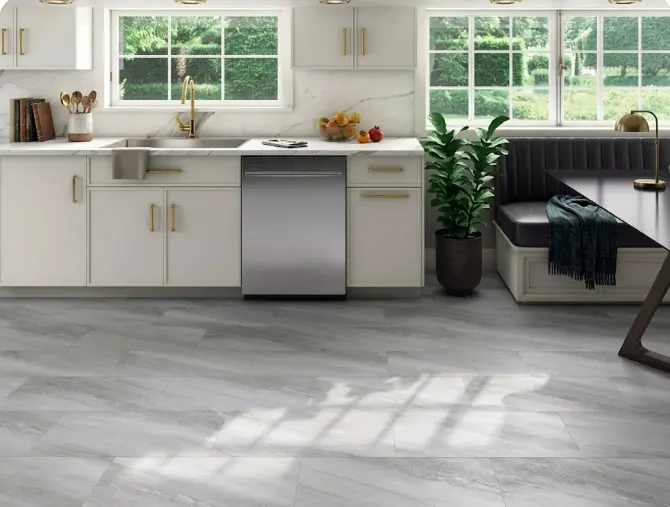
| Kitchen | LVP | Laminate swells with water. LVP's waterproof core is essential in kitchens. |
| Hallway | LVP | High foot traffic; LVP handles wear without the moisture sensitivity of laminate. |
| Bathroom | LVP | Humidity and standing water will destroy laminate. LVP is the only safe choice. |
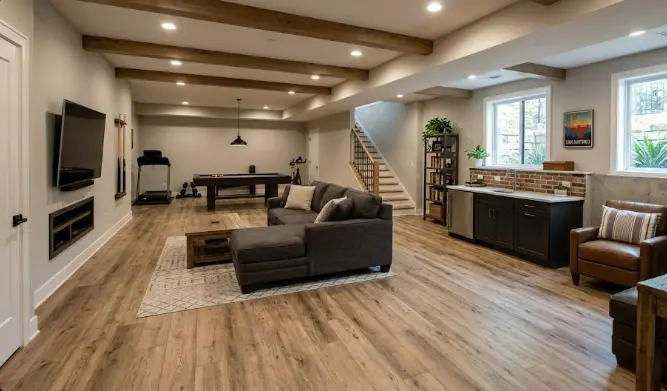
| Basement | LVP | Critical in DMV basements. Laminate warps with seasonal moisture; LVP is unaffected. |
| Home Office | Mixed | Laminate in seating zone for aesthetics; LVP near entry for durability. |
| Playroom | LVP | Spills and accidents are inevitable. LVP cleans instantly with no permanent damage. |
Want expert advice? Visit our Rockville showroom to see laminate and LVP samples side by side.
Not sure which is right for your space? Bring photos or a video tour to our showroom or schedule a free in-home consultation. Our experts will evaluate your subfloor, moisture exposure, and lifestyle to recommend the right product for every room.
Cost Comparison: Laminate vs. LVP — Upfront vs. Long-Term Value
Laminate wins on upfront price, but one water event can force a full replacement. LVP costs more initially with far fewer surprises long-term.
| Cost Factor | Laminate | LVP |
|---|---|---|
| Material Only | $1-$5 per sq ft | $2-$10 per sq ft |
| Installed Cost (material + labor) | $3-$10 per sq ft | $4-$16 per sq ft |
| Underlayment | Often needed: $0.25-$0.75/sq ft | Often attached; separate ~$0.25-$0.50/sq ft |
| Maintenance (annual) | Minimal — sweep and occasional damp mop | Minimal — sweep and occasional damp mop |
| Water Damage Repair | $300-$2,000+ (swollen boards must be replaced) | Minimal — planks resist water damage |
| Replacement Cycle | 10-25 years (shorter if water damage occurs) | 15-25+ years with minimal care |
| 15-Year Total Cost of Ownership | $4,000-$10,000 (risk of early replacement) | $5,000-$13,000 (higher upfront; minimal surprises) |
Bottom line: Laminate is cheaper to install, but a single leaky appliance or flood in the DMV can wipe out those savings instantly. In moisture-prone areas, LVP's total cost of ownership is often lower despite the higher upfront price.
LVP vs. Laminate vs. Engineered Hardwood: Three-Way Comparison
How does laminate stack up against LVP and engineered hardwood across the most important buying criteria?
| Feature | Laminate | LVP | Engineered Hardwood |
|---|---|---|---|
| Water Resistance | ❌ Not waterproof | ✅ Fully waterproof | ⚠️ Some resistance; not waterproof |
| Cost Installed | $3-$10/sq ft | $4-$16/sq ft | $6-$20/sq ft |
| Visual Authenticity | High — photographic layer | Very good & improving | Authentic — real wood veneer |
| Refinishable | No | No | Yes (1-3 times) |
| Lifespan | 10-25 years | 15-25 years | 20-30+ years |
| Resale Value Impact | Moderate | Good | Highest |
| Best Use Case | Dry bedrooms; budget renovations | Whole-home; wet areas; basements | Main level; high-end renovations |
Our take: For most DMV homeowners, LVP offers the best balance of price, durability, and moisture resistance. Engineered hardwood is the premium choice for main-level renovations where resale value and authentic wood are the priority. Laminate makes sense only in dry, upper-level rooms with a tight budget.
The Smart DMV Approach: Using Both Laminate and LVP
The most popular approach combining the best of both materials — a strategy we see every week at our Rockville showroom.
Many of our clients choose to use both laminate and LVP in their homes — taking advantage of each material where it performs best:
- 🎯Main Level, Basement & Wet Areas: Install LVP for waterproof protection in kitchens, bathrooms, entryways, basements, and living rooms where spills, pets, or humidity are factors.
- 🎯Upper Floors & Dry Bedrooms: Install laminate in bedrooms and dry upper-level spaces where moisture isn't a concern, taking advantage of its lower cost and superior visual realism.
- 🎯Transitions: Match plank thickness (both typically 8-12mm) and use T-molding or reducer strips at doorways to create clean, seamless transitions between the two materials.
This strategy maximizes your budget — paying for waterproof LVP only where you need it, and using laminate's cost and aesthetic advantages where moisture isn't a risk.
Putting the LVP half of that plan in a basement? LVP is usually right, but not always — in a basement that has actually flooded, porcelain or an epoxy coating outperforms any floating floor. Our installer’s guide to the best waterproof flooring for a basement ranks the options by how much water your basement actually sees, and covers the slab testing that decides the spec.
Frequently Asked Questions: Laminate vs. LVP
Answers to the most common questions homeowners ask when comparing laminate and LVP flooring.

Written by
Jason Brown
Flooring Specialist
Jason Brown has 14 years of flooring sales and installation experience across the DC, Maryland, and Virginia area.