If your hardwood floors look wavy, raised along the edges, or feel uneven underfoot, you may be dealing with hardwood floor cupping. Cupping usually means moisture is affecting the boards from below, above, or inside the home.
For homeowners in Maryland, Northern Virginia, and Washington, DC, this is especially common because of humid summers, finished basements, older homes, crawl spaces, concrete slabs, plumbing leaks, and seasonal moisture swings. The good news is that cupped hardwood floors do not always need to be replaced. In many cases, the right fix starts with moisture control, drying, and a careful inspection before any sanding or refinishing.
A professional floor inspection and repair helps determine whether your floor needs humidity correction, board repair, sanding and refinishing, or full replacement. The most important rule is simple: do not sand cupped floors until the moisture problem has been found and corrected. The National Wood Flooring Association warns against repairing cupped floors before all moisture sources are eliminated, and wood flooring experts also caution that sanding too early can create crowning later. (NWFA: Problems, Causes, and Cures)
Not sure if your floor can be saved? 2020 Flooring can inspect the moisture issue, explain whether repair or refinishing is possible, and help you avoid replacing floors unnecessarily. Get a free quote →
Quick Cupping Summary · 2020 Flooring · Serving DC, MD & VA Since 1997
Hardwood floor cupping happens when wood absorbs moisture unevenly and the edges of the boards rise higher than the center. In the Maryland, Northern Virginia, and DC area, common causes include summer humidity, damp basements, crawl spaces, leaks, slab moisture, and installation issues. Mild cupping may improve after the moisture source is fixed, but severe cupping may require sanding, refinishing, board replacement, or new flooring. The safest first step is a moisture inspection before choosing a repair.
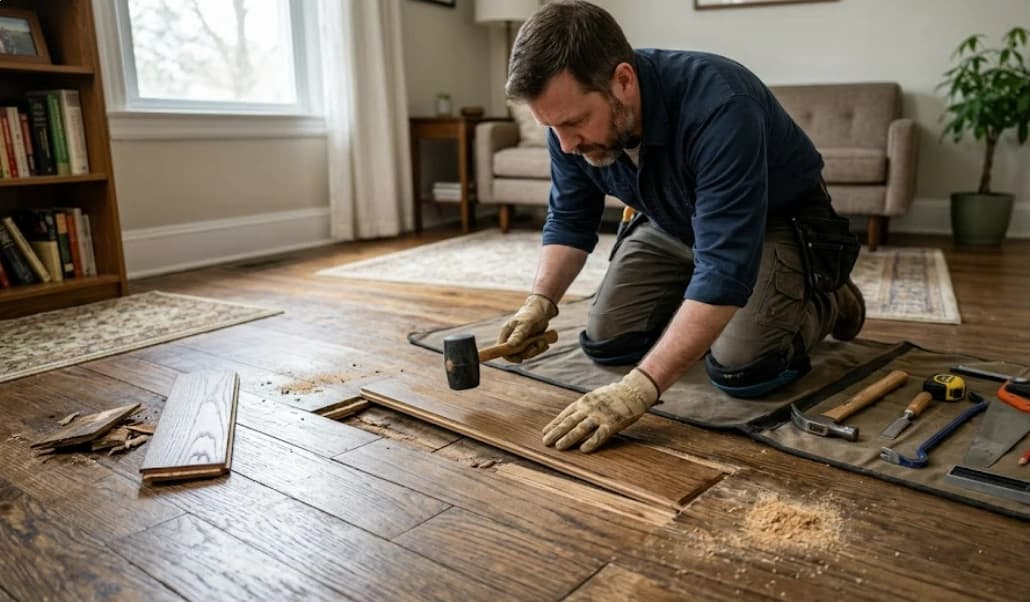
On-site hardwood floor repair after moisture-related cupping — a 2020 Flooring project in Bethesda, MD.
How Much Does It Cost to Fix Cupped Hardwood Floors?
What you can expect to pay to address cupping in the DMV, depending on the cause and how much damage has occurred.
Costs depend on the cause, floor type, and how much damage has occurred. A small moisture issue near a dishwasher costs much less to address than widespread cupping from basement humidity or subfloor moisture.
| Repair Type | Typical Situation | Estimated Cost Range |
|---|---|---|
| Moisture inspection | Floor is cupping but cause is unclear | Often included with estimate or a flat service-visit fee |
| Humidity correction | Mild seasonal cupping, no major damage | Cost of a dehumidifier or HVAC adjustment |
| Spot board replacement | Localized leak or damaged section | Varies by species, board availability, and labor |
| Sanding and refinishing | Floor dries flat enough to save | Usually priced by square foot |
| Full replacement | Severe warping, buckling, staining, or subfloor damage | Highest-cost option |
The cheapest repair is not always the best repair. Sanding too soon can make the floor look better temporarily, then create a bigger problem after the boards dry. A good contractor should first check moisture, identify the source, and explain whether the floor can be saved. Our team handles every step of hardwood floor repair — from diagnosis to dry-down to refinishing — so you do not pay for work that will not last.
Helpful Authoritative Sources
Independent industry and government sources we reference when diagnosing cupping.
- National Wood Flooring Association (NWFA) — one of the most trusted industry sources for wood floor problems, causes, and the correct repair sequence. Especially useful for understanding why moisture must be corrected before repairing cupped floors. NWFA: Problems, Causes, and Cures
- U.S. Environmental Protection Agency (EPA) — recommends keeping indoor relative humidity below 60%, ideally between 30% and 50%. This is the single most useful guideline for reducing moisture problems inside the home. EPA: Mold Course Chapter 2
- NOAA National Centers for Environmental Information — climate normals that help explain why local seasonal moisture and humidity matter in places like Maryland, Northern Virginia, and Washington, DC. NOAA: U.S. Climate Normals
What Does Hardwood Floor Cupping Look Like?
The visual and physical signs that a hardwood floor is cupping rather than wearing normally.
Cupping happens when the edges of each hardwood board rise higher than the center. The board starts to form a shallow “U” shape across its width.
You may notice raised edges, a rippled reflection under sunlight, boards that feel uneven underfoot, or a washboard look across the room. Some floors also show dark staining, finish damage, gaps, or lifted boards near kitchens, bathrooms, laundry rooms, exterior walls, basement stairs, or sliding doors.
Cupping is not just a surface problem. It almost always means the wood is reacting to moisture — and the moisture source needs to be found before anything else happens.
Cupping or something else? Moisture and insects often travel together. If the uneven boards also sound hollow, feel springy, or you notice pencil-width mud tubes on the foundation or joists, you may be dealing with termite damage in the floor rather than — or in addition to — cupping. Our termite floor damage guide walks through how to tell them apart.
Why Hardwood Floors Cup in Maryland, Northern Virginia, and DC Homes
The local climate, housing stock, and basement conditions that make cupping a common DMV problem.
Wood expands when it absorbs moisture and contracts when it dries. When the bottom of a board absorbs more moisture than the top, the underside expands more. That uneven movement causes the edges to lift.
We see this regularly in homes across Bethesda, Rockville, Silver Spring, Potomac, Chevy Chase, Gaithersburg, Arlington, Alexandria, Falls Church, McLean, and Washington, DC.
Local homes can be especially vulnerable because many have finished basements, older subfloors, crawl spaces, additions, slab areas, and seasonal humidity changes. DC rowhomes, Arlington colonials, Bethesda basements, and Silver Spring split-level homes can all develop cupping when moisture gets trapped under or around hardwood flooring.
Common Causes of Cupped Hardwood Floors
The five moisture sources behind almost every cupped hardwood floor we inspect.
1. High Indoor Humidity
Summer humidity in the Mid-Atlantic can push indoor moisture levels well above the 30–50% range the EPA recommends. When hardwood absorbs that moisture, boards swell and cup. This is common in basement-level rooms, older homes, and spaces where the air conditioner does not run long enough to remove moisture.
2. Moisture Under the Floor
Moisture from below is one of the biggest causes of cupping. Damp basements, crawl spaces, concrete slabs, and wet subfloors can push moisture into the underside of the hardwood. This typically creates cupping across a wider area rather than one small spot.
3. Plumbing or Appliance Leaks
A slow dishwasher leak, refrigerator line leak, sink leak, toilet leak, or washing machine issue can quietly cup hardwood floors over weeks. Sometimes the floor changes before the homeowner notices the leak. If cupping appears near a kitchen, bathroom, laundry room, powder room, or utility closet, check for a localized moisture source first.
4. Improper Acclimation Before Installation
Hardwood flooring needs time to adjust to the home before installation. If the boards are installed before they reach the right moisture balance with the indoor environment, they will keep moving after the job is finished — leading to cupping, gaps, crowning, or buckling. This is one reason a careful installer will check moisture before laying the first board.
5. Missing Moisture Protection or Subfloor Problems
Even high-quality hardwood can fail if the subfloor is not ready. Problems can include trapped moisture, missing vapor protection, poor ventilation, tight expansion space, or the wrong installation method for the substrate. This is why cupping repair should start with diagnosis — not sanding.
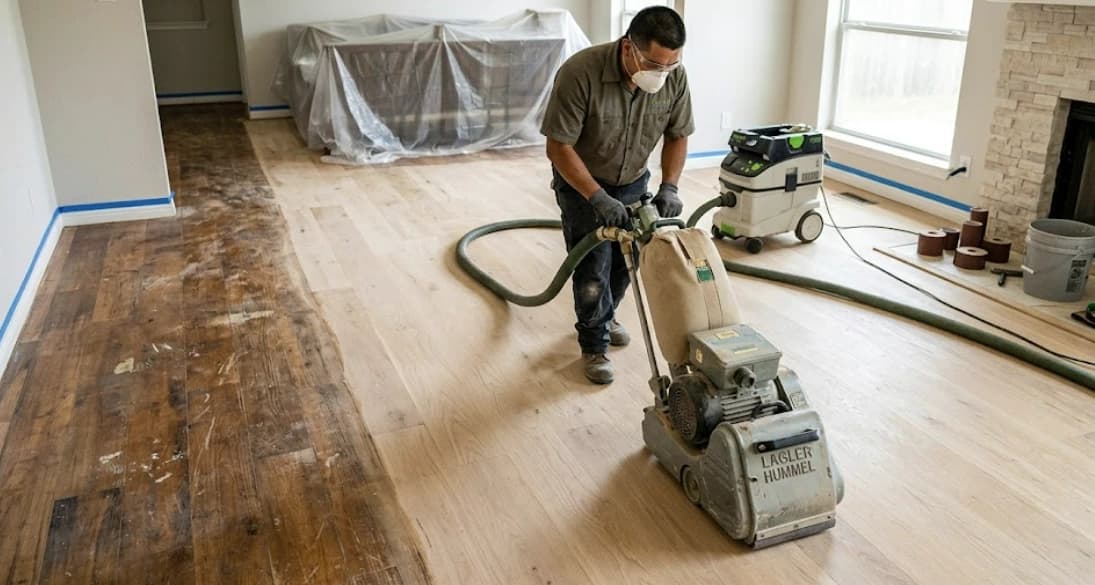
Sanding and hardwood refinishing after a cupped floor has been dried and stabilized.
Expert Video: How to Fix Hardwood Floor Cupping
A short, plain-language explanation of how cupping happens and how the pros actually fix it — from The Home Show Radio.
The video reinforces the rule we follow on every repair: find the moisture source first, let the floor dry and stabilize, and only then decide on sanding, refinishing, or board replacement.
Will Cupped Hardwood Floors Flatten Out?
The honest answer: sometimes yes, sometimes no — and why the timing matters.
Sometimes, yes. Mild cupping can improve after the moisture source is corrected and the wood dries slowly over several weeks.
But not every floor returns to normal. Recovery depends on how wet the floor became, how long it stayed wet, whether the floor is solid or engineered hardwood, and whether the boards are stained, cracked, buckled, or delaminated.
The biggest mistake
Sanding too early. If a cupped floor is sanded while the boards are still wet, the floor may later flatten and create crowning — where the center of the board becomes higher than the edges. That requires another sanding cycle or full board replacement to fix.
What Should You Do First?
The questions a good contractor will ask before recommending any repair.
Start by asking where the moisture could be coming from.
- Did the cupping appear after heavy rain, a leak, or a humid stretch of weather?
- Is the damage near a kitchen, bathroom, laundry room, exterior wall, basement, crawl space, or patio door?
- Does the basement feel damp, or do you smell musty air below the floor?
- Was the hardwood recently installed — or is it decades old?
These clues help determine whether the floor needs drying, repair, refinishing, or replacement.
What Not to Do When Hardwood Floors Are Cupping
Four things that make cupping worse — or turn a repairable floor into a replacement project.
- Do not sand the floor right away.
- Do not refinish over an active moisture problem.
- Do not cover the cupped area with rugs while it is drying — trapped moisture makes cupping worse.
- Do not use extreme heat (space heaters, hair dryers) to force the boards to dry quickly. Wood cracks and splits when forced.
The right sequence is moisture source first, drying and stabilization second, repair decision third.
Repair, Refinish, or Replace?
Match what you see on the floor to the most likely next step.
| What You See | Likely Next Step |
|---|---|
| Mild cupping after humid weather | Control humidity and monitor |
| Cupping near one appliance | Fix the leak, dry the area, inspect boards |
| Floor flattens after drying | Sanding and refinishing may work |
| Persistent uneven boards | Repair or board replacement may be needed |
| Dark stains or water marks | Board replacement may be needed |
| Buckling or lifted boards | Schedule an inspection quickly |
| Cupping shortly after new installation | Check acclimation, subfloor, and moisture readings |
Can Cupped Hardwood Floors Be Sanded and Refinished?
When sanding and refinishing is the right choice — and when it is not.
Yes — but only after the floor is dry and stable.
Refinishing may be a good option when cupping is mild to moderate, the boards have flattened, the wood is not badly cracked or warped, and the floor has enough wear layer left to sand. Our hardwood refinishing team measures moisture in the boards and subfloor before touching a sander.
Solid hardwood usually gives you more refinishing options. Engineered hardwood depends on the thickness of the top wear layer — anything under 2 mm usually cannot be flat-sanded without going through the veneer. If the layer is thin, board replacement may be the better long-term answer.
When Boards Need to Be Replaced
Some boards cannot be saved — and that is actually fine, as long as the rest of the floor is healthy.
Replacement may be needed when boards are deeply stained, cracked, buckled, loose, warped, or delaminated.
Localized board replacement can work well after a dishwasher leak, refrigerator line leak, toilet overflow, or small water-damaged section. If the damage is widespread or the subfloor itself is affected, larger replacement — or a fresh hardwood flooring installation — may be the better long-term solution.
Local Conditions That Drive Cupping in the DMV
Why the same hardwood floor performs differently in a Rockville basement, an Arlington colonial, and a DC rowhouse — and what we look for first in each one.
The Mid-Atlantic climate creates a handful of patterns we see again and again when we inspect cupped floors. Three things drive most of the cases:
- Sharp humidity swings between humid summers (often 70–85% relative humidity outside) and dry, heated winters that drop indoor RH below 30%.
- Older housing stock — many homes have original plywood or plank subfloors with limited vapor protection underneath the hardwood.
- Below-grade or partially below-grade living space where moisture can move up through slabs, crawl spaces, or unsealed concrete.
Maryland: Finished Basements and Crawl-Space Kitchens
Across Montgomery County, cupping shows up first in basement-level rooms, in rooms built over crawl spaces, and at the perimeter of slab-on-grade additions where the slab was never sealed against ground moisture. In homes around Bethesda, Rockville, Silver Spring, Potomac, Chevy Chase, and Gaithersburg, a finished basement that feels comfortable in winter can quietly run high humidity all summer — and that is enough to cup hardwood over the warm months even if there is no visible leak. Adding (or properly sizing) a dehumidifier and checking the dryer vent path are often the first low-cost steps before any sanding decision.
Northern Virginia: Mixed Construction and River-Corridor Humidity
In Arlington, Alexandria, Falls Church, and McLean, older homes near the Potomac corridor combine high summer humidity with tight, renovated interiors that trap moisture inside. Newer rear additions often place a slab-on-grade room right next to original framed floors, so two completely different moisture conditions meet at one threshold. That transition line is where cupping frequently starts. HVAC imbalance — one zone over-cooling and condensing, another under-ventilated — is another quiet contributor we check during inspection.
Washington, DC: Rowhouses, Basements, and Party Walls
In Washington, DC rowhouses and older single-family homes, cupping often starts in basement apartments and kitchens. Shared party walls limit cross-ventilation, original subfloors are often laid directly over joists with no underlayment, and many basement units have had several waterproofing approaches layered over the decades. Neighborhoods like Capitol Hill, Georgetown, Petworth, Brookland, Cleveland Park, and the Northwest quadrants share these patterns to different degrees. Before any repair, we want to know whether the basement slab has ever shown efflorescence (white mineral residue) and whether the floor reacts seasonally — both are strong clues about the moisture path.
A floor can look like a refinishing problem when the real issue is below the boards. That is why every cupping job we take on starts with a moisture inspection rather than a sander.
Schedule a Hardwood Floor Inspection
Cupping is a warning sign. The sooner you find the moisture source, the better your chance of saving the floor and avoiding unnecessary replacement. 2020 Flooring repairs, refinishes, replaces, and installs hardwood floors throughout Maryland, Northern Virginia, and Washington, DC. We inspect the floor, look for likely moisture issues, explain your options clearly, and recommend the right next step.
Schedule a hardwood floor inspection today or get a flooring quote for repair, refinishing, or replacement in Maryland, Northern Virginia, and Washington, DC.
FAQs About Cupped Hardwood Floors
Answers to the most common questions homeowners ask us about cupped hardwood floors.

Written by
Jason Brown
Flooring Specialist
Jason Brown has 14 years of flooring sales and installation experience across the DC, Maryland, and Virginia area.