If your floor sounds hollow when you tap it, feels springy underfoot, or has boards that are suddenly buckling or blistering, you may be looking at termite damage in your hardwood floors. Termites cost U.S. homeowners more than $5 billion a year, and most insurance policies do not cover the repair — so catching it early, and fixing it in the right order, makes an enormous difference.
Here is the part most articles get wrong: by the time termites show up on the surface of a hardwood floor, they have usually been eating the subfloor and joists underneath for months or years. The finished wood you can see is the last thing they reach, not the first. That is why termite floor damage is really a two-part problem — an insect problem and a structural problem — and why the fix almost always needs both a pest-control company and a flooring repair contractor.
This guide, written by the team at 2020 Flooring, covers how to identify termite floor damage, how to tell it apart from water damage, whether your floor can be repaired or needs to be replaced, and — the question we get most — how to find and vet a contractor who can actually replace your floors and the structure beneath them across Maryland, Washington, DC, and Northern Virginia.
Already have termite damage in a floor? Once the infestation has been treated, 2020 Flooring can assess the subfloor and joists, rebuild the structure, and repair or replace the finished floor. Get a free repair quote →
Quick Summary · 2020 Flooring · Serving DC, MD & VA Since 1997
Subterranean termites — the type found throughout the DMV — attack the structural wood beneath your floor first: joists and subfloor. Look for pencil-width mud tubes on the foundation, hollow-sounding or springy boards, blistering that looks like water damage, and spring swarms. Treat the infestation with a licensed pest-control company before any repair. Minor surface damage to solid hardwood can be filled and refinished, but structural damage means joist and subfloor repair, then replacing the finished floor. Choose a licensed, insured flooring contractor who repairs the structure — not just an installer who lays new boards over a compromised subfloor.
Anatomy of Termite Floor Damage
A cutaway of where subterranean termites actually feed — and why the surface is the last place you notice.
Where termites actually attack a floor
- 1Blistered, hollow, or sunken surface boards — often the last place damage shows.
- 2Hollow galleries eaten through the floor joists — the structural damage.
- 3Chewed, weakened subfloor that makes the floor feel spongy or springy.
- 4Pencil-width mud tubes climbing the foundation from the soil — the #1 giveaway.
Illustration: 2020 Flooring. Subterranean termites — the species found across the DMV — feed on the soft structural wood beneath your finished floor long before you see damage on the surface.
How to Identify Termite Damage in a Floor
Seven signs of termite damage in a floor, from the obvious to the easily missed.
Termites are quiet and slow, so identification is about spotting the clues they leave behind. Any one of these on its own is worth a closer look; two or more together is a strong signal to call an inspector.
Mud tubes
Pencil-width tunnels of dried soil running up foundation walls, piers, joists, or basement/crawl-space surfaces. This is the single most reliable sign of subterranean termites — they build tubes to travel from the soil to your wood without drying out.
Hollow or papery sound
Tap or knock on boards and baseboards. Termites eat wood from the inside out, so damaged areas sound hollow or drum-like while sound wood sounds solid. Inspectors do this constantly for a reason.
Springy, sagging, or uneven floors
When joists or subfloor are eaten away, the floor loses support. You may feel bounce or softness, see sagging or dips, or notice the floor flexing near walls, doorways, or over a crawl space.
Blistering that looks like water damage
On laminate and engineered floors, termite damage bubbles and sags almost exactly like water damage. Look underneath for a hollow network of tunnels to tell them apart.
Loose or shifting tiles
When a subfloor weakens and termites add moisture, tile adhesive fails and grout cracks. Tiles that suddenly rock, lift, or sound hollow can point to trouble in the wood below.
Swarmers and discarded wings
In spring, winged reproductive termites swarm. Finding small piles of identical, teardrop-shaped wings on windowsills, near doors, or in a basement is a classic early warning.
A seventh, sneakier sign: doors and windows that suddenly stick. As termite-weakened floors and frames sag, openings rack out of square and jam — often blamed on humidity when the real cause is structural.
Termite Damage vs. Water Damage
The two are constantly confused — here is how to tell them apart before you pay for the wrong repair.
This matters because the fixes are different. Chasing a water-damage repair when the real issue is termites — or vice versa — wastes money and lets the real problem keep spreading.
| What you see | Points to termites | Points to water |
|---|---|---|
| Mud tubes on foundation/joists | Yes — the defining sign | Never |
| Inside the wood | Hollow galleries, soil/mud packed in | Solid but soft and stained |
| Smell | Faint earthy/soil smell | Musty, moldy odor |
| Wings or insects | Discarded wings, live termites | None |
| Pattern | Follows the grain in layered channels | Radiates from a leak or low spot |
One more nuance: moisture and termites travel together. Subterranean termites need damp conditions, so a long-running leak or a damp basement can both rot the wood and invite termites. It is common to find both problems in the same spot — which is another reason to get a professional assessment rather than guessing.
Why Termite Floor Damage Is So Common in the DMV
Why Maryland, DC, and Northern Virginia homes are genuinely high-risk — not just a sales line.
The Eastern subterranean termite is the most widespread wood-destroying insect in the Mid-Atlantic, and most of Maryland, Washington, DC, and Virginia falls in the “moderate to heavy” termite infestation probability zone used in the residential building code. In plain terms, the region is built for termites:
- Humid Mid-Atlantic summers keep soil and crawl spaces damp — exactly the moisture subterranean termites need to survive.
- A lot of older housing stock — DC rowhouses, Arlington colonials, mid-century Montgomery County homes — with original subfloors and limited moisture protection.
- Finished basements, crawl spaces, and slab additions that put wood close to the soil where colonies live.
- Landscaping habits that raise risk: mulch beds, firewood, and soil piled against the foundation give termites a bridge to the house.
Locally, swarm season runs roughly March through May, and warm days after spring rain are when homeowners most often spot swarmers indoors. If you see them, do not wait for the season to pass — a visible swarm usually means an established colony is already nearby.
Can Termite-Damaged Floors Be Repaired — or Replaced?
Whether a termite-damaged floor can be saved depends almost entirely on how deep the damage goes.
The honest answer is: surface damage can sometimes be repaired; structural damage has to be rebuilt. Here is how the decision usually breaks down by material.
| Situation | Typical solution |
|---|---|
| Minor surface damage to solid hardwood, structure sound | Dig out damage, fill with structural wood epoxy, sand, stain, and refinish |
| Several damaged solid-hardwood boards | Board-by-board replacement woven into the existing floor, then refinish to blend |
| Damaged subfloor | Cut out and replace the affected subfloor sheathing before any finished floor goes down |
| Damaged floor joists | Temporary shoring, then sister or replace joists — a structural repair, not a filler job |
| Laminate or engineered over a damaged subfloor | Remove and replace — these cannot be sanded or filled like solid wood |
| Widespread damage across a room | Full tear-out and new installation is usually the better long-term value |
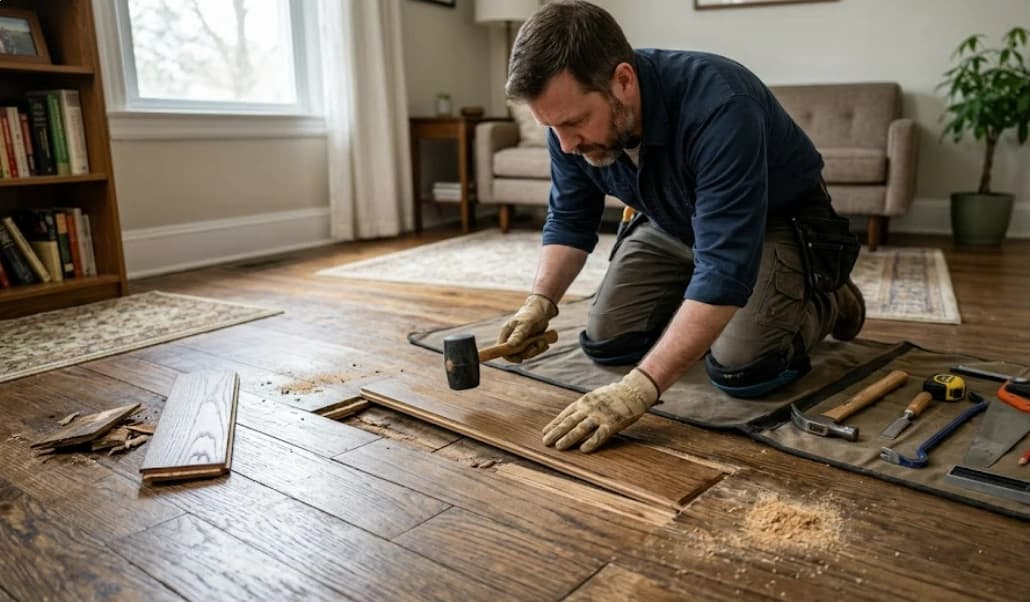
Restoring an original solid-hardwood floor is worth doing when the structure is sound — refinished period floors add real value, and a skilled installer can weave in replacement boards and blend them with sanding and refinishing. But no amount of surface work fixes a joist that has been hollowed out. If the framing is compromised, that gets repaired first, then the finished floor is installed over a solid base.
The order that matters
Treat, then rebuild, then finish. Never install or refinish a floor over an active infestation — you will just be feeding the colony new wood. Confirm the termites are gone, repair the structure, and only then repair or replace the floor you see.
How to Find a Contractor to Replace Your Floors
The exact steps — and the license checks — for hiring someone to replace floors after termite damage.
Termite floor damage almost always takes two different professionals, and confusing their roles is the most common mistake homeowners make:
Pro #1
Licensed pest control
Confirms the species, treats the colony (liquid soil barrier or a bait system), and gives you documentation that the infestation is handled. In our region they are licensed through the Maryland Department of Agriculture, Virginia's VDACS, or the District. They kill termites — they do not rebuild floors.
Pro #2
Flooring / general contractor
Assesses and repairs the subfloor and joists, then repairs or replaces the finished floor. This is the pro who actually gets your floors back — and the one this guide helps you vet. That is the role 2020 Flooring fills across the DMV.
Verify the license first
Before anything else, confirm the flooring contractor is licensed for your jurisdiction. This is quick, free, and screens out most bad actors:
- Maryland — a current MHIC (Maryland Home Improvement Commission) license, verifiable online by name or license number.
- Virginia — a DPOR contractor license (Class A, B, or C depending on project size).
- Washington, DC — a Home Improvement Contractor license through the Department of Licensing and Consumer Protection.
- Everywhere — proof of general liability insurance and workers' compensation, plus a written contract.
Questions that separate real repair contractors from installers
- Will you inspect and repair the subfloor and joists, or only install the new flooring on top?
- Do you provide a written structural assessment before quoting the finished floor?
- Can you coordinate timing with my pest-control company so we treat before we rebuild?
- Can you match my existing hardwood species, board width, and stain if we are patching, not replacing the whole room?
- Do you carry insurance, and will the work be permitted if joists are being replaced?
Red flags to walk away from
- Wants to lay a new floor without ever looking at the subfloor or crawl space.
- Has no license number you can verify, or dodges the question.
- Cash-only, no written contract, or pressure to decide today.
- Claims to both exterminate and rebuild with no pest-control license to show for it.
Local Termite Conditions Across the DMV
What we look for first when we inspect termite-damaged floors in each part of the region.
Maryland: crawl spaces, mulch beds, and finished basements
Across Montgomery County we most often find damage where wood sits close to damp soil — crawl-space joists, sill plates, and the first row of subfloor over a slab addition. In homes around Bethesda, Rockville, Silver Spring, Potomac, Chevy Chase, and Gaithersburg, mulch and garden beds pushed up against the foundation are a frequent entry point. We check the crawl space and sill first — the surface floor is usually the last chapter of the story.
Northern Virginia: mixed construction and older framing
In Arlington, Alexandria, Falls Church, and McLean, older colonials and homes near the Potomac corridor combine humid soil with original framing. Rear additions often set a slab-on-grade room beside framed floors, and that transition — where two moisture conditions meet — is a spot we probe carefully for both termites and rot.
Washington, DC: rowhouses, party walls, and basement units
In Washington, DC rowhouses, damage tends to start low — at basement joists, stair stringers, and subfloor near grade. Shared party walls limit ventilation and keep the framing damp, and many basements have layered waterproofing fixes over the decades. We look for mud tubes on the foundation and check whether the floor reacts seasonally before recommending a repair plan.
The common thread everywhere: a termite-damaged floor is a structural question first and a finish question second. Every job we take starts with an inspection of what is under the floor — not a sander or a box of new boards.
Preventing the Next Infestation
Once your floors are repaired, these habits keep termites from coming back.
- Schedule an annual termite inspection — cheap insurance in a high-probability region, and often required to keep a termite bond active.
- Keep soil, mulch, and firewood away from the foundation, and maintain a visible inspection gap at the base of the wall.
- Fix moisture: grade soil away from the house, clear gutters and downspouts, and dehumidify damp basements and crawl spaces.
- Cover crawl-space soil with a vapor barrier and keep it ventilated.
- Consider a termite bond or bait system so a licensed company monitors the property year-round.
Repairing Floors After Termite Damage?
Once your infestation is treated, 2020 Flooring assesses the subfloor and joists, rebuilds the structure, and repairs or replaces hardwood, laminate, and tile floors throughout Maryland, Northern Virginia, and Washington, DC. Licensed, insured, and focused on fixing the structure — not just covering it up.
Suspect termite damage in your floors? Get a free repair quote or contact our team for floor repair and replacement in Maryland, Northern Virginia, and Washington, DC.
Termite Floor Damage FAQs
The questions DMV homeowners ask us most about termite damage in floors.

Written by
Jason Brown
Flooring Specialist
Jason Brown has 14 years of flooring sales and installation experience across the DC, Maryland, and Virginia area.