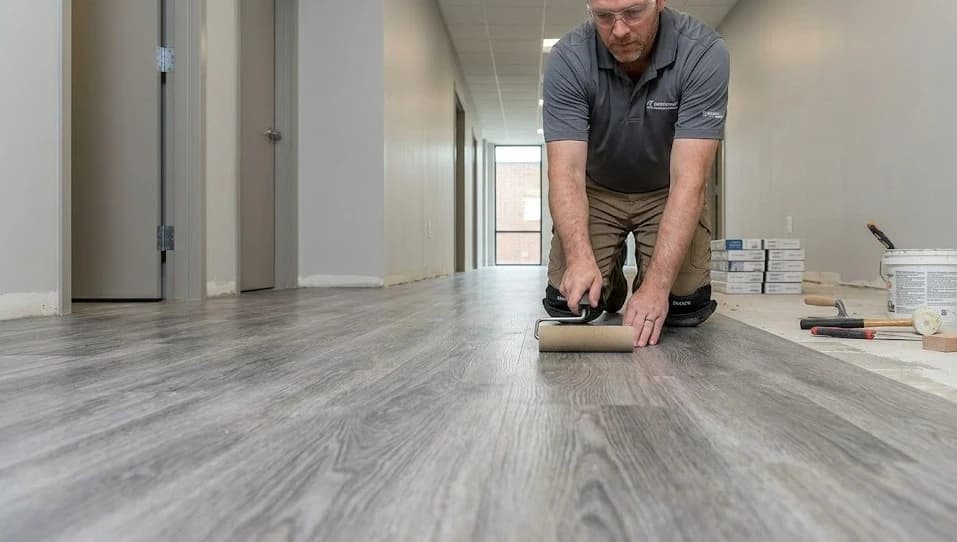
Homeowners comparing Marmoleum and linoleum are often surprised to learn they are not two different types of flooring. Marmoleum is a brand of natural linoleum made by Forbo Flooring Systems. Linoleum is the broader category; Marmoleum is one of its best-known product lines. The more useful comparison, then, is Marmoleum versus other linoleum products, installation formats, and other eco-friendly resilient flooring options. If you are still deciding between natural linoleum and vinyl altogether, start with our linoleum vs. LVP vs. LVT comparison — it covers cost, water performance, and which material belongs in each room.
For homeowners in Washington, DC, Maryland, and Northern Virginia, the right choice also depends on the subfloor, the room, the design, and how much preparation the project needs. 2020 Flooring installs both Marmoleum and other natural linoleum — sheet, glue-down tile, and floating click formats — across the DMV every week, so the ranges and local notes below reflect what people here are genuinely paying and dealing with in 2026.
The Short Answer · 2020 Flooring · Serving MD, DC & VA Since 1997
Marmoleum is a premium linoleum brand — so it is a type of linoleum, not a rival to it. Both are natural resilient floors made largely from linseed oil, wood flour, and limestone (not the same thing as synthetic vinyl). In the DMV, plan on roughly $7–$11 / sq ft installed for Marmoleum click flooring, $8–$13 for glue-down tile, and $9–$15+ for sheet Marmoleum. The format you choose and the condition of your subfloor move the price far more than the brand does.
Want an exact number for your room? Resilient flooring is only as good as the surface underneath it, so we price from an on-site look at your subfloor. Get a free Marmoleum & linoleum quote →
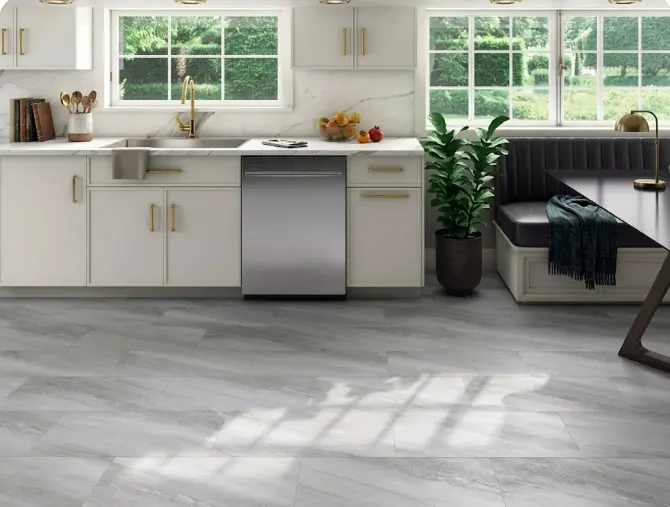
Kitchens are the most common room for Marmoleum and linoleum — comfortable underfoot, cleanable, and available in a huge color range. See our kitchen flooring service.
Is Marmoleum the Same as Linoleum?
Yes and no — and the diagram below clears up the confusion that most comparisons miss.
Linoleum is a resilient flooring traditionally made from linseed oil, wood flour, resins, pigments, and a backing material. It has been used in homes and commercial buildings for generations. Marmoleum is Forbo's brand of linoleum, available as sheet, glue-down tiles, and floating click-together planks or tiles. A simple way to hold it in your head:
All Marmoleum is linoleum, but not all linoleum is Marmoleum.
When people search “Marmoleum vs. linoleum,” they are usually comparing Marmoleum with generic linoleum, sheet linoleum, click flooring — or even vinyl flooring that has been incorrectly called linoleum. Getting that distinction right is the first step to choosing well.
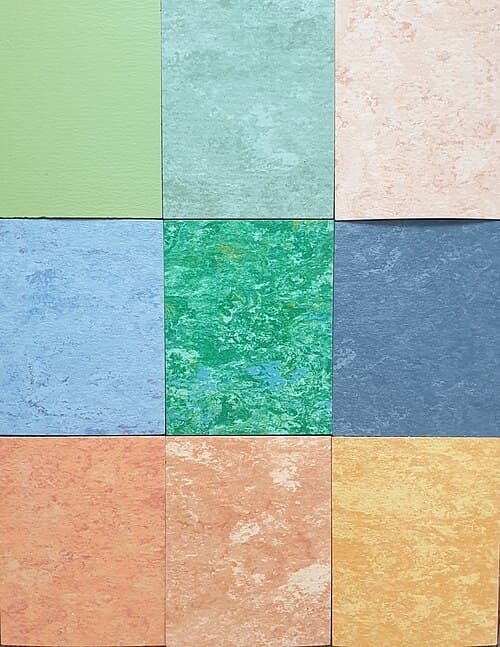
Natural linoleum comes in an enormous color range — one reason Marmoleum coordinates so easily with existing cabinets and trim. Photo: Wikimedia Commons.
Is Linoleum Sustainable?
One of the strongest reasons homeowners choose linoleum over synthetic vinyl.
Yes — and it is a genuine sustainability story, not marketing. Natural linoleum is built almost entirely from renewable, non-toxic, and fully biodegradable raw materials: linseed oil pressed from flax (much of it grown on the Canadian prairies), plus wood flour, cork dust, tree rosin, ground limestone, natural pigments, and a jute backing. Because it contains no chlorinated petrochemicals the way PVC vinyl does, its ecological footprint is small compared with most plastic flooring on the market.
Renewable & biodegradable
Made from crops and minerals that regrow, and it breaks down naturally at end of life instead of sitting in a landfill.
Long service life
A well-maintained linoleum floor lasts 20+ years, so it is replaced less often — the greenest floor is the one you keep.
Low-waste manufacturing
Factory off-cuts are fully recyclable — ground up and blended back into new batches of linoleum cement.
Leading brands back this up with third-party environmental certifications — Forbo's Marmoleum and Artoleum lines are among the best known. That is why we group natural linoleum alongside cork, bamboo, and FSC-certified wood on our eco-friendly flooring menu, and cover it in our sustainable flooring guide.
A Quick History of Linoleum
Linoleum is not a modern invention — it has been underfoot for over 150 years.
Linoleum was invented in England by Frederick Walton in the 1850s. As the story goes, Walton noticed the rubbery, flexible skin of dried linseed oil that had formed on a can of oil-based paint and wondered whether it could stand in for India rubber. Raw linseed oil oxidizes very slowly, so he sped the process up with heat and additives until the oil hardened into a resinous mass. Cheap cotton cloth was dipped in it, coated, and boiled down with solvents into a durable floor covering. The name itself comes from the Latin for flax and oil — linum and oleum.

Early linoleum still in service at Tyntesfield, a Victorian estate in England — a floor that has lasted well over a century. Photo: Wikimedia Commons.
That century-old survivability is the point: real linoleum earned its reputation for durability long before modern brands like Marmoleum refined the colors and formats. When it is installed over a properly prepared subfloor and maintained, it genuinely lasts.
Marmoleum vs. Linoleum at a Glance
Marmoleum against other linoleum products, feature by feature.
| Feature | Marmoleum | Other Linoleum |
|---|---|---|
| Product type | A specific linoleum brand | The general flooring category |
| Manufacturer | Forbo Flooring Systems | Varies by brand |
| Formats | Sheet, modular tile, and click | Depends on manufacturer |
| Colors & patterns | Extensive coordinated collections | Varies considerably |
| Installation | Glue-down or floating | Usually sheet or glue-down tile |
| Subfloor prep | Critical | Critical |
| Water resistance | Format- and install-specific | Product- and install-specific |
| Repairs | Tile formats easier to spot-replace | Depends on format & availability |
| Cost | Positioned as a premium linoleum | May be lower or similar |
Sheet vs. Tile vs. Click Flooring
The installation format affects cost and performance more than the brand does.
Sheet Marmoleum
Installed with adhesive for a clean look with relatively few seams. Great for kitchens, larger rooms, commercial spaces, and custom borders. It is the hardest format to measure, cut, and adhere correctly, and subfloor imperfections can telegraph through — professional installation is strongly recommended.
Glue-down Marmoleum tile
Modular tiles or planks individually adhered to a prepared substrate. Ideal for multi-color patterns, checkerboards, and borders, and an individual tile can be replaced later. Still requires a smooth, stable, properly prepared subfloor.
Marmoleum click flooring
A floating floor that clicks together rather than being glued down. Appeals to homeowners who want faster installation, less adhesive, and easier future removal. Floating does not eliminate the need for a flat, sound subfloor, and door clearances, expansion space, and transitions all have to be planned.
How Much Does Marmoleum Cost in the DMV?
Real 2026 DMV planning ranges — not national averages that ignore our labor rates and older housing.
The installed price is based on far more than the advertised material price. A complete estimate can include the flooring, adhesive or underlayment, delivery, existing-floor removal and disposal, subfloor repair, leveling, installation labor, pattern or border work, baseboards and transitions, and appliance handling. Use these as planning ranges, not guaranteed quotes:
| Installation type | Typical DMV range |
|---|---|
| Marmoleum click flooring | $7 – $11 / sq ft installed |
| Glue-down Marmoleum tile | $8 – $13 / sq ft installed |
| Sheet Marmoleum | $9 – $15+ / sq ft installed |
| Extensive subfloor prep / leveling | Add ~$1.50 – $4 / sq ft |
| Existing-floor removal & disposal | Add ~$1 – $3 / sq ft |
| Custom patterns or borders | Priced after design review |
Small rooms often cost more per square foot because setup, delivery, cutting, and finishing labor spread over less flooring. A straightforward rectangular room over a sound plywood subfloor costs less than a kitchen that needs several old layers removed, extensive patching, and a custom multi-color layout. Choosing a premium material while skimping on the necessary prep is usually a false economy — the performance of a linoleum floor depends heavily on the work done before the finished flooring goes down. If your existing floor is failing, our flooring repair team can handle subfloor correction as part of the same project.
DMV Local Insights
Why the same Marmoleum job prices and installs differently across DC, Maryland, and Northern Virginia.
Washington, DC
Rowhouses and older detached homes routinely stack several generations of flooring — vinyl over underlayment over an original wood floor. Narrow rooms, angled walls, radiator pipes, built-in cabinets, and tight material staging all add labor. Occupied-home scheduling and parking access matter too.
Maryland
Montgomery County ranges from historic and mid-century homes to townhomes, condos, and new construction. Expect plywood seams and old repairs, additions with different floor heights, and concrete basement slabs that need moisture evaluation and leveling before any resilient floor goes down.
Northern Virginia
Plywood, OSB, or concrete substrates depending on age and property type. Condo and townhouse projects often carry HOA rules — work-hour limits, elevator reservations, sound-control requirements, and delivery restrictions — that shape scheduling as much as the floor itself.
The through-line across all three: subfloor preparation matters as much as the flooring itself, and DMV basements and slab-on-grade units nearly always need a moisture check first. If you are weighing a below-grade install, read how we approach basement flooring and waterproof flooring, since natural linoleum is not the automatic choice for a damp slab.
Which Rooms Are Best for Marmoleum?
Marmoleum shines in some rooms and needs careful evaluation in others.
Great fits
- Kitchens — comfortable underfoot, cleanable, huge color range (mind appliance clearances and seams near sinks)
- Entryways and mudrooms — durable and cleanable, paired with mats
- Playrooms — warmer than ceramic tile with endless design options
- Home offices — modern or traditional; protect chair casters
- Powder rooms — fewer moisture concerns than a full bath
Evaluate carefully
- Full bathrooms with a tub or shower — seam and moisture detailing is critical
- Basements — assess the slab and any history of moisture first
- Any room over an unresolved leak or wet slab — fix the water problem before flooring
- Very high-traffic commercial zones — plan adhesives, phasing, and maintenance
For genuinely wet rooms, compare against bathroom flooring in tile and stone. Marmoleum is also widely used in offices, schools, and healthcare settings — see our commercial flooring service for phased, occupied-space installs.
Marmoleum vs. Vinyl Flooring
Linoleum and vinyl are constantly confused, but they are different materials.
| Feature | Marmoleum / Linoleum | Vinyl (LVP / LVT) |
|---|---|---|
| Material | Natural linoleum (linseed oil, wood flour, limestone) | Synthetic resilient flooring (PVC) |
| Formats | Sheet, glue-down tile, floating click | Sheet, plank, tile |
| Appearance | Marbled, solid, linear, patterned | Realistic wood and stone visuals |
| Water performance | Product- and install-specific | Often chosen for wet areas |
| Design focus | Color, pattern, natural material | Wood and stone replication |
| Best for | Kitchens, offices, eco-minded homes | Basements, baths, rentals, high-moisture rooms |
Neither is universally “better.” If a natural material, distinctive color, and comfort underfoot matter most, Marmoleum wins. If you need maximum water resistance for a basement, bath, or rental turnover, waterproof luxury vinyl plank usually makes more sense. Our comparison guides on laminate vs. LVP and carpet vs. LVP walk through the same trade-offs across other resilient options, and our sustainable flooring guide covers where natural linoleum fits among green options.
Marmoleum Advantages & Disadvantages
An honest look at where Marmoleum earns its keep — and where it does not.
Advantages
- Available in sheet, tile, and floating formats
- Exceptionally broad range of colors and patterns
- Modular products enable custom layouts and borders
- Natural material composition, not synthetic vinyl
- Warmer and more comfortable than ceramic tile
- Tile formats let you replace individual sections
- Residential and commercial applications
Disadvantages
- Sheet installation requires specialized skill
- Subfloor prep can add significantly to the cost
- An uneven substrate can show through the surface
- Availability may be more limited than vinyl
- Detailed patterns increase labor
- Some products need adhesive and curing time
- Moisture conditions must be evaluated carefully
Authoritative Sources
Independent references for linoleum construction, installation, and green-building standards.
- Forbo Flooring Systems — the manufacturer of Marmoleum, with product specifications, format options, and installation requirements for each collection. Forbo: Marmoleum
- Resilient Floor Covering Institute (RFCI) — industry association covering resilient flooring standards, installation, and indoor-air certifications for both linoleum and vinyl. RFCI
Request a Marmoleum Flooring Estimate in the DMV
Marmoleum can be an excellent floor, but the product is only one part of a successful project. 2020 Flooring helps homeowners and property owners compare sheet, modular tile, and click formats against other eco-friendly and resilient options — with on-site floor evaluation, moisture testing, subfloor prep, and expert installation across Washington, DC, Maryland, and Northern Virginia.
Marmoleum & Linoleum FAQs
The questions DMV homeowners ask us most about Marmoleum and linoleum.

Written by
Jason Brown
Flooring Specialist
Jason Brown has 14 years of flooring sales and installation experience across the DC, Maryland, and Virginia area.