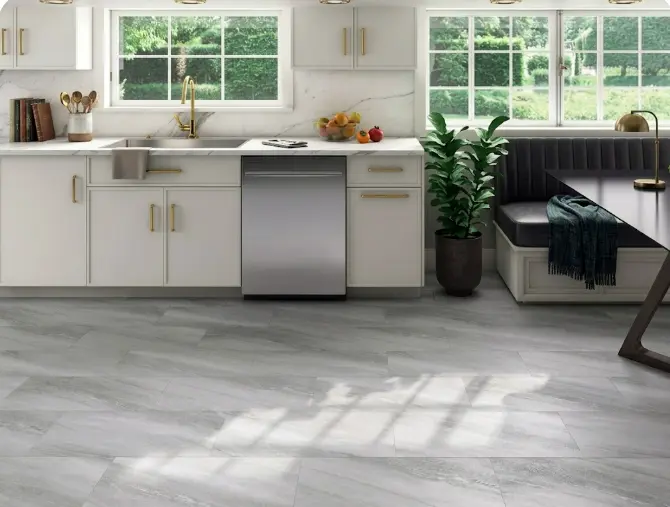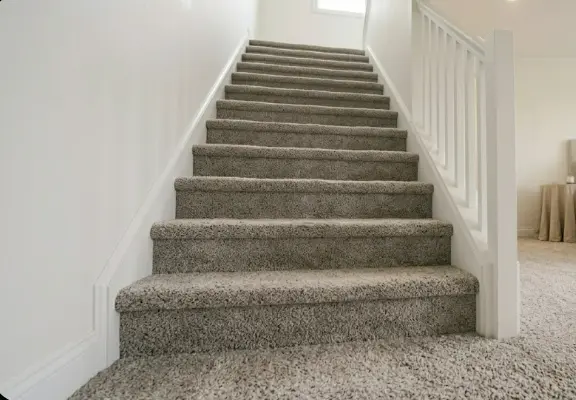
Homeowners who have decided they want a natural, eco-friendly floor usually end up with the same three names on the shortlist: Marmoleum, cork, and bamboo. All three are genuinely renewable, all three are sold with the same green marketing language, and all three are regularly put in rooms they do not belong in.
They are not interchangeable. One is a resilient sheet material you can mop, one is a closed-cell insulator that makes a condo quiet, and one is a plant fibre pressed hard enough to outscore red oak on an indentation test and still move with the seasons. This guide compares them on the things that decide a project in Washington DC, Maryland, and Northern Virginia: construction, hardness, how each handles our summer humidity and our slab basements, indoor air quality, real sustainability, and 2026 installed cost.
The Short Answer · 2020 Flooring · Serving MD, DC & VA Since 1997
Marmoleum for kitchens, allergies, and long wear life. Cork for comfort, warmth, and quiet — especially a condo. Bamboo when you want the look and hardness of wood from a rapidly renewable crop. In the DMV, the deciding factor is almost never the marketing: it is moisture. Our July dew points sit in the low 70s°F while a below-grade slab holds 60–68°F, which is why bamboo is the least forgiving of the three here and why none of them belong on a basement floor. Plan on roughly $7–$15/sq ft installed for Marmoleum, $6–$12 for cork, and $7–$14 for bamboo, with the subfloor — not the material — moving the number most.
Not sure which of the three fits your rooms? We will look at the substrate, test the slab for moisture, and tell you plainly when one of these materials is wrong for the space. Get a free natural-flooring consultation →
How Each Floor Is Actually Made
Each one fails in a different way, and the reason is in the stack-up.
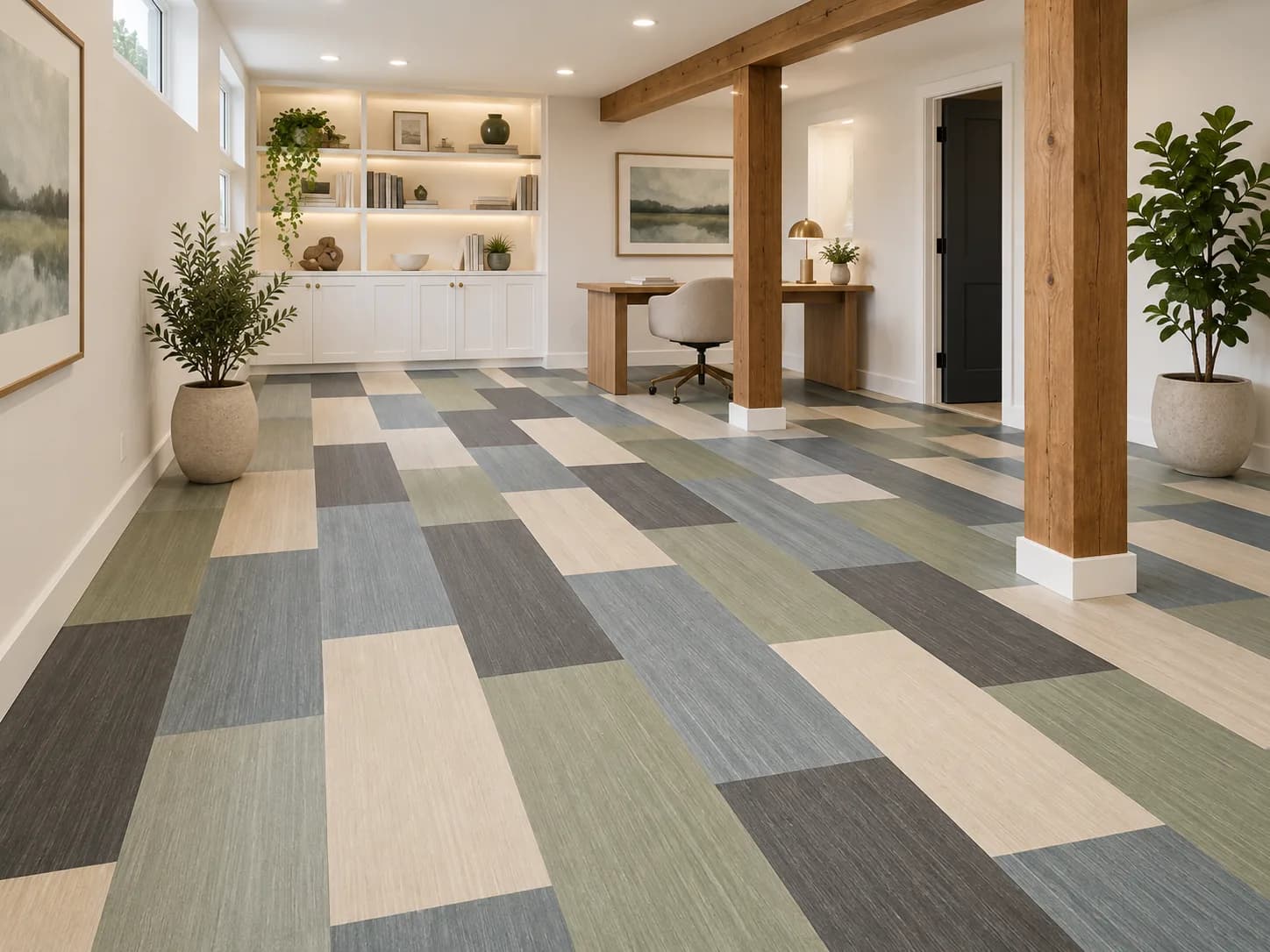
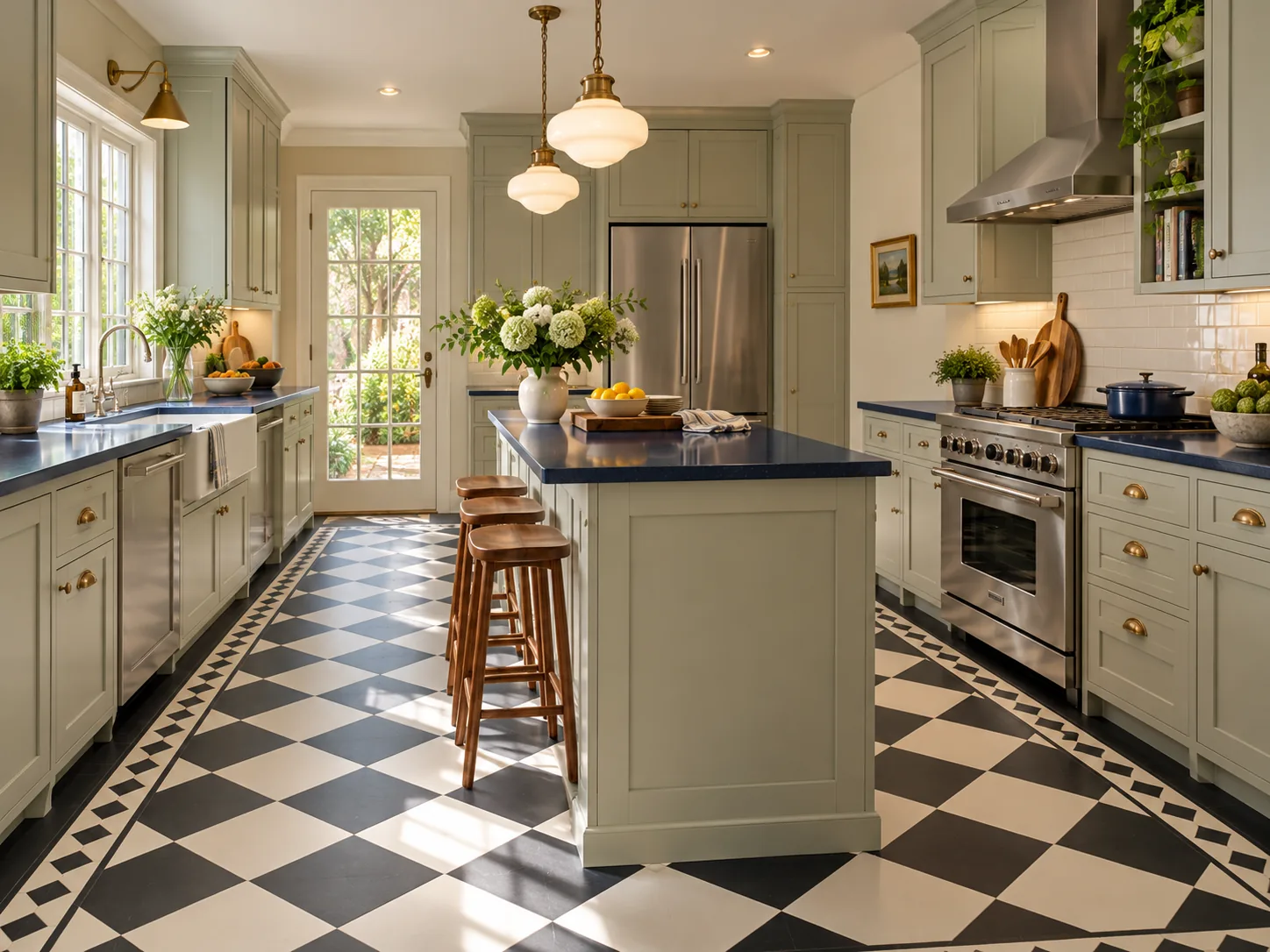
Marmoleum is linoleum — Forbo's brand of it, not a separate category. It is a homogeneous resilient sheet pressed from linseed oil, pine rosin, wood flour, ground limestone, and pigments onto a jute backing, finished at the factory with Topshield2, a double UV-cured coating. Forbo states Marmoleum is made from 97% natural raw materials with 43% recycled content, and sells it as 2.0–2.5 mm sheet, modular glue-down tile, and floating click panels. If you are weighing Forbo against generic linoleum specifically, that is a separate comparison, and we wrote it up in our Marmoleum vs. linoleum guide.
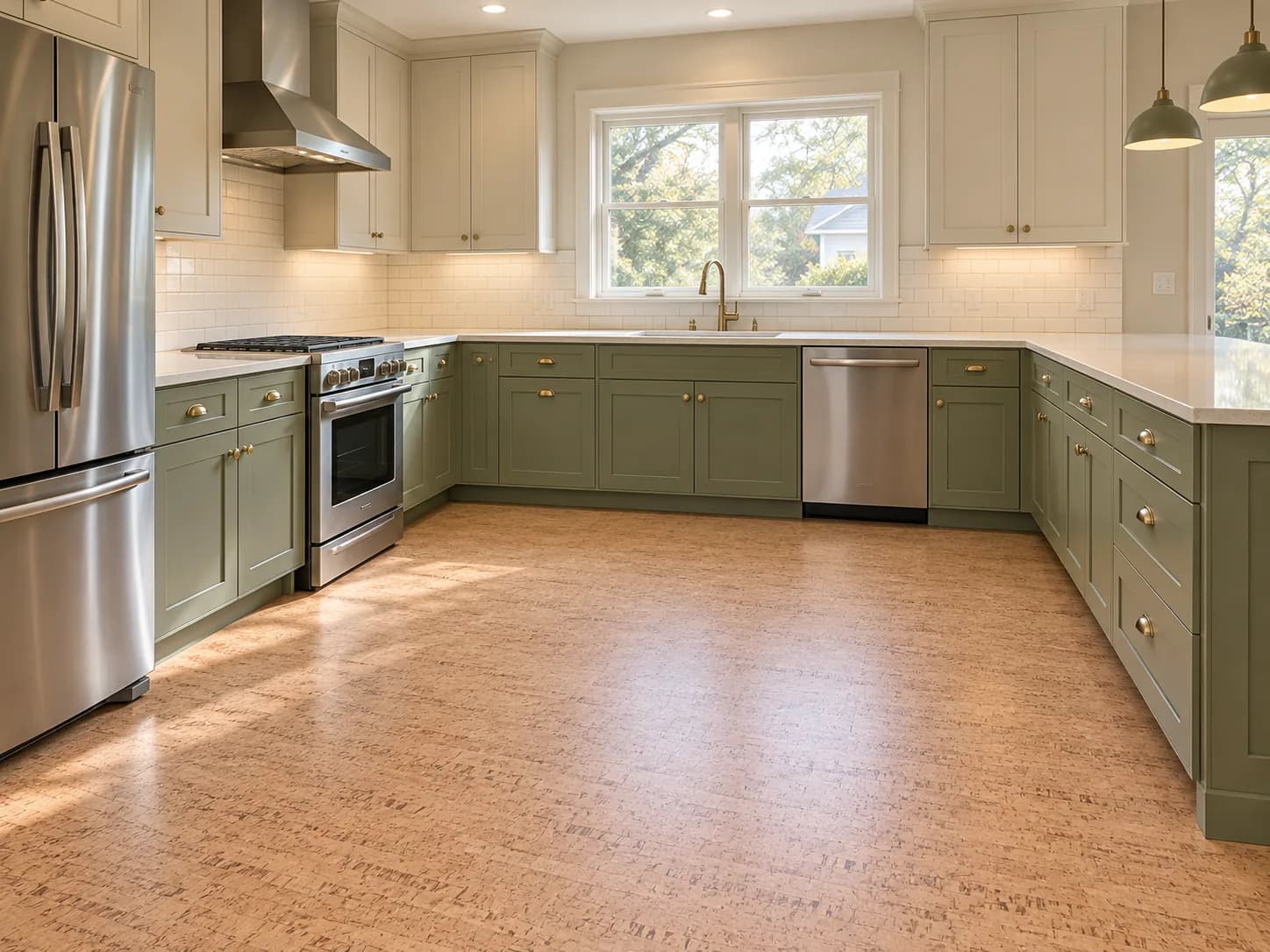
Cork is the bark of the cork oak, Quercus suber, granulated and resin-bound into tiles or panels. Amorim describes cork as a honeycomb of microscopic cells filled with an air-like gas and built mostly from suberin, lignin, and polysaccharides — which is the whole reason cork insulates, absorbs sound, and springs back under your heel. It comes two ways: a 4–6 mm glue-down tile, or a 10–12 mm floating click panel with a cork wear layer over an HDF core. That core matters. Floating cork is only as water-tolerant as the fibreboard hidden inside it.
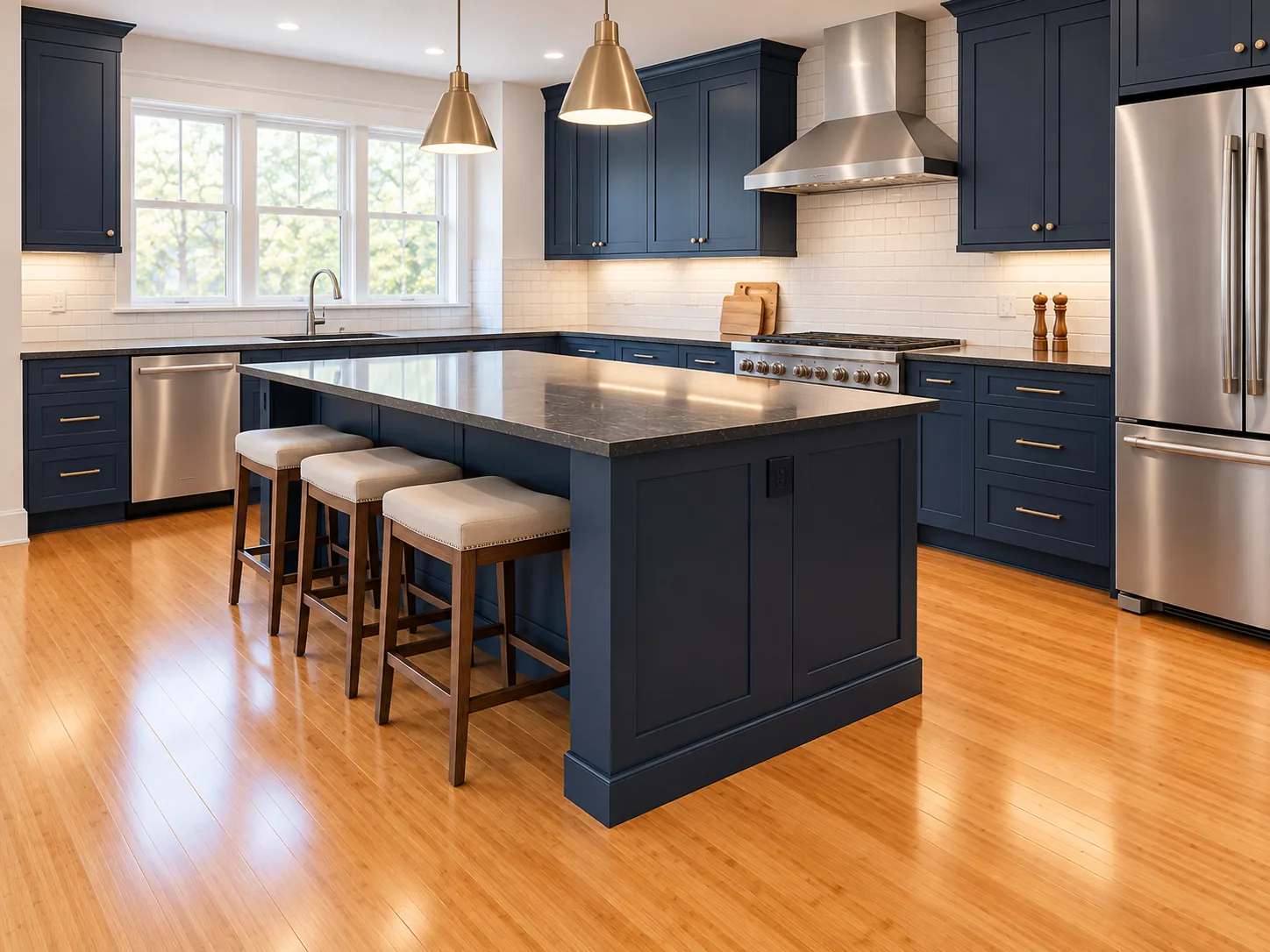
Bamboo is a grass, not a wood. Horizontal and vertical grain products laminate milled strips together; strand-woven bamboo shreds the culm into fibre, saturates it with resin, and compresses it into a board. Strand-woven is dramatically harder and is what most showrooms now carry. It is also the most resin-heavy of the three constructions, which is why the formaldehyde question below is a real one rather than a talking point.
Marmoleum vs. Cork vs. Bamboo at a Glance
The whole comparison on one screen.
| Marmoleum | Cork | Bamboo | |
|---|---|---|---|
| Material | Linseed oil, rosin, wood flour, limestone, jute | Resin-bound cork oak bark | Bamboo culm, laminated or strand-woven with resin |
| Feel | Firm but resilient, slightly warm | Softest — cushioned, warm underfoot | Hard, like a dense hardwood |
| Dent resistance | Moderate; recovers from some point loads | Lowest; partial recovery | Highest — strand-woven is published at ~2,800–4,000+ lbf Janka |
| Moisture tolerance | Best of the three; not waterproof | Fair if sealed; HDF core is the limit | Weakest — wants a stable 35–55% RH |
| Acoustic / thermal | Thin; depends on underlayment | Best — Amorim publishes up to 20 dB impact reduction | Bright and hard; needs underlayment |
| Refinishable | No — wears through its thickness | Sometimes, on thick solid tile | Solid bamboo can be sanded once or twice |
| Typical DMV installed cost | $7–$15+ / sq ft | $6–$12 / sq ft | $7–$14 / sq ft |
| Best for | Kitchens, allergy households, heavy-traffic rooms | Condos, nurseries, home offices, standing rooms | Living areas and stairs where you want a wood look |
Hardness, Dents & Scratches
Hard and durable are not the same property, and the Janka number only measures one of them.
Strand-woven bamboo wins on paper. Manufacturers publish Janka indentation figures from roughly 2,800 to over 4,000 lbf, against about 1,290 lbf for solid red oak. Those are manufacturer-reported numbers from different labs on different products, so treat them as a class indication rather than a spec you can compare brand to brand — but the direction is real. A dropped cast-iron pan is far less likely to mark strand-woven bamboo than any other floor in this comparison.
What the Janka test does not tell you. Janka drives a steel ball into the surface — it measures resistance to indentation, not to scratching. Bamboo's factory finish is what resists scratches, and a hard, light, uniform bamboo surface shows grit scratches and pet claws more readily than a busy hardwood grain does. Hardness and scratch-concealment are separate questions, and bamboo wins one of them.
Cork is the softest and nobody should be surprised by that — the cushion you feel is the same compressibility that takes a mark from a piano leg or a barstool. The closed-cell structure recovers from some point loads, so a chair dent often fades; a permanent static load generally does not. Felt pads and wide furniture coasters are not optional on a cork floor.
Marmoleum sits in the middle on hardness and wins on wear life. It can be gouged by a dragged appliance, but the colour runs through the full body of the material rather than sitting in a printed film, so ordinary abrasion does not expose a different layer underneath. That is why you find linoleum in schools and hospitals decades after installation. The trade-off: at 2.0–2.5 mm there is nothing to sand, so damage means a patch or a replacement section, not a refinish. If sanding and refinishing matters to you, that is a point for hardwood over all three of these.
Moisture: The DMV Decider
The section that decides most DMV projects. Read this one even if you skip the rest.
Our climate is hard on natural floors in a specific way: outdoor dew points routinely reach the low 70s°F through July and August, then forced-air heat drops indoor relative humidity below 30% in January. Every material in this comparison is a plant product, and plant products move with that swing.
Bamboo is the least tolerant of the three. Suppliers typically specify a service range of 35–55% relative humidity, with best stability around 40–50%. MOSO — a bamboo manufacturer, writing about its own premium line — states plainly that standard strand-woven bamboo has “low stability, resulting in high shrink and swell levels.” In a DMV house with no humidity control, that shows up as winter gaps between boards and summer cupping or peaking. It is the single most common bamboo complaint we are called out to look at.
Floating cork is limited by its core, not by the cork. The cork itself is closed-cell and shrugs off humidity; the HDF layer beneath it swells irreversibly if water gets into the joints. Glue-down cork tile avoids that core entirely, which is why it is the format we recommend for anywhere with a real spill risk. Cork also needs its finish maintained — a worn seal is how water reaches the substrate.
Marmoleum handles water best of the three and is still not waterproof. Sheet Marmoleum over a properly prepped substrate, with seams and perimeter detailed correctly, is a genuinely good kitchen, mudroom, or laundry floor. The jute backing means a sustained leak is a different story. For spaces that actually get wet, we point people to waterproof flooring or tile and stone instead.
DMV Field Note · Slab Basements
Montgomery County split-levels, Silver Spring ramblers, and DC rowhouse lower levels almost all sit on a slab. Bringing 72°F dew-point air into a room with a 64°F slab condenses liquid water on the floor — the same physics as a cold drink sweating on a table. No natural floor in this comparison survives that for long.
Before anything goes down on a slab, the slab gets measured: in-situ relative humidity probes per ASTM F2170, or calcium chloride per ASTM F1869. A quote for a below-grade floor that does not include slab testing is a quote that has not looked at the job.
There is also a code dimension if you are in a mapped floodplain. FEMA Technical Bulletin 2 (revised January 2025) limits construction below the base flood elevation to flood damage-resistant materials — products that can take direct, prolonged contact with floodwater without significant damage. Marmoleum, cork, and bamboo are not among them, and the bulletin specifically flags that sheet coverings restrict drying of the materials they cover. For a below-grade room, read our basement flooring page and look at luxury vinyl plank instead.
Warmth, Comfort & Quiet
The one category where cork is not close — it wins outright.
Cork's honeycomb cell structure is a built-in insulator and sound absorber. Amorim publishes impact sound reduction of up to 20 dB and Impact Insulation Class values from 51 to 78 dB across its cork range depending on product and thickness, and claims cork floors can cut walking noise by up to 53%. For a standing kitchen, a nursery, a home office where you are on your feet, or a room over a bedroom, nothing else in this comparison is in the same category.
If you live in a DC, Arlington, or Bethesda condo, check the house rules first. Most buildings require a tested floor-ceiling assembly meeting IIC and STC 50, following the International Building Code, and plenty of boards set a higher bar in their own rules. Cork is one of the easiest ways to hit a demanding number; bamboo over a thin underlayment is one of the hardest. Get the requirement in writing before you order, and remember the rating belongs to the assembly, not the flooring. Our small-space flooring guide goes deeper on condo sound rules.
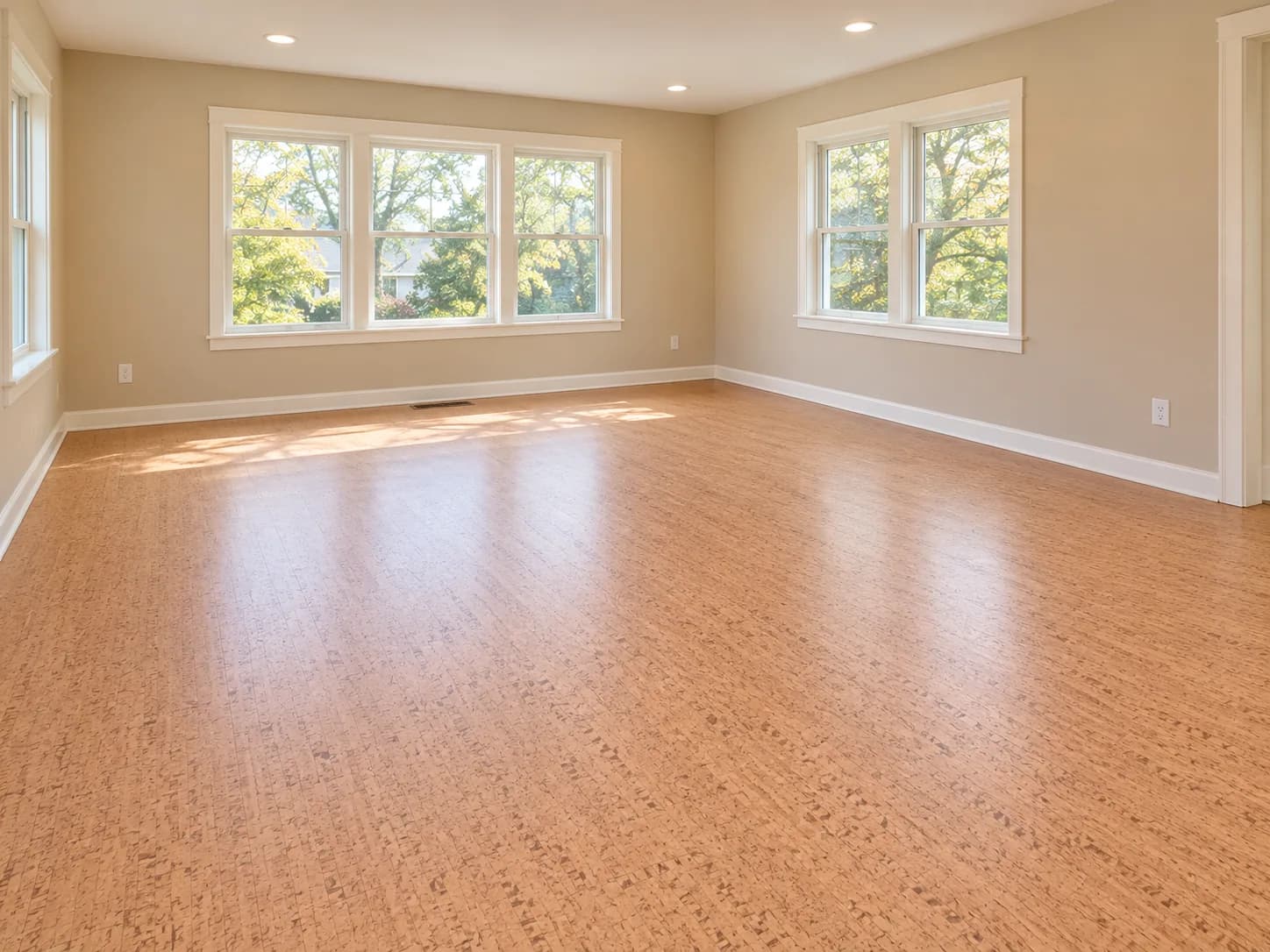
Marmoleum is firm but not cold, and because it is thin, its acoustic performance is mostly whatever underlayment sits beneath it. Bamboo is the hardest and brightest of the three — pleasant to look at, loud to walk on, and the one most likely to need an acoustic underlayment to satisfy a condo board.
Indoor Air Quality & Allergies
Ask for the certificate, not the adjective.
Marmoleum has the strongest independent credential of the three for allergy households. Allergy UK lists Forbo Marmoleum among the products carrying its Seal of Approval, awarded after independent testing for allergen reduction; the reasoning is simply that a smooth, seamless, cleanable surface gives house dust mites nowhere to live. For a household with asthma or dust-mite allergy, that is a concrete reason to choose it over carpet and over a floor with many joints.
Bamboo and cork are both resin-bound, so the binder chemistry is a fair question. Composite wood products sold in the United States must meet the EPA formaldehyde emission standards under TSCA Title VI, which were harmonized with California's CARB Phase 2 limits; compliant product carries a TSCA Title VI label. For resilient and hard-surface flooring more generally, FloorScore, administered through the Resilient Floor Covering Institute, is the common indoor-air-quality certification.
Three questions to ask any natural-flooring salesperson
- Can I see the TSCA Title VI or FloorScore certificate for this product? A brochure saying “low VOC” is marketing. A certificate is a document.
- What adhesive goes down with it, and what is its emission rating? On a glue-down floor the adhesive is part of the indoor air story, and it is routinely left out of the conversation.
- Is there a current EPD or Health Product Declaration? Environmental product declarations exist for some lines and not others — and a product with a published EPD is one whose claims somebody had to substantiate.
Which Is Actually Greenest?
All three are renewable. They are not renewable in the same way, or on the same clock.
Cork has the best story, and it is not close. The bark is stripped from a living cork oak and regrows; the tree is never felled. APCOR, the Portuguese cork association, notes that harvesting at intervals of less than nine years is prohibited outright, and Amorim puts the first harvest at around 25 years of age — once the trunk reaches 70 cm diameter measured 1.3 m from the ground. A cork oak lives roughly 200 years and is stripped some 15 to 17 times over its life. The cork montado landscape it supports is itself a protected habitat.
Bamboo's advantage is speed. Moso culms are cut at roughly four to six years, against decades for a hardwood sawlog, and the root system survives to send up replacements. Against that: it is resin-intensive, it ships from Asia to the East Coast, and if a bamboo floor fails on humidity in year six, the fast-growing feedstock has not bought anyone much. Ask about FSC certification on the raw material.
Marmoleum's raw material is an annual crop. Flax is harvested every season for linseed oil, and Forbo states 97% natural raw materials with 43% recycled content and roughly 72% renewable content on its consumer pages. Figures vary a few points between Forbo pages and lines, so if a green-building target depends on the number, pull the current environmental data sheet for the exact product. Marmoleum's real sustainability argument, though, is service life: a floor that stays down for 25 to 40 years is a floor nobody replaced three times.
Longevity beats feedstock. The greenest floor in any of these comparisons is usually the one you do not replace. Before you optimise for renewal cycle, make sure the material suits the room — because a rapidly renewable floor torn out after six years of DMV humidity has a worse footprint than a well-chosen one that lasts thirty. Our sustainable flooring guide covers the wider menu, including wool, FSC hardwood, and polished concrete.
Installed Cost in the DMV
2026 planning ranges for DC, Maryland, and Northern Virginia — not quotes.
| Floor & format | Installed / sq ft | What moves it |
|---|---|---|
| Marmoleum click | $7–$11 | Subfloor flatness, transitions, expansion detailing |
| Marmoleum glue-down tile | $8–$13 | Pattern layout, adhesive, leveling |
| Marmoleum sheet | $9–$15+ | Seaming, template work, curing time |
| Cork floating click | $6–$11 | Underlayment spec, flatness tolerance |
| Cork glue-down tile | $7–$12 | Substrate prep, site-applied finish coats |
| Bamboo, horizontal / vertical | $7–$12 | Acclimation, nail vs. glue, stairs |
| Bamboo, strand-woven | $8–$14 | Material grade, moisture control, trim and nosings |
Three things move a natural-flooring estimate far more than the material line item: old-floor removal, subfloor leveling, and moisture mitigation. A 1958 Bethesda split-level with three layers of vinyl over a wavy plywood deck is a different job from a 2015 Rockville townhouse, even with identical flooring. Small rooms also cost more per square foot: setup, templating, and cut waste spread across less area. If you want to sanity-check material quantities before you call anyone, our flooring waste calculator handles the overage maths.
These are planning ranges, not your price. We price natural floors from an on-site look at the substrate, because that is the part that varies. Get a free itemized estimate →
Room by Room
Where we would actually put each one in a Maryland, DC, or Northern Virginia home.
Kitchen
Marmoleum
Resilient underfoot, mops clean, no printed film to wear through. Sheet or glue-down tile, never floating click with an exposed core. See kitchen flooring.
Bedrooms & living rooms
Cork or bamboo
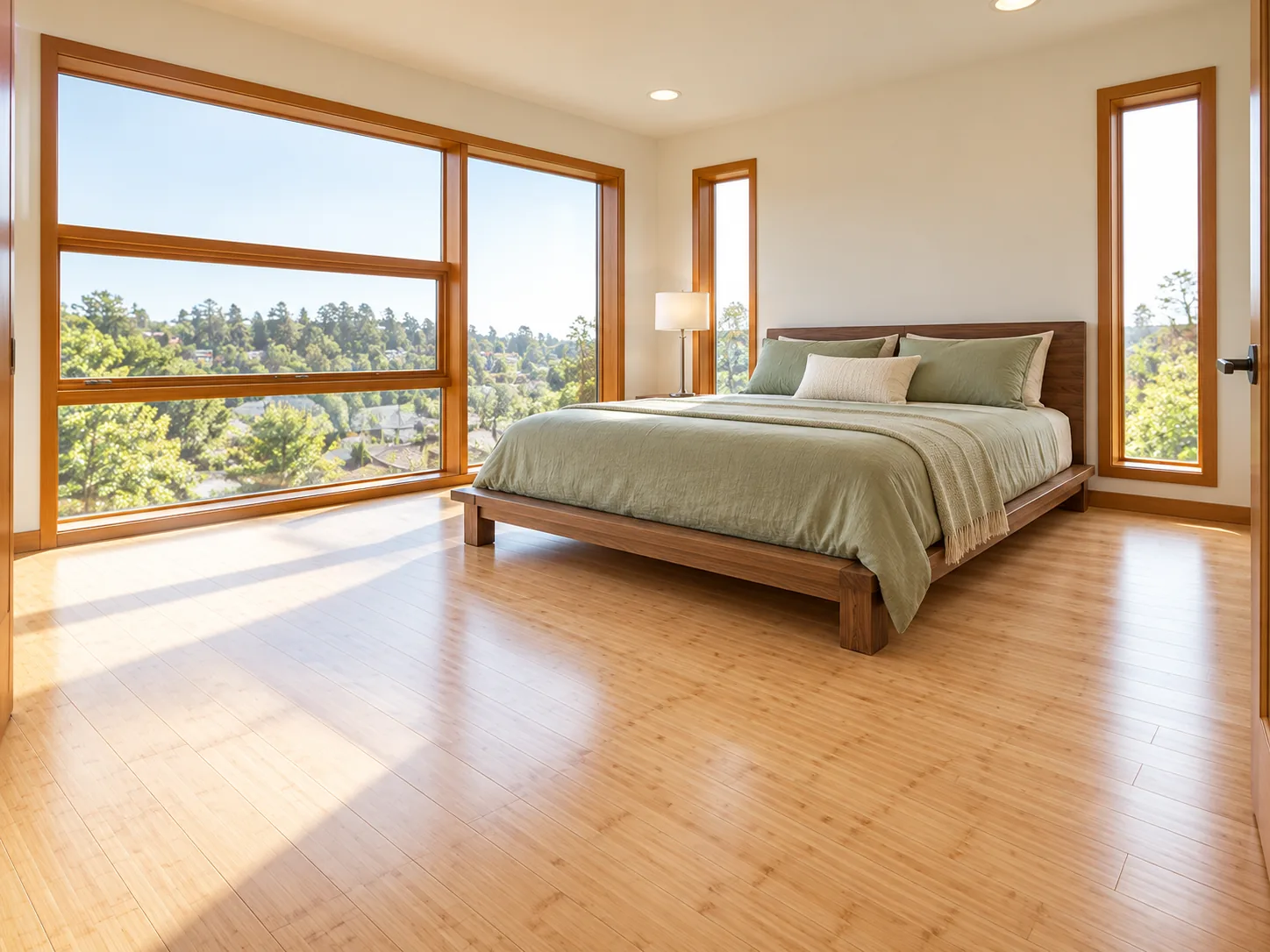
Both are at home here. Cork if comfort and quiet matter; bamboo if you want the look and hardness of wood. Keep indoor RH in the 35–55% band year round.
Condo or co-op
Cork
The easiest of the three to satisfy an IIC/STC 50 assembly requirement, and the most forgiving of a neighbour below. Confirm the building's number first.
Home office & nursery
Cork
Warm, quiet, soft on a dropped knee, and naturally resistant to mould and mildew thanks to suberin in the cell walls.
Stairs
Bamboo
The only one of the three that works properly on treads, with matched nosings. See stairs & railings.
Basement & full baths
None of the three
Go to waterproof flooring or tile. Test the slab per ASTM F2170 before you commit to anything.
Commercially, the calculus shifts toward Marmoleum sheet: heat-welded seams, a homogeneous wear body, and a maintenance regime building services staff already know. We spec it for offices, clinics, and schools through our commercial flooring side. Cork and bamboo rarely survive a commercial rolling-load programme.
The Verdict
There is no overall winner — there is a winner per priority.
Marmoleum
Wins on wear life, kitchens & allergies
The most practical of the three. Homogeneous wear body, the best moisture tolerance here, an Allergy UK Seal of Approval behind it, and a format for every room above grade. Costs the most installed as sheet, and cannot be refinished.
Cork
Wins on comfort, warmth & sound
Nothing else in this comparison is close on quiet and underfoot comfort, and the nine-year bark harvest is the strongest sustainability story in flooring. Pay for it in dents: felt pads, coasters, and a maintained finish are part of ownership.
Bamboo
Wins on hardness & a wood look
Strand-woven bamboo is the hardest surface here by a wide margin and reads as a wood floor at a rapidly renewable price. It is also the least forgiving of DMV humidity, so it needs a house that holds 35–55% RH year round.
Still weighing natural materials against vinyl on cost and water performance? That comparison is in our linoleum vs. LVP vs. LVT guide, and the full renewable menu — wool, FSC hardwood, polished concrete, recycled carpet — is on our eco-friendly flooring page. If an existing natural floor is cupping, gapping, or lifting, that is a flooring repair conversation first and a replacement conversation second.
Authoritative Sources
Primary references for the specifications, certifications, and code requirements cited above.
- Forbo Flooring Systems — Marmoleum eco-labels & certification — The manufacturer’s own composition, recycled-content, renewable-content, and certification data for Marmoleum, plus environmental data sheets per product line. Forbo: Marmoleum eco-labels
- Allergy UK — Forbo Marmoleum floorcovering — Allergy UK’s own listing of Marmoleum among the products awarded its Seal of Approval following independent allergen testing. Allergy UK: Marmoleum
- APCOR — the cork oak — The Portuguese Cork Association on the harvest cycle, including the prohibition on stripping bark at intervals of less than nine years. APCOR: Cork oak
- Amorim — cork raw material and properties — Amorim on cork’s closed-cell structure, suberin content, first-harvest age and trunk diameter, and the number of strippings over a tree’s life; its technical documentation carries the impact-sound and IIC figures. Amorim: Cork
- US EPA — formaldehyde emission standards for composite wood products (TSCA Title VI) — The federal emission standards and labeling requirements that apply to composite wood products including bamboo and cork flooring, harmonized with CARB Phase 2. EPA: TSCA Title VI
- FEMA — NFIP Technical Bulletin 2, Flood Damage-Resistant Materials Requirements (January 2025) — The federal definition of flood damage-resistant material and the lists of acceptable and unacceptable materials below the base flood elevation — the governing document for floodplain basements. FEMA: Technical Bulletin 2
- Resilient Floor Covering Institute — FloorScore — The independent indoor-air-quality certification program used across resilient and hard-surface flooring, and the credential to ask for by name. RFCI
- MOSO — strand-woven bamboo stability — A bamboo manufacturer’s own technical comparison, which states that standard strand-woven bamboo has low dimensional stability with high shrink and swell. MOSO: Bamboo stability
Janka figures for strand-woven bamboo are manufacturer-reported and vary by product and testing laboratory; the ~1,290 lbf reference figure for solid red oak is the industry standard comparison point. Cost figures are 2020 Flooring planning ranges for the DC, Maryland, and Northern Virginia market in 2026, not quotes.
Get a Natural Flooring Estimate in the DMV
Marmoleum, cork, and bamboo are all good floors in the right room and expensive mistakes in the wrong one. 2020 Flooring evaluates the substrate, tests slabs for moisture, walks you through eco-friendly options against waterproof alternatives where the room demands it, and installs across Washington DC, Maryland, and Northern Virginia.
Marmoleum, Cork & Bamboo FAQs
What DMV homeowners ask us most when they are weighing these three natural floors.

Written by
Jason Brown
Flooring Specialist
Jason Brown has 14 years of flooring sales and installation experience across the DC, Maryland, and Virginia area.