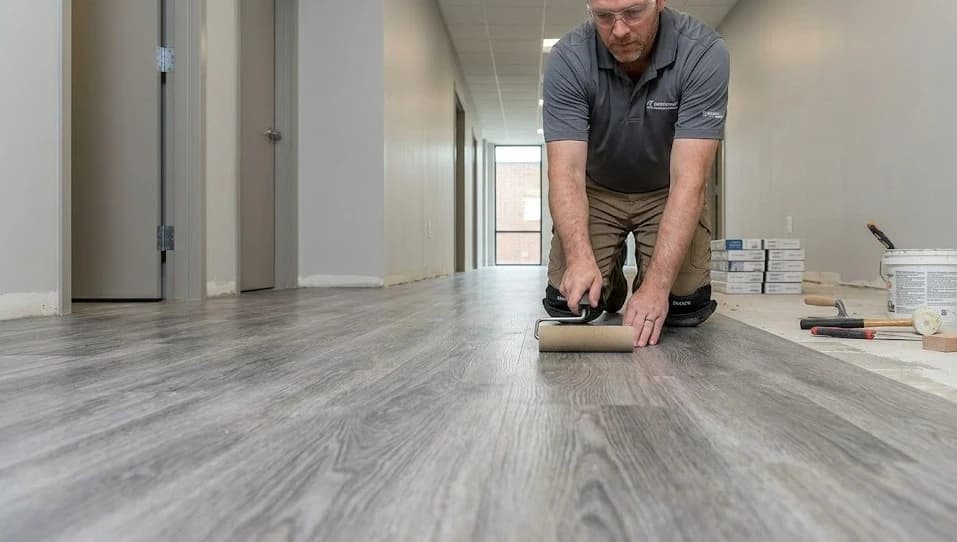
Linoleum, LVP and LVT all belong in the resilient-flooring conversation, but they are not three versions of the same material. That distinction matters. Linoleum is a natural resilient floor traditionally made with linseed oil, wood flour, pine rosin, limestone and pigments. LVP and LVT are vinyl flooring products — and LVP versus LVT is mostly a difference in format and appearance, not a battle between two fundamentally different materials.
After nearly three decades of flooring work across Maryland, Washington, DC and Northern Virginia, our biggest piece of advice is this: don't choose between these floors from a sample board alone. The room, subfloor, moisture exposure, installation method and the quality of the specific product matter as much as the name printed on the box.
The Short Answer · 2020 Flooring · Serving MD, DC & VA Since 1997
Choose LVP for a realistic wood look with strong water resistance and competitive pricing. Choose LVT for essentially the same benefits in a stone, ceramic, concrete or patterned tile appearance. Choose linoleum when natural material content, sustainability, color and comfort matter more than getting the most convincing wood-look floor. In the DMV, plan on roughly $5.50–$12+ / sq ft installed for luxury vinyl and $7–$15+ / sq ft for natural linoleum, depending on format.
One terminology point is worth clearing up immediately. The Resilient Floor Covering Institute describes LVT as luxury vinyl flooring produced in either tile or plank formats. In everyday residential language we call the longer wood-look pieces LVP — luxury vinyl plank — and square or rectangular tile-look products LVT — luxury vinyl tile.
LVP and LVT are close relatives within the same luxury-vinyl family. Linoleum is a different flooring material entirely.
Want a number for your actual room? Resilient flooring is only as good as the surface underneath it, so we price from an on-site look at your subfloor. Get a free linoleum, LVP or LVT quote →
Linoleum, LVP and LVT: Three Cards, Three Jobs
What each material actually is, what it looks like, and the project it belongs on.
Linoleum
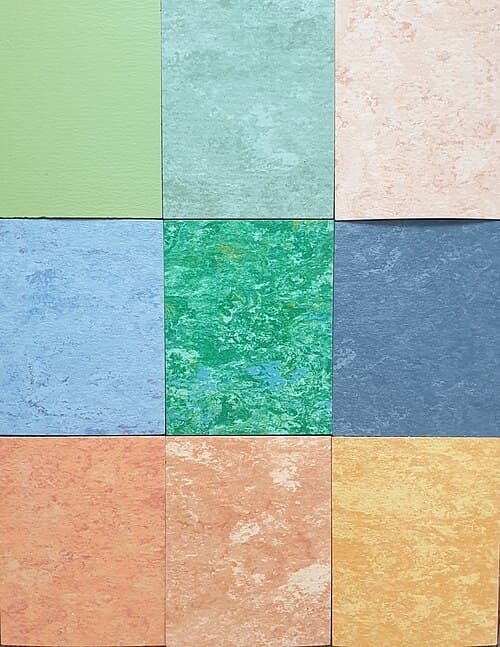
A natural resilient floor made from linseed oil, wood flour, pine rosin, limestone and pigments — not a vinyl product.
- Typical looks
- Marbled, speckled, solid and graphic colors
- Formats
- Sheet, glue-down tile, floating click
- Choose it when
- Natural material content, color-driven design and long service life matter more than a convincing wood look.
LVP
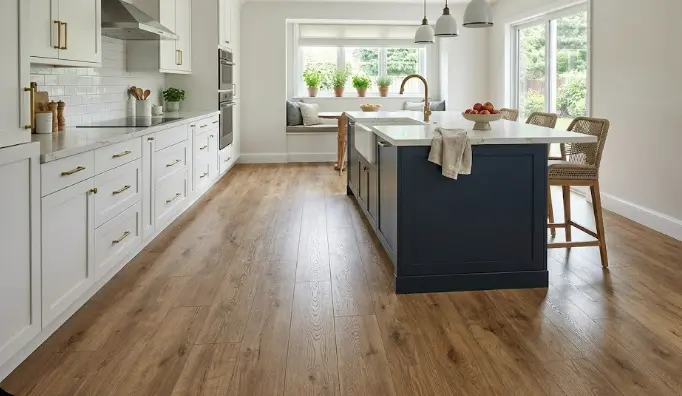
Luxury vinyl manufactured in plank dimensions, usually to reproduce hardwood, often over a rigid SPC or WPC core.
- Typical looks
- Oak, hickory, maple, walnut, wide-plank and reclaimed wood
- Formats
- Click-lock floating or glue-down; rigid or flexible
- Choose it when
- You want a realistic wood look, strong water resistance and competitive pricing.
LVT
The same luxury-vinyl family as LVP, made in tile formats. The difference homeowners notice is the visual, not the material.
- Typical looks
- Marble, limestone, travertine, slate, concrete, encaustic tile
- Formats
- Click-lock or glue-down; groutable and pattern layouts
- Choose it when
- You want stone, ceramic or patterned looks without the hardness and grout upkeep of real tile.
At a Glance
RFCI groups linoleum and luxury vinyl within the broader resilient-flooring category, but describes them separately — the differences below are why.
| Feature | Linoleum | LVP | LVT |
|---|---|---|---|
| Basic material | Natural resilient flooring | Vinyl | Vinyl |
| Typical appearance | Solid, marbled, linear and graphic colors | Primarily wood looks | Stone, ceramic, concrete and patterns |
| Common formats | Sheet, glue-down tile, click tile/plank | Plank; flexible or rigid core | Tile/plank; flexible or rigid core |
| Water performance | Depends heavily on product and installation | Excellent on many modern products | Excellent on many modern products |
| Installation | Glue-down sheet/tile or floating click | Floating click or glue-down | Floating click or glue-down |
| Subfloor prep | Very important | Very important | Very important |
| Design strength | Natural color and pattern | Realistic wood replication | Realistic tile and stone replication |
| Typical DMV installed cost | $7–$15+ / sq ft, depending on format | $5.50–$12+ / sq ft | Usually similar to LVP |
| Best fit | Kitchens, offices, living spaces, sustainability-focused projects | Baths, basements, kitchens, rentals, whole-home floors | Baths, kitchens, commercial areas, tile-look designs |
What Is Linoleum Flooring?
Real linoleum is not old-fashioned sheet vinyl.
Modern natural linoleum is a legitimate high-performance floor, available in sheet goods, modular tiles and — in some product lines — click-together floating formats. Forbo's current Marmoleum products use natural ingredients including linseed oil, pine rosin and wood flour, in sheet, tile and plank formats. That makes linoleum particularly interesting for homeowners who want a resilient floor without choosing a conventional PVC product — the same reason it sits on our eco-friendly flooring menu.
Installer's perspective
Linoleum's weak point usually isn't the material — it's the preparation. Glue-down linoleum, and sheet material especially, shows you exactly how well the substrate was prepared. Ridges, patch edges, fasteners, plywood joints, old adhesive and poorly finished leveling all telegraph through a resilient surface. A beautiful roll of material over a bad substrate still produces a bad floor, which is why professional linoleum estimates look expensive next to the advertised material price: you are largely paying for what happens underneath the floor.
If you are specifically comparing Marmoleum against generic linoleum — formats, colors and DMV installed costs — that comparison has its own guide: Marmoleum vs. linoleum.
What Is LVP Flooring?
Vinyl flooring in plank dimensions, usually built to reproduce hardwood.
Modern luxury vinyl plank combines photographic films, embossed textures, bevels, matte finishes and rigid cores to look considerably more realistic than older generations of vinyl. RFCI defines rigid-core/multilayer flooring as modular flooring using a rigid polymeric core, a decorative surface and, depending on the product, an attached underlayment. Three constructions cover most residential work:
SPC
Stone-polymer rigid cores focused on dimensional stability and indentation resistance.
WPC
Expanded polymer cores that tend to feel somewhat more cushioned underfoot.
Flexible LVP
Thinner vinyl planks glued directly to a properly prepared substrate.
The right construction depends on the room and the job. “Rigid core” isn't automatically better than glue-down vinyl — and if you are weighing LVP against other wood-look options, our laminate vs. LVP guide and carpet vs. LVP guide run the same trade-offs.
What Is LVT Flooring?
Same luxury-vinyl family as LVP — the difference homeowners notice is the design.
From a material standpoint, LVT belongs to the same category as LVP. Where LVP imitates oak, hickory, maple, walnut, reclaimed wood and wide-plank hardwood, LVT imitates marble, limestone, travertine, slate, concrete and ceramic or encaustic-style tile. Some LVT can even be installed with grout or in patterns such as herringbone and checkerboard — Mannington currently offers glue-down luxury vinyl tile designed for pattern layouts and optional grouted installations.
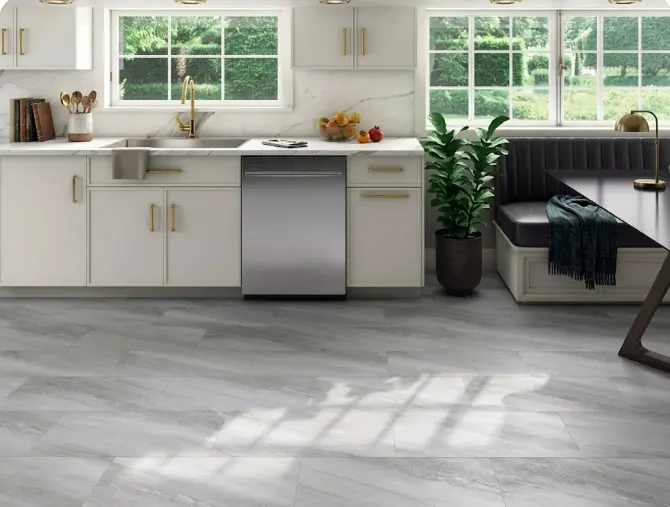
So is LVT better than LVP? Not inherently. If two products have comparable construction, wear surfaces and quality, the LVP-versus-LVT label tells you more about the shape and visual than the performance. Compare the actual specification, not the acronym.
Vinyl vs. Linoleum: How to Tell the Difference
People regularly call an older kitchen or bathroom floor 'linoleum' when it is actually vinyl. Here is how we tell.
Look at the pattern
Modern vinyl uses a printed design layer, which is how LVP and LVT reproduce individual boards, knots, grout joints and marble veining so convincingly. Natural linoleum reads differently — marbling, speckling, solid color, linear patterns and graphic color combinations. It is a clue, not a hard rule.
Look at an exposed edge
Where there is already a safe exposed edge at a doorway, vent or transition, look at the construction. Many luxury vinyl products show several distinct layers or a rigid composite core beneath the decorative surface. Traditional sheet linoleum is built differently and may use a jute-type backing, while click linoleum such as Forbo's CinchLOC mounts the linoleum surface over a waterproof core with a cork backing. Do not damage an unknown older floor just to identify it.
Don't identify flooring by age alone
An old floor is not automatically linoleum. Vinyl has been around for generations too, and “linoleum” became a generic household word for almost any smooth resilient floor — RFCI notes that it actually describes one specific flooring type.
Find the manufacturer if you can
A box, invoice, spec sheet, leftover piece or product stamp settles the question far more reliably than appearance. That matters most when you are deciding whether an existing floor can stay in place beneath a new installation — see our flooring repair and subfloor work for what happens when it cannot.
Linoleum vs. LVP vs. LVT Cost
Real 2026 DMV planning ranges — not national averages that ignore our labor rates and older housing stock.
For most homeowners, LVP and LVT have the lower entry price. Mid-range luxury vinyl installations run around $5.50–$8.50 per square foot installed, while premium, wider-plank and commercial-grade products reach $9–$12+. Natural linoleum tends to start higher once professional installation is included.
| Flooring / installation | Typical DMV installed range |
|---|---|
| Mid-range LVP / LVT | $5.50 – $8.50 / sq ft |
| Premium LVP / LVT | $9 – $12+ / sq ft |
| Click linoleum / Marmoleum | $7 – $11 / sq ft |
| Glue-down linoleum tile | $8 – $13 / sq ft |
| Sheet linoleum | $9 – $15+ / sq ft |
Why can linoleum cost more? Not because the material itself is extraordinarily expensive — the difference is usually labor. Sheet linoleum requires accurate measuring and cutting, adhesive work, careful placement and an exceptionally well-prepared substrate. Glue-down tile also exposes substrate problems that a thicker floating product may visually disguise. Want to sanity-check a quote? Our LVP & LVT cost calculator gives an instant per-room estimate.
What actually moves the number — on either floor
Installer's take: comparing two flooring quotes by material price alone is almost useless. Ask what each contractor has included for preparation.
Pros and Cons
An honest look at where each material earns its keep — and where it does not.
Linoleum pros
- Natural material composition — Its biggest differentiator — made primarily from natural raw materials rather than conventional vinyl construction.
- Excellent color and design potential — Strong when you want color rather than an imitation wood species: mid-century interiors, checkerboards, borders, commercial-style layouts.
- Comfortable resilient surface — Warmer and less hard underfoot than ceramic or porcelain tile.
- Established commercial track record — Generations of history behind it, still manufactured for residential and commercial work.
Linoleum cons
- More specialized installation — Sheet work in particular is not where we would recommend learning flooring installation.
- Unforgiving of subfloor prep — Thin resilient flooring exposes preparation mistakes.
- Water performance is product-specific — Forbo now sells Marmoleum CinchLOC Seal with a waterproof core, so "linoleum can never go in a bathroom" is no longer accurate — but do not assume every product matches it.
- Fewer realistic wood visuals — If the goal is a 7-inch white oak plank look, LVP is the stronger design choice.
LVP / LVT pros
- Excellent water performance — Many rigid-core products are engineered and marketed as waterproof; Mannington’s ADURA Max uses a waterproof WPC core and a locking profile designed to stop fluids passing through plank joints.
- Extremely broad design range — Printing and registered embossing produce very convincing reproductions of both wood and stone.
- Multiple installation systems — Click-lock floating, glue-down, rigid, flexible, tile or plank — adaptable to a wide range of projects.
- Usually more economical — For a typical DMV residential renovation, quality mid-range LVP normally comes in below professionally installed natural linoleum.
LVP / LVT cons
- It is still synthetic vinyl — Homeowners specifically minimizing synthetic materials will prefer linoleum.
- Waterproof does not mean the subfloor stops mattering — A waterproof plank can sit on top of a moisture problem. That does not make the moisture problem disappear.
- Cheap click flooring creates expensive problems — Locking-joint quality, dimensional stability, core construction and manufacturing tolerances all matter.
- Rigid does not mean it can bridge a bad floor — A rigid plank still needs a substrate meeting the manufacturer’s flatness requirements; humps and low spots cause movement, hollow spots and joint stress.
Which Is Best by Room?
The same three materials give three different answers depending on the room.
Bathrooms
For most residential bathrooms, quality waterproof LVP or LVT is our practical first choice of these three: strong water resistance, easy cleaning, no cold ceramic surface, plenty of wood and stone looks, fast installation and simple replacement if a plank or tile is damaged. Mannington currently offers waterproof-core luxury vinyl in both plank and tile formats, which illustrates how little performance difference the LVP/LVT labels necessarily create. Want a wood look? LVP. Want marble, limestone, concrete or ceramic? LVT. See our bathroom flooring service for how we detail these rooms.
Linoleum in a bathroom deserves a more nuanced answer than it used to. Traditional installations demand careful attention to seams, edges, penetrations, substrate moisture and the exact manufacturer's specification — but products such as Marmoleum CinchLOC Seal now use a waterproof core and are marketed for all rooms in the home. So we would not say “never put linoleum in a bathroom.” We would say:
Choose the exact linoleum product for the exact bathroom, and follow its installation details. Don't assume every sheet, tile and click linoleum has identical water performance.
One more installer point: a waterproof finished floor does not turn the bathroom into a waterproof assembly. Plumbing penetrations, toilet leaks, tub overflows, perimeter gaps and water getting below the floor still matter — and when they don't get caught, they become emergency floor repair calls.
Kitchens
Choose linoleum when
You want natural materials, a distinctive color palette, warmth underfoot and a design that does not need to imitate hardwood or stone.
Choose LVP when
You want the visual continuity of wood flooring through the kitchen without putting real hardwood around sinks, dishwashers and refrigerators.
Choose LVT when
You want a tile or stone appearance without the hardness and grout maintenance of conventional tile.
The kitchen is genuinely close — all three can make sense when installed correctly over properly prepared substrate.
Basements
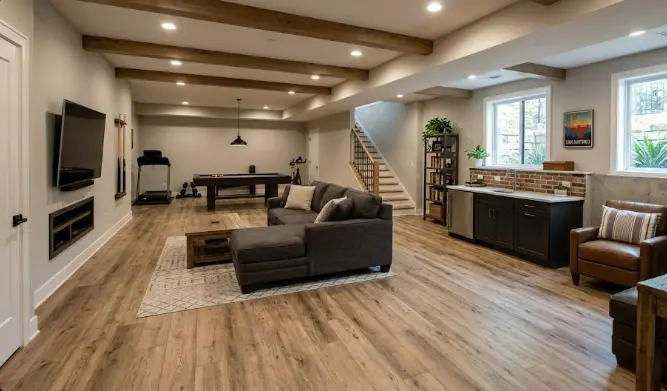
Usually LVP or LVT — but only after evaluating the slab. This is where “waterproof flooring” gets oversold: a waterproof rigid-core floor tolerates water at its surface very well, while DMV basement slabs can present moisture conditions underneath the finished material. Before covering a questionable slab we want to know whether moisture has entered before, whether the slab is flat enough, what the flooring manufacturer requires, whether old adhesive or flooring has to come out, and whether moisture mitigation is necessary. Linoleum works in many applications, but we would not automatically specify it over a basement slab with an unresolved moisture history. More on how we approach basement flooring and waterproof flooring.
Which Is Easier to Repair?
Repairability depends on the installation format, not the material name.
| Format | Repair outlook |
|---|---|
| Glue-down LVT | Individual tiles or planks can often be removed and replaced locally. |
| Floating LVP / LVT | A damaged plank may be replaceable, but the floor sometimes has to be unlocked back from a wall depending on location and product. |
| Linoleum tile | Individual damaged pieces may be replaceable if matching material is still available. |
| Sheet linoleum | Localized repairs are much more specialized — you are working within one continuous sheet. |
Installer's tip
Keep leftover flooring. Colors, textures, dimensions and locking systems change. A box stored after installation can be worth far more five years later than the small amount of space it takes up — and it makes a spot repair invisible instead of obvious.
Why Don't People Use Linoleum Anymore?
Linoleum never disappeared — luxury vinyl simply became the mainstream residential answer.
They do. Manufacturers still produce modern linoleum in sheet, tile and click formats, and RFCI describes the category as experiencing renewed interest thanks to its natural ingredients and environmental properties. What changed was the competition. Luxury vinyl became extremely attractive to residential buyers through highly realistic wood and stone graphics, embossed textures, click-lock installation, waterproof rigid cores, enormous retail availability and a broad price range — RFCI points specifically to advances in printing and embossing as major drivers of LVT's consumer acceptance.
So linoleum is not a floor nobody uses. It became a more specialized choice while luxury vinyl became the mainstream resilient-flooring choice for many residential renovations. Today it makes especially good sense when the homeowner actively values what makes it different, rather than simply looking for the cheapest smooth floor.
Which Is More Eco-Friendly?
If sustainability is driving the decision, the material story is not close.
Natural linoleum has the clearer material story. Modern Marmoleum is manufactured primarily from natural raw materials including linseed oil, wood flour and pine rosin, while luxury vinyl uses polymeric/vinyl construction. That does not mean every vinyl product should be judged identically — certifications help buyers compare products on emissions and other environmental criteria, and RFCI's FloorScore program is an independent indoor-air-quality certification used across resilient hard-surface flooring.
If indoor-air requirements matter to you, look for an actual certification rather than relying on a “low VOC” marketing statement. Our sustainable flooring guide covers where linoleum sits among cork, bamboo and FSC-certified wood on the eco-friendly flooring menu.
Which Floor Is Best Overall?
There is no single winner — there is a winner per priority.
An Installer's Advice Before You Buy Any of Them
Start with the floor you are covering, not the wear layer on the sample board.
We have installed flooring across DC, Maryland and Northern Virginia since 1997, and the expensive surprises normally come from the existing building — not from the flooring carton. Older homes can have multiple flooring layers. Additions can have mismatched floor heights. Condos can have acoustic requirements. Concrete can have moisture issues. Plywood can have seams, movement and previous repairs. And a kitchen that looks perfectly flat from standing height can tell a completely different story once the old flooring comes out.
The floor covering is only the visible part of the installation. The substrate is the job.
Authoritative Sources
Independent and manufacturer references behind the technical distinctions above.
- Resilient Floor Covering Institute (RFCI) — North American resilient-flooring association. Its technical material distinguishes flexible LVT/LVP, rigid-core products, sheet vinyl and linoleum, and explains modern resilient-flooring construction. RFCI
- Forbo Flooring Systems — manufacturer of Marmoleum natural linoleum. Current technical and product information was used to verify linoleum composition, formats and newer waterproof-core click products. Forbo: Marmoleum
- Mannington — U.S. flooring manufacturer. Current ADURA technical and product information was used to verify modern glue-down, rigid-core, plank, tile and waterproof luxury-vinyl configurations. Mannington: Luxury Vinyl
Free On-Site Estimate · MD, DC & Northern Virginia
Get a Linoleum, LVP or LVT Flooring Estimate in the DMV
The best flooring for your project isn't the material with the longest feature list — it's the floor that fits your room, your subfloor, your moisture conditions, your design goals and your budget. 2020 Flooring installs luxury vinyl plank and tile and natural linoleum throughout Maryland, Washington, DC and Northern Virginia — with on-site evaluation and the floor preparation that makes the finished installation last.
Before you decide between linoleum, LVP and LVT, let us look at what's underneath your current floor.
Linoleum, LVP & LVT FAQs
The questions DMV homeowners ask us most when comparing linoleum, LVP and LVT.

Written by
Jason Brown
Flooring Specialist
Jason Brown has 14 years of flooring sales and installation experience across the DC, Maryland, and Virginia area.