The short answer
When should you replace carpet?
Replace carpet when the pile has crushed flat in the traffic lanes, the backing has let go, odour returns after a professional clean, or water sat on it — whatever the carpet looks like, and whatever its age. Nothing in Maryland, DC or Virginia sets a replacement interval for a home you live in. Carpet is a condition decision, and the condition that matters is mostly underneath the part you can see.
If you want a planning number rather than a test: across the DMV homes we carpet, a builder-grade polyester in a busy household is usually finished at five to eight years, a mid-grade nylon or triexta with a decent pad commonly runs ten to fifteen, and wool in a quiet room can still look right past twenty. Stairs and the main hallway reach the end first, normally at around two-thirds the life of the rooms they connect.
The rest of this guide is the detail behind that: the ten signals we use on site, why the cushion decides more jobs than the carpet does, when cleaning or a re-stretch is genuinely the better buy, what the health and moisture evidence actually says, room-by-room calls for DMV houses, our 2026 installed cost ranges, and — because owners ask us constantly — a section on rentals covering who pays for carpet under Maryland, DC and Virginia deposit rules.
Who this is written for
The field test
Ten signs it is time to replace your carpet
When we walk a house, we are not grading the carpet on looks. Looks are what makes somebody call; they are rarely what settles the question. These are the ten things we check, roughly in the order they decide it.
| What we find | Verdict | Why |
|---|---|---|
| Pile is matted flat along the traffic lanes | Replace | Crushed pile does not come back — the fibre has permanently deformed, and cleaning makes it cleaner, not thicker. This is the most common reason a DMV homeowner finally books the job, and it is the clearest sign the carpet has reached the end of its service life rather than needing maintenance. |
| Odour returns a day or two after a professional clean | Replace | The smell is in the pad and often in the subfloor, and no surface clean reaches it. Pet accidents and unreported spills both do this. It is also the signal homeowners most often pay for twice, by cleaning again. |
| Water sat on it for more than a day | Replace | EPA's remediation guidance treats 24–48 hours as the window in which water-damaged carpet and carpet backing should be dried; past that, mold is the working assumption. Carpet can sometimes be saved if it was lifted and dried fast. The pad almost never is. |
| Carpet moves, ripples or feels loose underfoot | Repair first | If the ripples run in lines across a walking path, a power-stretch usually fixes it for a fraction of a replacement. If the carpet feels separated across a whole area, the backing has delaminated and a stretch will not hold. |
| Backing is visible, or the carpet sheds continuously | Replace | Once the face fibre has worn down to the backing there is nothing left to clean, groom or patch. Thinning at a doorway or at the top of a staircase is usually where it shows first. |
| Seams are open or fraying at doorways | Replace | A seam failure at a threshold spreads, and re-seaming an aged carpet puts a crisp join next to worn pile, which reads worse than the original fault. |
| Allergy or asthma symptoms that improve away from home | Replace pad, maybe carpet | Worth taking seriously, and worth a conversation with a doctor rather than a flooring contractor. EPA's asthma guidance identifies carpet as one of the places dust mites live. A dense low-pile carpet with a new pad, HEPA vacuuming, or hard surface in the bedrooms are all reasonable answers — see hypoallergenic carpet. |
| Stains, but the pad is dry and the pile still stands up | Clean first | This is the case where cleaning genuinely wins. Professional hot-water extraction is a small fraction of a replacement, and if it holds, the carpet keeps earning its place. |
| The carpet is the only thing dating the room | Replace | Not a failure, a judgement. Colour and texture date faster than fibre wears out, and in a house you are selling or have just bought, the carpet is frequently the cheapest thing on the list that changes how every other finish reads. |
| You know there is hardwood underneath | Replace pad, maybe carpet | Common in DMV rowhouses, Capitol Hill and older Montgomery County colonials. Before you order carpet, lift a corner: if the boards are sound, refinishing is often the better outcome for the same money or less. |
Notice how many of those are decided underneath the carpet rather than on top of it. That is not a coincidence, and it is the next section.
The thing under the carpet
It is almost always the pad
Carpet is the part you can see, so it is the part that gets judged. In practice the cushion underneath fails first, and the cushion is what decides whether cleaning will hold. Pad is open-cell foam or bonded crumb: it absorbs, it holds, and it does not release. A spill that looks like a twelve-inch mark on the surface is frequently a two-foot stain on the underside of the carpet and a damp patch on the subfloor below that.
This is why the most expensive mistake in a carpet decision is booking a cleaner before lifting a corner. The clean does what cleans do — it lifts what is in the face fibre — and anything sitting in the cushion wicks back up over the following week. Now you have paid for the clean and the replacement.
The two-minute check that settles it
- Pick an inconspicuous corner — a closet, or behind a door — and pull the carpet off the tack strip with pliers. It goes back down afterwards.
- Look at the underside of the carpet, not the top. Staining there is much larger than the surface mark, and that difference is the real extent of the problem.
- Press the pad. If it is stained, crumbly, or compressed and does not spring back, it is finished regardless of what the carpet looks like.
- Look at the subfloor. Dark rings on plywood or a tide mark on a slab means the contamination went all the way through, and the subfloor needs cleaning and sealing before any new floor goes down.
The one that comes back
Where contamination or water has reached the structure, that is a subfloor job rather than a carpet job. We cover it under flooring repair, and events with standing water under emergency floor repair.
How long it lasts
How long carpet actually lasts in a DMV home
There is no published standard for this, and anyone quoting you a single number for “how often you should replace carpet” is averaging over a spread far wider than the average is useful. What we can give you is what we see when we pull carpet out of DMV houses — which is the same data, gathered the hard way.
| Carpet and where it is | What we see | Note |
|---|---|---|
| Builder-grade polyester or olefin, busy household | 5–8 years | What comes in most new construction and most flips. Crushes early in the traffic lanes. |
| Mid-grade nylon or triexta, upgraded pad | 10–15 years | The specification most homeowners settle on once they have replaced carpet once. |
| Wool or premium goods, lightly used rooms | 15–25 years | Recovers from crushing better than anything else, and is the slowest to date visually. |
| Stairs and the main hallway, any grade | 60–70% of the rest | Concentrated traffic and grit. Stairs are usually the first thing in the house to fail. |
| Below-grade basement over slab | Shortest of all | DMV humidity plus a slab. One water event usually ends it. |
What moves the number in practice
- Pad quality, more than carpet quality. A good cushion under a mid-grade carpet outlasts a cheap cushion under a good one. Pad is the cheapest place to buy years, and the most commonly value-engineered out of a quote.
- Fibre. Nylon recovers from crushing; polyester and olefin recover poorly. That is why the traffic lane in a builder-grade carpet can look ten years old at four.
- Grit at the door. Street grit cuts fibre at its base. Units and houses without a hard-surface entry pull it straight onto the carpet, and no vacuum gets it all back out.
- Pets. One accident history can end a carpet in a single year, and the damage is in the pad and subfloor rather than the pile.
- Vacuuming, genuinely. Soil left in the pile is abrasive; the fibre wears against it every time somebody walks across the room. EPA's asthma guidance recommends a HEPA-filter vacuum on carpet and fabric furniture, which is good for the carpet as well as the air.
- Humidity and below-grade rooms. See the DMV section — this is the local variable that surprises people moving here.
Keep the installation invoice
The money question
Clean it, repair it, or replace it?
Most people arrive at this guide holding this question rather than the previous one, and the good news is that it has a short answer: clean when it is dirty, repair when it is loose, replace when it is worn. Dirt, looseness and wear are three different failures, and spending on the wrong one is the single most common way to waste money on a floor.
| What the corner shows | What to do | Relative spend |
|---|---|---|
| Soiled, but pile stands up and pad is dry | Professional hot-water extraction | Lowest |
| Ripples in defined lines across a walkway | Power-stretch and re-fit | Low |
| One damaged area, matching offcut in the attic | Patch or bonded insert repair | Low |
| Sound carpet, flattened or crumbling pad | Lift carpet, replace pad, re-fit | Medium |
| Crushed pile, visible backing, open seams | Replace carpet and pad | Full |
| Odour returning after cleaning | Replace carpet and pad, seal subfloor | Full plus subfloor |
| Repeat water in the same room | Change material, not just the carpet | Full, different floor |
Three things worth knowing before you spend
- Cleaning cannot restore pile. It restores colour and removes soil. If the fibre has deformed, a clean produces a cleaner flat carpet — which usually reads as a disappointment, because the room still looks tired.
- A re-stretch is a real repair, not a stopgap — provided the backing is intact. Carpet relaxes off its tack strip over years, particularly where it was originally fitted without a power stretcher, and re-stretching it is a legitimate way to buy another five years.
- Patching works, and only with matching material. If an offcut from the original installation is in the basement or the attic, a bonded insert in a damaged area is nearly invisible. Without one, dye lots never match — and that is also why replacing one room at a time next to an older carpet never looks right.
Two rooms, one mobilisation
Air, allergens and moisture
Allergies, asthma, mold — what the evidence actually says
This is the part of the question where we are careful, because it is the part where flooring companies habitually overclaim in both directions. Carpet is neither a health hazard nor an air filter. What the federal guidance supports is narrower and more useful than either slogan.
Dust mites and allergens
EPA's Asthma Triggers: Gain Control identifies dust mites as living in bedding, pillows, carpets and upholstered furniture, and notes that their body parts and droppings can trigger asthma in people who are allergic to them. Its practical recommendations are to vacuum carpet and fabric-covered furniture with a HEPA-filter vacuum, and for the person with asthma or allergies to leave the room while it is being vacuumed. That is a maintenance instruction, not a verdict on carpet — but if someone in the house has asthma and the carpet is old, worn and has not been deep-cleaned in years, replacement is a reasonable part of the answer. Our guide to hypoallergenic carpet covers what to specify if you are staying with carpet, and eco-friendly flooring covers the low-emission hard-surface options.
Mold, and the 24–48 hour rule
This is the firmest guidance on the page, and the one most likely to save you money. EPA's mold remediation guidance sets out a water-damage response table built around acting within 24 to 48 hours, and carpet and carpet backing appear in it: remove the water with a wet vacuum, lift the carpet and pad off the floor, move air across them with fans, and bring the room's humidity down with a dehumidifier. EPA's homeowner guide, A Brief Guide to Mold, Moisture and Your Home, makes the companion points: dry wet materials quickly, keep indoor humidity down, and accept that porous, absorbent materials — carpet and pad among them — may have to be discarded if they become mouldy, because mold cannot be reliably cleaned out of them.
What that means in a practical decision
Water on carpet is a clock, not a condition. Inside roughly a day, a lifted and properly dried carpet often survives and the pad sometimes does. Past two days — and in a DMV August, sooner — the working assumption is that the pad is a loss and the carpet probably is. Clean water from a supply line is a better story than water from a drain, a sewer backup or a flood, which is a replacement conversation from the start.
If a floor is wet right now, that is emergency floor repair and the timing matters more than the choice of carpet.
New carpet and indoor air
A new carpet, its adhesive and its cushion can have a noticeable smell for the first few days. Our practice is to ventilate during installation and for several days afterwards, run the HVAC fan, and to schedule bedrooms so that nobody sensitive sleeps in a freshly-carpeted room the first night. If this matters in your household, ask us for goods carrying a recognised low-emission certification and we will specify accordingly.
Local conditions
Why DMV homes are harder on carpet than the brochure assumes
Carpet life expectancy figures are national, and the DMV is not an average climate for soft flooring. Five local conditions shorten carpet life here, and all five are worth knowing before you spend money on the same specification twice.
- Summer humidity. Dew points sit in the seventies for weeks between June and September. That is what makes old pet contamination re-activate, what keeps a damp pad damp, and what turns a minor spill in July into a problem a January spill never becomes.
- Below-grade living space. Finished basements are normal in Maryland and Northern Virginia, and a slab moves moisture upward whether or not anything has leaked. It is the single shortest-lived place to put carpet in the region — see basement flooring.
- Spring pollen. The tree-pollen season here is heavy and long, and it arrives indoors on shoes and through open windows. It lands in the pile, and it is one more argument for a hard-surface entry.
- Winter grit and salt. Treated sidewalks and driveways put abrasive and hygroscopic material directly onto the carpet at the door. Salt also leaves white blooming that cleans out poorly.
- Rowhouse and condo realities. In DC rowhouses and older condos there is frequently hardwood under the carpet, which changes the decision entirely; and in condos and co-ops, swapping carpet for hard surface is usually the association's business too, with acoustic underlayment requirements and approval processes that need checking before anything is ordered.
We work across Bethesda, Rockville, Silver Spring, Potomac, Chevy Chase and Gaithersburg, and across the line into Washington DC, Arlington and the rest of Northern Virginia — and the conditions above are why the same carpet gets a different recommendation in a Potomac basement than in a Capitol Hill bedroom.
Where carpet still wins
Room by room: keep carpet, or change material?
When carpet comes out, the question stops being when and becomes what. We will not re-run the whole product comparison here — that is the job of our carpet vs. LVP, carpet vs. hardwood and carpet vs. LVT guides. This is just the call we make, room by room, in a DMV house.
| Room | Our call | Why |
|---|---|---|
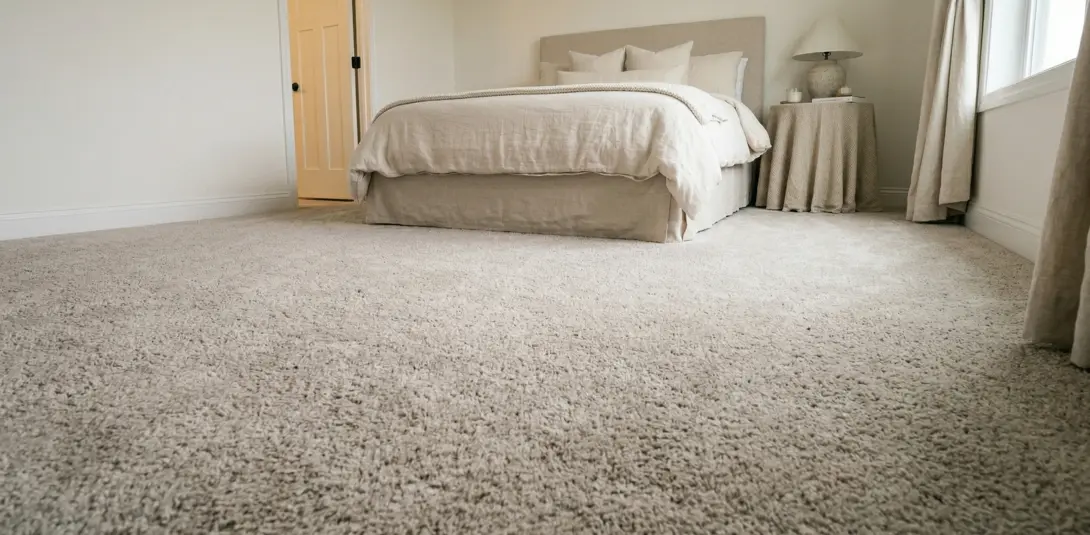
| Bedrooms | Keep carpet | Softness and quiet where it is wanted, and the lightest traffic in the house. This is the room carpet is still unambiguously the right answer in, and the room most DMV homeowners keep carpeted even when everything else goes hard. |
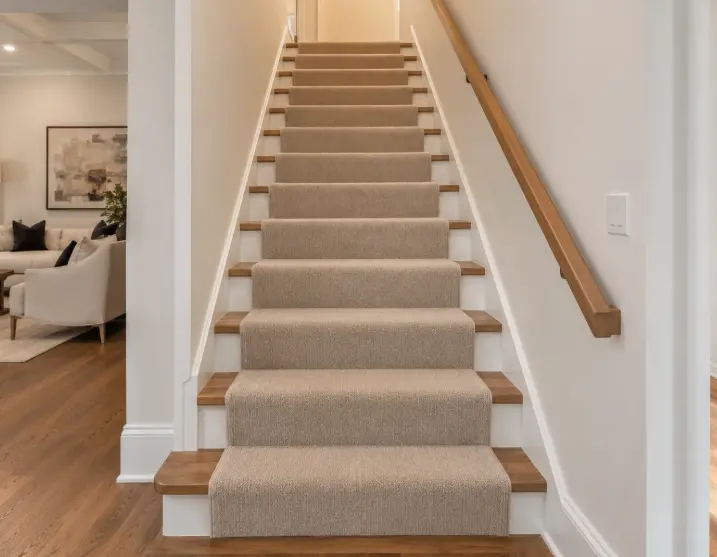
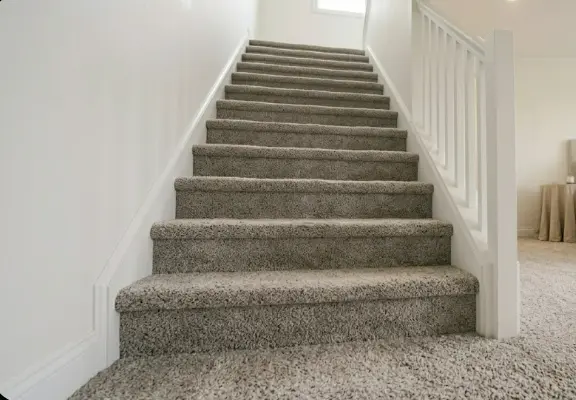
| Stairs | Usually carpet | Grip, noise and the feel underfoot all favour carpet on a staircase, and it wears fastest there — budget for stairs to be replaced before the rooms they connect. See best carpet for stairs and waterfall vs. Hollywood. |
| Entry and main hallway | Hard surface | Street grit cuts fibre at its base, which is why hall carpet looks a decade older than the bedroom carpet installed the same day. A hard entry protects every carpet behind it. |
| Living and family rooms | Either, with a pad decision | Both work. If you keep carpet, put the extra money in the cushion rather than the face fibre. If you are weighing the switch, our carpet vs. hardwood and carpet vs. LVP guides run the comparison properly. |
| Basements | Waterproof hard surface | A below-grade slab plus DMV summer humidity is the hardest environment carpet faces here. See waterproof basement flooring. |
| Kitchens and bathrooms | Never carpet | Standing water is routine in both rooms, and carpet has no recovery path from it. If there is carpet in a DMV bathroom today, it is almost certainly a 1970s hangover. |
| Homes with pets | Hard surface in the wet rooms | One accident history can end a carpet in a single year, and the damage is in the pad and subfloor rather than the pile. Keeping carpet in bedrooms only is the compromise that works. |
The pattern most DMV homeowners end up at is the split: luxury vinyl plank or wood through the entry, hall, kitchen and living areas, carpet kept in the bedrooms and on the stairs. It is not a compromise so much as putting each material where it is actually good.
Budget
What carpet replacement costs in the DMV in 2026
Installed ranges we are quoting across DC, Maryland and Northern Virginia, materials and labour together. Every house prices on its own measure — stairs, closets, transitions, furniture, upper-floor access and disposal all move the number — so treat these as planning figures rather than a quote.
| Item | Installed range | Note |
|---|---|---|
| Builder-grade carpet, supplied and installed | $3.50 – $5.50 / sq ft | Includes a standard 6–8 lb pad, tack strip and basic tear-out. |
| Mid-grade nylon or triexta with upgraded pad | $5.00 – $8.00 / sq ft | Where most homeowners land the second time they buy carpet. |
| Wool and premium goods | $9.00 – $16.00 / sq ft | Longest service life and the slowest to look dated. |
| Carpet on stairs | $25 – $55 / step | Priced per tread. Waterfall is cheaper than upholstered; stairs always price separately. |
| Old carpet removal and disposal | $0.50 – $1.25 / sq ft | Higher for glued-down carpet, walk-ups, or contaminated material. |
| Pad replacement only | $0.75 – $1.75 / sq ft | Viable only where the face carpet is genuinely sound. Lift a corner first. |
| Power-stretch and re-fit, per room | $150 – $400 | Fixes ripples. Does not fix a delaminated backing. |
| Subfloor cleaning and sealing after pet contamination | $0.50 – $1.50 / sq ft | Skipping this is why odour comes back through a brand-new floor. |
| Luxury vinyl plank, supplied and installed | $5.50 – $9.00 / sq ft | Higher up front, materially longer service life in wet and high-traffic rooms. |
For a typical DMV house that puts a three-bedroom upper floor somewhere in the low-to-mid four figures in carpet, with a staircase adding several hundred dollars on its own. The number worth deciding on is not the single job price but the cost per year of service: spending 30% more on a better cushion and a nylon face commonly doubles the time before you do this again.
Two line items people try to cut, and should not: the cushion, and removal and disposal of the old carpet. The first is where the years come from. The second is the one you cannot usefully do yourself in a third-floor condo with an elevator reservation and a dumpster rule. If several floors are coming out at once, see floor removal.
Scheduling
Timing the job, and what the day looks like
Carpet is not seasonally sensitive the way hardwood is — there is no humidity window it has to go down in. What is seasonal is us: late spring through summer is the busiest stretch of the year, and the weeks before Thanksgiving book out early. If you want carpet down before guests arrive or before a house goes on the market, the measure should happen a month earlier than feels necessary.
A workable sequence
- Measure early. A measure takes under an hour and does not need the room empty, so there is no reason to wait for the rest of the project.
- Lift a corner before you choose a direction. This is where you find out whether you are buying carpet, a pad, or a hardwood refinish.
- Paint first, carpet after. Always. Trim paint gets touched up when tack strip comes out, and no new carpet should be under a paintbrush.
- Order with lead time in hand. Stocked goods are quick; a specific colour or a special order is not. Ask for the lead time before you commit to a date that matters.
- Plan the furniture. Rooms need to be clear. We move furniture as part of the job where that is agreed in advance — it is worth saying so at quote stage rather than on the morning.
- Pre-1978 house? Pulling tack strip and shoe moulding disturbs painted trim. EPA's Renovation, Repair and Painting rule requires firms paid to do work that disturbs painted surfaces in pre-1978 housing to be certified and to use lead-safe work practices; Maryland adds its own contractor requirements, summarised in the MHIC's lead paint FAQs. Raise the house's age at quote stage.
- Older than 1985? Resilient tile and black cutback adhesive under the carpet can contain asbestos, and it gets tested before anyone disturbs it. Our Maryland permit and licensing guide covers that, plus why finish-flooring replacement needs no building permit and why hard-surface installation still needs an MHIC-licensed contractor.
How long it takes
If you rent the property out
For landlords: who actually pays for the carpet
Everything above applies to a rental unchanged — the signals, the pad, the cost ranges. What changes in a tenancy is that somebody has to pay, and that question is governed by law rather than by condition. This section is the short, accurate version for owners and property managers in the DMV. If you are deciding what to put down rather than when, our landlord's guide to the best flooring for rental properties is the companion piece.
Read first — this is not legal advice
2020 Flooring is a flooring contractor, not a law firm. What follows is a plain-language summary of published law and government guidance, with every source linked so you can read the original yourself. It is general information about how the rules are written — not advice about your lease, your unit or your dispute. Before you withhold a deposit or dispute a charge, read the current statutory text, check what your county or city adds on top, and speak to an attorney. This page was written in November 2026.
No jurisdiction sets a replacement interval
Not Maryland, not the District, not Virginia. What the statutes do instead is divide the cost. Under Md. Code, Real Property § 8-203(f)(1)(i) a deposit may be withheld for unpaid rent, breach of lease, or damage by the tenant or their family, guests or invitees in excess of ordinary wear and tear; and § 8-203(f)(2) adds that the deposit is not liquidated damages and may be kept only to the extent the landlord is actually damaged. Virginia's Va. Code § 55.1-1226 allows deductions for damages but expressly less reasonable wear and tear. So carpet that has simply worn out is an owner cost everywhere in the DMV.
The Maryland People's Law Library describes ordinary wear and tear as deterioration from normal use, and says damage caused by a tenant's negligence, abuse, misuse or accidents does not qualify. Montgomery County's Landlord-Tenant Commission puts it as deterioration occurring without negligence, carelessness or abuse by the tenant or their household. Note what the test turns on: conduct, not condition. How bad the carpet looks is not the question.
The county figure everybody quotes: seven years
For a working number, Montgomery County DHCA's booklet What Is Ordinary Wear and Tear? puts the average life expectancy of carpeting in a rental unit at seven years, against fifteen for vinyl sheet or tile and 100+ for marble, ceramic, porcelain, pine or oak. Two caveats before anyone quotes it at anyone: it is county guidance, not law, and the booklet itself says actual useful life may be longer or shorter and that the landlord must be able to justify any charge.
The same booklet carries the wear-versus-damage chart local investigators work from. On flooring, it puts “carpeting slightly worn or faded by the sun” and “a rug worn thin by ordinary use” in the wear column, and “torn, stained or burned carpeting” and “stains and odors in rug caused by pets, spills or leaks” in the damage column — which is the county agreeing with what we find under the carpet.
Even real damage is charged at depreciated value
Montgomery County's method is straight-line depreciation on remaining useful life, and its own worked example for carpeting is the most consequential arithmetic in the booklet.
| Cost of new carpeting | $1,000 |
|---|---|
| Life expectancy of carpeting | 7 years |
| Age of carpeting at end of tenancy | 7 years |
| Remaining life (7 − 7) | 0 years |
| Remaining value (0 ÷ 7) | 0% |
| Tenant responsibility ($1,000 × 0%) | $0 |
Read the last line again: a seven-year-old carpet has zero remaining value on that chart, so tenant responsibility is zero — however bad the condition. It cuts the other way too: a carpet installed last year and destroyed this year sits at roughly six-sevenths of its value, which is a larger number than most tenants expect.
The deadlines, by jurisdiction
Carpet is rarely what loses a deposit case. Paperwork is. Each jurisdiction attaches consequences to missing its own clock, and they are not the same clock.
| Where | What the rule requires |
|---|---|
| Maryland | Deposit and interest back within 45 days of the end of the tenancy, less anything rightfully withheld (§ 8-203(e)(1)). If anything is withheld, a written list of damages plus an itemized statement of costs within the same 45 days, by first-class mail to the last known address (§ 8-203(g)(1)) — missing that forfeits the right to withhold for damages (§ 8-203(g)(2)). Supporting documentation is required with the statement, and an estimate may be used (§ 8-203(j)); if an estimate was used, the final invoice and any refund of the excess follow within 30 days of completion (§ 8-203(k)). Withholding without a reasonable basis exposes the landlord to up to threefold the amount plus attorney's fees (§ 8-203(e)(4)), and none of the section can be waived in a lease (§ 8-203(l)). |
| Washington DC | A two-step clock under D.C. Code § 42-3502.17 and its implementing rules at 14 DCMR §§ 308–311: within 45 days of the end of the tenancy the housing provider must either return the deposit with interest or give written notice of an intent to withhold, and where it withholds, the itemized statement and any balance follow within 30 days of that notice. Read the regulation text itself — published summaries of the DC timing disagree with each other more than for any other DMV jurisdiction. |
| Virginia | Va. Code § 55.1-1226 requires the deposit back with a written itemization of deductions within 45 days of the later of the termination date or the date the tenant vacates. Permitted deductions are unpaid rent, damages less reasonable wear and tear, other charges the rental agreement provides for, and actual damages for breach. |
The trap that is not about carpet at all
What a defensible carpet deduction has behind it
- Dated move-in photographs or a signed condition report showing the carpet at day one.
- The original installation invoice, which is what establishes the carpet's age.
- Dated move-out photographs of the specific damage, from the same angles.
- A written quote or paid invoice for the replacement, as supporting documentation.
- The depreciation calculation shown, not just the net figure.
- Everything sent inside the jurisdiction's deadline, to the right address.
The thing we are asked for most, and cannot give
Pre-1978 rentals: the obligation that lands on the same day
Maryland's Reduction of Lead Risk in Housing law applies to all rental properties built before 1978. MDE's guidance for rental property owners sets out the obligations, including registration and a new lead inspection certificate at each change of occupancy. Pulling carpet usually means removing tack strip and disturbing painted baseboard and casings, so the floor work and the inspection have to be sequenced deliberately rather than discovered on install day — and the federal RRP rule applies to the contractor doing the disturbing. Confirm the correct order with MDE or your lead inspector; we are flooring contractors, not accredited lead inspectors.
For turnovers we schedule as a block across a portfolio, which is usually the difference between a unit relet on time and a unit sitting another fortnight. For common areas and multi-unit buildings, commercial carpet tile changes the calculation again, because a damaged area is replaced tile by tile rather than room by room.
Take this with you
The decision checklist
- Corner lifted in a closet — underside of the carpet and the pad inspected, not just the pile
- Pad pressed: does it spring back, or is it flat, stained or crumbling?
- Subfloor checked for rings, tide marks or odour
- Ripples assessed: defined lines across a walkway (re-stretch) or loose across an area (replace)
- Any water event in the last two years identified, with how long it sat
- Odour tested a week after any cleaning, not the day after
- Checked whether there is hardwood underneath before ordering carpet
- Traffic lanes and stairs budgeted to fail before the bedrooms
- Cushion specified deliberately — the cheapest place to buy extra years
- Rooms within a year of finished grouped into one visit, one dye lot
- Pre-1978 house flagged to the contractor before install day
- Condo or co-op: association rules and underlayment requirements obtained before ordering
- Rental: installation invoice on file, dated move-in photos, deposit paperwork checked
Bottom line
Bottom line
Replace carpet when the pile has crushed, the backing has let go, odour returns after cleaning, or water has sat on it. Age is a clue and not a rule: no DMV jurisdiction sets an interval for a house you live in, and the honest ranges — five to eight years for builder-grade goods, ten to fifteen for a mid-grade nylon with a good cushion, longer for wool — are wide because the cushion, the fibre, the grit at the door and the humidity in the room matter more than the calendar.
The practical advice is dull and it works. Lift a corner before you book a cleaner. Put the money in the pad. Keep the installation invoice. Do adjacent rooms in one visit. Protect the carpet with a hard-surface entry. And when the carpet in the wet and high-traffic parts of the house has failed for the second time, that is the house telling you it wants luxury vinyl plank or wood there and carpet in the bedrooms.
References
Sources
- U.S. EPA — Mold Remediation in Schools and Commercial Buildings, Chapter 4 and Table 1 (water damage response within 24–48 hours, including carpet and carpet backing)
- U.S. EPA — A Brief Guide to Mold, Moisture and Your Home (EPA 402-K-02-003): drying time, porous materials, and indoor humidity
- U.S. EPA — Asthma Triggers: Gain Control (dust mites, carpet and vacuuming)
- U.S. EPA — Renovation, Repair and Painting (RRP) Program: certified firms and lead-safe work practices in pre-1978 housing
- Maryland Department of Labor, Maryland Home Improvement Commission — Lead Paint FAQs for contractors
- Md. Code, Real Property § 8-203 — Security deposits (full statutory text, Maryland General Assembly)
- Maryland People’s Law Library (Thurgood Marshall State Law Library) — Ordinary Wear and Tear
- Office of the Maryland Attorney General, Consumer Protection Division — Landlords and Tenants: Tips on Avoiding Disputes
- Montgomery County DHCA, Office of Landlord-Tenant Affairs — What Is Ordinary Wear and Tear? (© October 2021; life-expectancy chart at pp. 11–14, tenant-responsibility calculations at pp. 15–16)
- Va. Code § 55.1-1226 — Security deposits (Virginia Residential Landlord and Tenant Act), Virginia Legislative Information System
- D.C. Code § 42-3502.17 — Security deposits (Council of the District of Columbia); the implementing rules are 14 DCMR §§ 308–311
- Maryland Department of the Environment — Lead Poisoning Prevention: Information for Rental Property Owners
Disclaimer
This guide summarises federal agency guidance and DMV statutory text as of November 2026 and is not legal or medical advice. 2020 Flooring is a flooring contractor. Statutes are amended and counties and municipalities add their own requirements, so verify every legal point against the primary sources above before acting on it and consult an attorney about your own lease or dispute; if someone in the household has asthma or allergies, talk to their doctor rather than a flooring company. The life-expectancy figure and the worked depreciation example are transcribed from the Montgomery County DHCA booklet What Is Ordinary Wear and Tear? (© October 2021): they are county guidance, not statute, they are not binding on a court, and outside Montgomery County your jurisdiction may publish different figures or none. The lifespan ranges and cost figures are our own installed experience and 2026 DMV pricing — planning estimates, not published standards and not quotations.
Good questions
Carpet Replacement FAQs
How often should you replace carpet in a house?
There is no rule, and no code or standard in Maryland, DC or Virginia sets an interval for an owner-occupied home — it is a condition decision, not a calendar one. Across the homes we carpet in the DMV, builder-grade polyester and olefin in a busy household is usually finished somewhere between five and eight years; a mid-grade nylon or triexta with a decent pad commonly runs ten to fifteen; and wool in a lightly used room can still look right at twenty or more. Replace it when the pile has crushed flat in the traffic lanes, the backing has let go, odour comes back after cleaning, or the pad has been wet. Those four signs decide almost every job we do.
What are the signs you need new carpet?
Matted, flattened pile in the walking lanes that does not lift after cleaning; ripples or movement underfoot; odour that returns within a few days of a professional clean; visible backing or shedding fibre; open seams at doorways; stains that have gone through to the pad; and any area where water sat for more than a day or two. Looks alone are a weak signal — a carpet can look tired and still have years in it, and it can look acceptable while the pad underneath is finished.
Is it better to clean carpet or replace it?
Clean first when the pile still stands up, the backing is sound and the pad is dry — professional hot-water extraction costs a fraction of a replacement and often buys two or three more years. Replace when the pile is crushed rather than dirty, when the carpet moves underfoot, or when odour returns after a clean, because that means the contamination is in the pad where no surface clean can reach it. The two-minute test is to lift a corner in a closet and look at the underside of the carpet and the pad, not the top of the pile.
How long does carpet last in a basement?
Less than anywhere else in a DMV house, and often much less. A below-grade slab moves moisture upward year-round, and our summers add dew points in the seventies for weeks at a time. EPA’s homeowner mold guide makes the general point that keeping indoor relative humidity down and drying wet materials quickly is what prevents mold, and EPA’s remediation guidance treats 24 to 48 hours as the window in which water-damaged carpet and carpet backing should be dried. A basement carpet that has been wet once is usually a replacement, and a basement that has been wet twice is usually an argument for a waterproof hard surface instead.
Does old carpet affect allergies or air quality?
It can, and the mechanism is dust mites and trapped allergens rather than the carpet fibre itself. EPA’s asthma guidance notes that dust mites live in carpets, bedding and upholstered furniture, and that their body parts and droppings can trigger asthma in people allergic to them; it recommends vacuuming carpet and fabric furniture with a HEPA-filter vacuum and having the person with asthma or allergies leave the room while it is being vacuumed. Separately, EPA’s mold guide is clear that porous, absorbent materials — carpet and carpet pad among them — may have to be discarded if they become mouldy, because mold cannot be reliably cleaned out of them.
How much does it cost to replace carpet in Maryland, DC or Northern Virginia?
Supplied and installed in 2026, we are quoting roughly $3.50 to $5.50 per square foot for builder-grade carpet with a standard pad, $5.00 to $8.00 for a mid-grade nylon or triexta with an upgraded pad, and $9.00 to $16.00 for wool and premium goods. Stairs price separately at about $25 to $55 per step. Removing and disposing of the old carpet runs $0.50 to $1.25 per square foot. Every house prices on its own measure — closets, transitions, stair count, furniture and upper-floor access all move the number — so treat those as planning figures rather than a quote.
Can carpet be stretched instead of replaced?
Yes, when the ripples are the only problem. Carpet that has relaxed off its tack strip can be power-stretched and re-fitted, which is a fraction of the cost of replacing it. What a re-stretch cannot fix is delamination — when the backing itself has failed, the carpet will ripple again within a season. The test is whether the ripples run in defined lines across a traffic path, which usually re-stretches, or whether the carpet feels loose and separated across a whole area, which usually does not.
Should I replace carpet before selling my house in the DMV?
Usually yes where the carpet is visibly finished, and usually in a neutral mid-grade rather than a premium one. Worn carpet is one of the few things a buyer prices immediately and generously against you, and the fix is cheap relative to the deduction. The judgement call is whether to carpet at all: in DMV rowhouses and older colonials where there is hardwood under the carpet, refinishing the wood often reads better to buyers than new carpet over it, and it is worth having someone lift a corner before you order anything.
What time of year is best to replace carpet?
Spring and autumn are the easiest windows in the DMV, mostly for scheduling rather than for the carpet itself: late spring through summer is when we are busiest, and the weeks before Thanksgiving book out early every year. Carpet is not moisture-sensitive the way hardwood is, so there is no seasonal restriction on installing it, but the house should be at normal living temperature and humidity when it goes down and for a few days afterwards.
How often does a landlord have to replace carpet in Maryland?
Maryland law sets no replacement interval — no section of the Real Property Article says carpet must be replaced on a schedule. What the law decides is who pays: a tenant cannot be charged for ordinary wear and tear (Real Property § 8-203(f)(1)(i)), so carpet that has simply worn out is the owner’s cost. For a working number, Montgomery County’s Office of Landlord-Tenant Affairs puts the average life expectancy of carpeting in a rental unit at seven years in its booklet What Is Ordinary Wear and Tear? That is county guidance rather than law, and the booklet notes that actual useful life may be longer or shorter and that a landlord must be able to justify any charge.
Can a landlord charge a tenant for carpet replacement?
Only for damage beyond ordinary wear and tear, and only for the value actually lost. In Maryland, § 8-203(f)(1)(i) allows a deposit to be withheld for unpaid rent, breach of lease, or tenant damage in excess of ordinary wear and tear, and § 8-203(f)(2) adds that the deposit is not liquidated damages and may be kept only to the extent the landlord is actually damaged. Virginia’s § 55.1-1226 likewise allows deductions for damages but excludes reasonable wear and tear. Those provisions are why an owner generally cannot bill a departing tenant for a brand-new carpet when the old one was already part-way through its useful life.
How is carpet depreciation calculated for a security deposit deduction?
By straight-line depreciation on remaining useful life. Take the carpet’s life expectancy, subtract its age at move-out to get the remaining life, divide that by the life expectancy for the remaining percentage value, and apply that percentage to the replacement cost. Montgomery County’s own worked example uses $1,000 of new carpeting, a seven-year life expectancy and a carpet seven years old at the end of the tenancy: remaining life is zero, remaining value is 0%, and the tenant’s responsibility is $0. The county also specifies that depreciated values are based on replacement cost, not original cost.
Do you need a permit to replace carpet?
No. Replacing finish flooring is not permit work in DMV jurisdictions when no structural change is involved. Two separate obligations can still attach: in a pre-1978 home, EPA’s Renovation, Repair and Painting rule requires firms paid to perform work that disturbs painted surfaces to be certified and to follow lead-safe work practices, and pulling tack strip can disturb painted baseboard; and hard-surface flooring installation in Maryland is home improvement work requiring an MHIC-licensed contractor.
Keep reading
Related guides
- Carpet vs. LVP and carpet vs. hardwood — the product comparisons in full, once you have decided the when.
- Best carpet for stairs and waterfall vs. Hollywood stair carpet — stairs wear and price differently from rooms.
- Hypoallergenic carpet — what to specify when allergies are driving the decision.
- Best waterproof flooring for a basement — the hardest room in a DMV house for carpet.
- Best flooring for rental properties in DC, Maryland & Virginia — the landlord's companion to the rentals section above.
- Do you need a permit to replace flooring in Maryland? — permits, MHIC licensing, asbestos and lead.
- Tipping floor installers in the DMV — the question we get asked most on install day.
Not sure whether your carpet is finished? We will lift a corner and tell you straight.
We have been installing and removing carpet across DC, Maryland and Northern Virginia since 1997, from our showroom at 5550-F Nicholson Lane in North Bethesda. We will check the pad and subfloor, tell you whether a clean or a re-stretch is the better buy, and give you a written measure and quote either way. Request a free estimate or call (301) 881-1115.

Written by
Jason Brown
Flooring Specialist
Jason Brown has 14 years of flooring sales and installation experience across the DC, Maryland, and Virginia area.