
The short answer
Carpet is cheaper to install; LVT is cheaper to own. Choose luxury vinyl tile anywhere water, wheels or grit reach the floor — kitchens, basements, bathrooms, corridors, reception areas and break rooms. Choose carpet where comfort and quiet matter more than cleanability — bedrooms, conference rooms and open-plan work areas. In commercial spaces the right answer is almost always both, split by zone.
This guide is about luxury vinyl tile: the square and rectangular formats in stone, concrete and patterned visuals, and the glue-down commercial LVT that runs through offices, clinics and shops. If you are weighing carpet against wood-look planks for a house, our carpet vs. LVP guide covers that decision room by room. Here we focus on where tile-format and commercial LVT change the answer, and on what it really costs in Maryland, DC and Northern Virginia.
Terms first
What “LVT” means on a quote
The letters mean two different things depending on who wrote the quote, and it is the most common source of apples-to-oranges bids we see.
In a showroom
LVT is the tile format — 12" x 24", 18" x 36", hexagons — as opposed to LVP, the wood-look plank. Same materials, different shape and visual. The LVP vs. LVT breakdown covers that distinction.
On a commercial spec
LVT is the product category, planks included, usually a thin, glue-down product specified to ASTM F1700 with a wear layer of 20 mil or more. It is not the same thing as the thick floating click floor sold for homes.
That second point matters. A residential rigid-core tile such as the Mannington ADURA APEX formats we carry is rated for light commercial use — a boutique, a small office — and it is a very good floor. It is not what we would put in a hospital corridor or a big-box aisle, which is where true glue-down commercial LVT earns its price. You can browse the residential tile formats on our luxury vinyl plank & tile collections page.
Under the surface
How each floor is built
Carpet tile and LVT look like rivals on a price sheet, but they are different kinds of thing. One is a textile that wears by crushing and soiling; the other is a layered sheet that wears by abrasion through a clear film. That is why they fail differently, and why the specs you compare are different.
Compare LVT on wear layer, not thickness. A 5 mm floor with a 12-mil wear layer will show traffic sooner than a 2.5 mm glue-down tile with 28 mil. For commercial corridors we specify 20 mil as a floor, and more for retail and healthcare.
Compare carpet tile on construction, not softness. A dense, low-profile loop in solution-dyed nylon on a hardback outlasts a softer, taller product in any space with chairs on it.
Side by side
Carpet vs. LVT at a glance
| Factor | Carpet / carpet tile | LVT | Edge |
|---|---|---|---|
| Upfront cost | Lower, in homes and in commercial carpet tile | Higher, especially glue-down commercial | Carpet |
| Service life in commercial traffic | 8–12 years | 15–20 years with a 20-mil+ wear layer | LVT |
| Water and spills | Absorbs; wet carpet must dry in 24–48 hours | Waterproof surface; wipes clean | LVT |
| Rolling loads (chairs, carts) | Crushes and ripples in lanes | Glue-down LVT rolls easily and holds | LVT |
| Noise in the room | Absorbs footfall and speech | Reflects sound; needs rugs or acoustic backing | Carpet |
| Comfort and warmth | Soft and warm underfoot | Firm; room-temperature to the touch | Carpet |
| Daily cleaning | Vacuum plus periodic hot-water extraction | Dust mop and damp mop or auto-scrub | LVT |
| Spot repair | Swap one 24" tile from attic stock | Cut out and re-set one glue-down tile | Tie |
| Stone and concrete looks | Pattern and colour only | Convincing tile, stone and concrete visuals | LVT |
The money question
Is carpet cheaper than LVT?
Upfront, yes, in every setting. Over the life of a commercial floor, usually not. These are the installed ranges we quote across Maryland, DC and Northern Virginia in 2026, including standard floor prep but not major levelling or moisture work.
Homes — installed, per sq ft
| Residential carpet with padPolyester and nylon broadloom; wool higher | $2 – $8 |
|---|---|
| Floating rigid-core LVT (home)Stone and concrete looks, 12 – 20 mil | $5.50 – $8.50 |
| Premium LVT (home)Large formats, attached pad, 20 mil+ | $9 – $12+ |
Commercial — installed, per sq ft
| Commercial carpet tileOpen offices, conference, private offices | $5 – $11 |
|---|---|
| Glue-down commercial LVTCorridors, reception, break rooms, retail | $7 – $13 |
| Moisture mitigation (either floor)Only if the slab tests high; budget for it | $2 – $5 |
In a home, the gap is wide and carpet saves real money on day one — and bedrooms rarely wear carpet out fast enough for LVT's longer life to pay back. In a commercial suite the gap is only a couple of dollars a square foot, and carpet tile in a busy space generally needs replacing once inside LVT's first service life. The chart below plots that out. Hover or tap to read any year.
The model leaves out cleaning, which is where the difference usually widens. Carpet tile needs daily vacuuming plus periodic hot-water extraction; LVT needs a dust mop and a damp mop or auto-scrubber, and never the strip-and-wax cycle of old VCT. Run your own square footage through our luxury vinyl cost calculator and carpet tile calculator before you compare bids.
Offices, clinics, retail
Carpet tile vs. LVT in commercial spaces
Commercial flooring decisions are rarely “one or the other.” They are about where the line between the two falls. The plan below is the zoning we install most often in office suites from Bethesda and Rockville to Tysons and downtown DC.
Where LVT wins
Rolling loads. Carts, mail trolleys, wheelchairs and task chairs carve lanes into carpet. Glue-down LVT stays put and rolls with less effort, which matters in healthcare and any building with deliveries.
Spills and hygiene. Break rooms, reception desks with coffee, clinic corridors and retail aisles all see spills. LVT cleans with neutral cleaner and a mop; carpet tile needs extraction and can hold what soaks in. Our dental office flooring guide goes deeper on clinical areas.
Entrances. DMV winters mean road salt and brine. Put a recessed or commercial walk-off mat at the door and LVT behind it; carpet near an entrance shows the salt line by February.
Where carpet tile wins
Acoustics. In an open plan, carpet tile is the cheapest noise control you can buy. LVT reflects footfall and voices, and making it as quiet takes an acoustic backing, ceiling treatment or both.
Comfort and phasing. Carpet tile is kinder to people standing or walking all day, and it can be installed room by room around occupancy, often lifting furniture rather than clearing a floor. Glue-down LVT needs demolition, flat prep and adhesive time, which usually means nights and weekends.
Replacement one square at a time. Buy 2–3% extra as attic stock and a stained or worn tile becomes a five-minute swap.
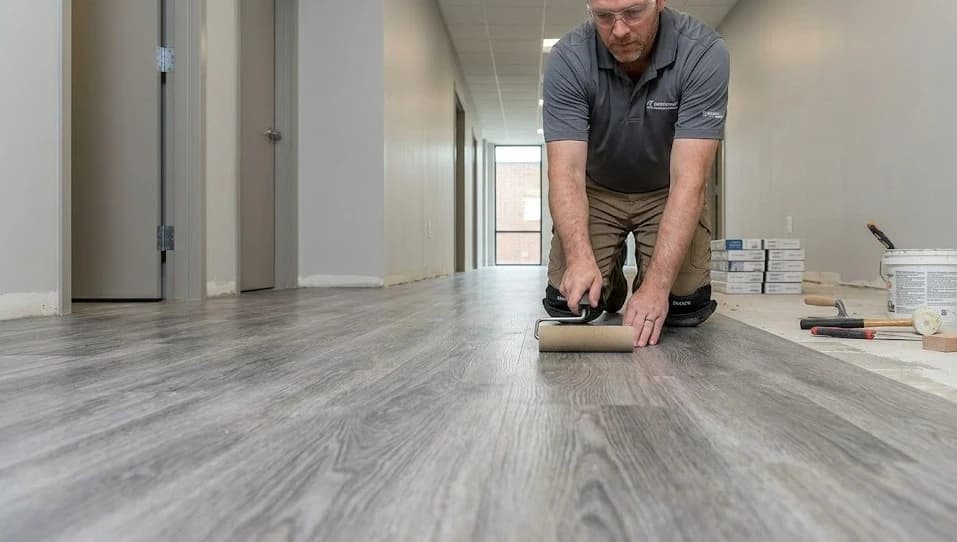
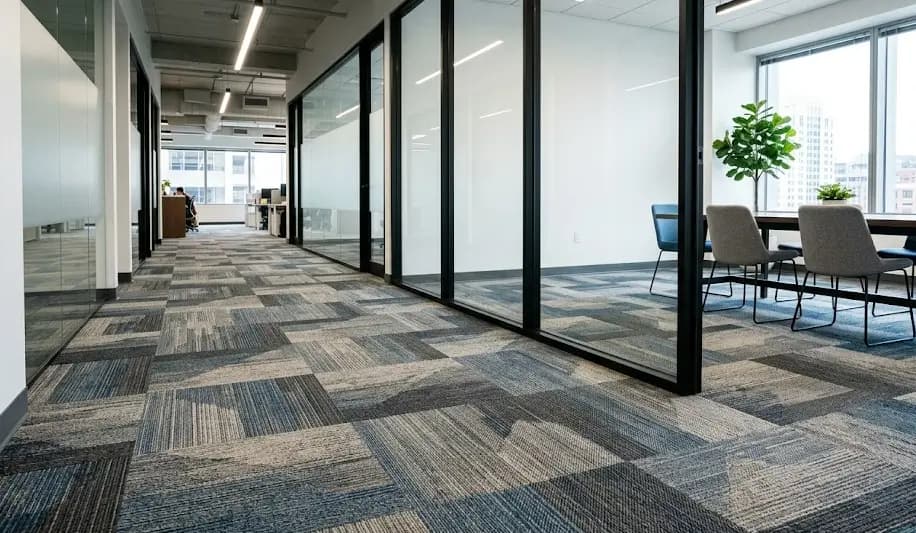
We install both through our commercial vinyl flooring and commercial carpet crews, and an existing floor worth saving goes to commercial floor restoration first. For the wider office picture — porcelain, polished concrete, rubber and how to compare proposals — see our commercial office flooring guide.
For facility managers and specifiers
The codes and specs that decide it
Commercial floors answer to more than taste. These are the standards that come up on almost every DMV commercial job we bid.
Fire rating in corridors
Floor finishes in exit corridors are classed by critical radiant flux under ASTM E648: Class I at 0.45 W/cm² or more, Class II at 0.22 or more. Both carpet tile and commercial LVT are sold with these ratings; ask for the test report, not the brochure. Every carpet sold in the US must also pass the federal FF 1-70 “pill test”.
Accessibility
The 2010 ADA Standards (§302.2) cap carpet pile at ½ inch, require a firm cushion or none, and require exposed edges to be fastened and trimmed. Commercial carpet tile meets this easily; plush residential carpet often does not. LVT has no pile to worry about, but its transitions still have to meet the change-in-level rules.
Sound between floors
In condos and apartments, the International Building Code §1206 requires floor-ceiling assemblies between dwelling units to reach IIC 50 in the lab (45 field-tested). Carpet and pad get there easily. LVT usually needs a rated acoustic underlayment, and most DMV condo boards want to see the product's test report before approving it.
Indoor air quality
Look for CRI Green Label Plus on carpet, cushion and adhesive, and FloorScore on LVT. Both test against California Section 01350 VOC limits and both count toward LEED.
At home
Carpet or LVT, room by room
Kitchen
LVTCarpet does not belong in a working kitchen. Dropped food, sink splash, dishwasher leaks and chair legs are exactly what LVT handles and carpet does not, and a tile-format LVT gives you the stone look without cold, hard porcelain underfoot. See our kitchen flooring options.
Living room
DependsThis is the one genuine toss-up. Choose carpet if the room is closed off, used for lounging on the floor, or sits over a bedroom. Choose LVT with an area rug if the living room is open to the kitchen, because one continuous floor with no transition reads larger and cleans in one pass. Pets and allergies tip it to LVT; a cold slab or a noisy upstairs neighbour tips it to carpet.
Basement
LVTLVT, over a slab that has been tested. Carpet in a Maryland basement is a bet that the slab never sweats and the sump never fails. The EPA advises drying wet materials within 24–48 hours to avoid mould, which a carpet and pad over concrete rarely manage. Our basement flooring page and basement waterproof flooring guide cover the prep.
Bedroom
CarpetCarpet still wins most bedrooms: warmer, quieter and cheaper, and DMV buyers still expect it upstairs. LVT only earns a bedroom for allergies, pets or a guest room over a finished basement. Our bedroom carpet page covers pile and pad choices.
Bathroom and laundry
LVTLVT, or porcelain. Carpet in a bathroom is a moisture trap. A glued or tightly seamed LVT tile in a stone look is the budget-friendly way to get a tile aesthetic here.
Home office
LVTA rolling desk chair will flatten a lane of carpet in months, which is why you see chair mats. LVT takes the casters without a mat. Put a low-pile rug under the desk area if the room echoes on video calls.
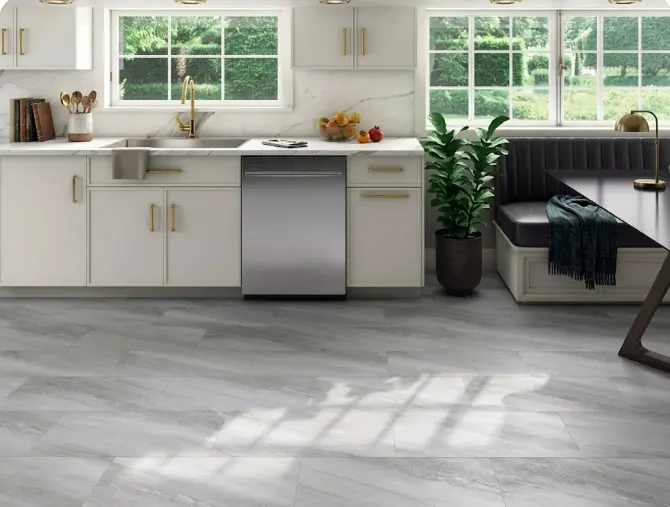
For a residential installation, our luxury vinyl installation crews handle the subfloor, transitions and trim, and our carpet installation team does the rooms that stay soft. Most homes we measure end up with both.
Where both floors fail
Slabs, moisture and water damage
The most expensive commercial flooring failure we are called to is not a worn floor. It is adhesive that has broken down over a wet slab, and it happens to carpet tile and LVT alike. The fix is cheap compared with the failure: test the slab to ASTM F2170 (in-situ relative humidity probes, left to equilibrate for 24 hours) and compare the reading with the adhesive manufacturer's limit before anything is ordered. Ground-floor and below-grade suites in older DMV buildings are where we find high readings most.
When water does get in, the two floors part ways. The EPA advises drying water-damaged materials within 24–48 hours to prevent mould, and notes that porous materials such as carpet may have to be thrown away once mould takes hold. LVT's surface does not absorb water, and FEMA's Technical Bulletin 2 lists vinyl tile in chemical-set adhesive over concrete among flood damage-resistant finishes. If you are dealing with a flood right now, our emergency floor repair team can help, and our waterproof flooring page lists what we would put back.
Across the DMV
We measure commercial suites and homes from our showroom at 5550-F Nicholson Lane in North Bethesda. Start from your local page — Washington DC, Bethesda, Rockville, Silver Spring or Arlington — or see every commercial flooring service we offer.
References
Sources
- ASTM F1700 — Standard Specification for Solid Vinyl Floor in Modular Format
- ASTM E648 — Critical Radiant Flux of Floor-Covering Systems
- ASTM F2170 — Relative Humidity in Concrete Floor Slabs Using in situ Probes
- U.S. Access Board — 2010 ADA Standards, Chapter 3 (§302.2 Carpet)
- eCFR — 16 CFR Part 1630, Surface Flammability of Carpets and Rugs (FF 1-70)
- International Building Code §1206 — Impact Sound Insulation (via UpCodes)
- Carpet and Rug Institute — Green Label Plus
- Resilient Floor Covering Institute — FloorScore
- U.S. EPA — A Brief Guide to Mold, Moisture and Your Home
- FEMA NFIP Technical Bulletin 2 — Flood Damage-Resistant Materials Requirements (2025)
Installed prices are 2020 Flooring's 2026 planning ranges for Maryland, DC and Northern Virginia, not manufacturer list prices. Every project is quoted after a site measure.
Good questions
Carpet vs. LVT FAQs
Is carpet cheaper than LVT?
Yes, upfront. In DMV homes carpet with pad typically runs $2–$8 per square foot installed against $5.50–$12+ for LVT, so carpet usually costs 40–60% less on day one. In commercial work the gap is narrower: carpet tile runs about $5–$11 installed and glue-down commercial LVT about $7–$13. Because commercial carpet tile generally needs replacing after 8–12 years and LVT lasts 15–20, carpet tile usually ends up costing more over a 15-year lease cycle.
Is LVT better than carpet in a kitchen?
Yes. LVT is waterproof, wipes clean, and handles dropped food, dishwasher leaks and chair legs. Carpet absorbs spills and odours and is not a practical kitchen floor. A stone- or concrete-look LVT tile gives you a tile appearance that is warmer and quieter than porcelain.
Should I choose carpet or LVT for a living room?
It depends on the layout. If the living room is open to the kitchen, run LVT through both and add an area rug for warmth and sound. If it is a separate, closed room where people sit on the floor, or it sits over a bedroom, carpet is more comfortable and quieter. Pets and allergies favour LVT.
Is LVT or carpet better for a basement?
LVT. Basement slabs in the DMV routinely carry moisture, and carpet with pad holds water and can grow mould if it is not dried within 24–48 hours. LVT is waterproof, but the slab should still be moisture-tested first, because excess moisture can break down the adhesive under glue-down LVT or trap moisture under a floating floor.
Is carpet tile or LVT better for an office?
Usually both. Glue-down commercial LVT belongs in corridors, reception, break rooms and copy areas where rolling loads, spills and grit concentrate. Carpet tile belongs in open offices, conference rooms and private offices, where it controls noise. Most DMV office projects we install use that split rather than one floor throughout.
Get a split spec drawn for your space
Send us a floor plan or book a walk-through and we will mark where carpet tile and LVT belong, test the slab, and price both so you can compare like for like. Request a free estimate anywhere in DC, Maryland and Northern Virginia.

Written by
Jason Brown
Flooring Specialist
Jason Brown has 14 years of flooring sales and installation experience across the DC, Maryland, and Virginia area.