Healthcare guide · 2020 Flooring · Serving DC, MD & VA since 1997
For most dental practices, the answer is not one floor. It is commercial sheet vinyl or properly specified glue-down LVT in treatment and sterilization areas, commercial LVT through corridors and reception, and carpet tile reserved for non-clinical rooms. This guide covers the room by room specification, why we are cautious about floating click floors in operatories, wear layer and adhesive selection, cleaning compatibility, slip resistance, subfloor preparation and realistic installed costs in the DMV.
Choosing flooring for a dental practice is not the same as choosing flooring for a normal office.
A dental floor has to deal with patients and staff walking through all day, rolling stools and equipment, frequent cleaning, occasional spills, dental materials and chemicals, wheelchair traffic and, in clinical areas, stricter expectations around cleanability.
And one of the biggest sources of wear is easy to overlook.
It is not always the patients walking through the door. In an operatory, a dentist or hygienist may roll and swivel between the patient chair, cabinetry and delivery equipment hundreds of times a day. That repetitive movement concentrates a surprising amount of stress onto a relatively small area of floor.
That is why a flooring product that performs perfectly well in a retail shop or residential property can fail prematurely in a dental practice.
For most dental projects, our approach is to select the flooring room by room rather than choosing one material for the entire practice.
At 2020 Flooring, we have installed flooring in nearly a dozen healthcare facilities across Maryland, Washington DC and Northern Virginia over the last five years, including dental and medical practices, and references are available on request. Our crews are in-house, licensed and insured in all three jurisdictions, and we have been working in this market since 1997. The guidance below is what we actually specify, not a product brochure.
What Is the Best Flooring for a Dental Office?
Three flooring systems do most of the work in a dental practice. The skill is putting each one where it belongs.
For most practices, there are three flooring systems we consider first: commercial sheet vinyl, commercial glue-down LVT, and commercial carpet tile in non-clinical rooms only.
| Area | Our usual starting point | Why |
|---|---|---|
| Treatment rooms and operatories | Commercial sheet vinyl or properly specified glue-down LVT | Cleanable, durable and capable of dealing with rolling traffic |
| Decontamination, sterilization and higher-hygiene clinical areas | Heat-welded sheet vinyl or another approved seamless resilient system | Fewer joints, easier detailing and excellent cleanability |
| Reception, corridors and waiting rooms | Commercial glue-down LVT, sheet vinyl or selected carpet tile | Allows more freedom with appearance, acoustics and comfort |
| Private offices and consultation rooms | LVT or commercial carpet tile | Lower clinical risk and greater emphasis on comfort and sound |
| Lab, plaster and model rooms | Sheet vinyl or a resinous system with a coved base | Gypsum slurry, acrylic monomer and constant wet cleanup |
| Surgical or operating rooms | Healthcare-grade monolithic system specified for the room classification | Stricter requirements may apply to seams, coving and cleaning |
A starting point, not a specification. Room classification, accreditation requirements and the practice cleaning regime can all change the answer.
There is no single flooring product that is automatically best everywhere.
The important part is matching the floor construction to what actually happens in that room.
Planning a dental fit-out, operatory addition or refurbishment in Maryland, Washington DC or Northern Virginia? We walk the suite room by room, test the slab, and bid each area on its own scope.
Get a Room-by-Room ProposalWhy a Dental Floor Wears Differently
The operatory, not the corridor, is where dental floors are won or lost.
Foot traffic in a dental practice is fairly ordinary. A busy general practice may see a few dozen patients a day, which is nothing next to a school corridor or a hotel lobby.
The unusual load is the stool. A clinician and an assistant work from wheeled seats, pivoting between the patient, the delivery unit and the rear cabinetry through every appointment. Hard casters stop, turn, reverse and load a small arc of floor repeatedly, every working day, for the life of the floor.
2020 Flooring drawing
Where an operatory floor actually wears
Two things follow from that drawing. First, rolling-load performance and adhesive selection matter more than almost anything else in a treatment room. Second, the floor in the operatory can be failing while the identical product in the corridor still looks new, which is exactly the pattern we are called out to look at.
A wheelchair or a walker adds a second kind of load, usually in reception and corridors rather than the operatory, and it puts the emphasis on flat transitions rather than on the field of the floor. Both loads point at the same conclusion: a fully adhered commercial system over a properly prepared substrate.
Our First Choice for Clinical Areas: Commercial Sheet Vinyl
Welded seams and an integral coved base are the reason this is still the clinical default.
For dental surgeries, treatment rooms, sterilization rooms and similar clinical environments, commercial sheet vinyl remains one of the strongest flooring options available.
The advantage is not simply that it is vinyl.
A properly specified healthcare sheet floor can be installed with welded seams and an integral coved base, creating a much more continuous surface than a floor made from hundreds of individual tiles or planks.
That makes day-to-day cleaning easier and reduces the number of joints and edges that have to be maintained. It also removes the dirt trap where the floor meets the wall, which is the detail staff complain about most in an older practice. Our commercial sheet vinyl installation page shows how we test the slab, weld the seams and run the flash cove.
What we look at on a sheet specification. Homogeneous or heterogeneous construction, thickness and the depth of the wear surface, rolling and static load ratings, chemical resistance against the disinfectants the practice actually uses, welding rod availability in the chosen colour, coved base height and cap detail, and whether the slab is flat and dry enough for sheet goods to look right. Sheet flooring is unforgiving of a substrate that is not flat, because every ridge telegraphs.
This is particularly relevant in markets with specific healthcare guidance. In England, for example, HTM 01-05 states that flooring in clinical-care and decontamination areas should be impervious and easily cleanable. It also states that joins should be welded or sealed and that the flooring should be coved to the wall.
For true procedure or operating rooms in the United States, requirements may be more demanding still. FGI guidance for operating rooms calls for a monolithic floor and wall-base assembly with an integral coved base extending at least six inches up the wall.
That distinction matters.
A standard dental operatory is not automatically an operating room simply because surgical dentistry is performed there. The room classification, accreditation requirements, applicable health code and authority having jurisdiction should be established before the flooring specification is finalized. In practice that is a short conversation with the architect or the practice owner, and it is much cheaper than having it after the material is ordered.
Sheet vinyl also sits in a family of resilient sheet products worth comparing directly. Our guide to linoleum against LVP and LVT covers how those constructions differ, and Marmoleum against traditional linoleum covers the linoleum route some practices prefer for its bio-based content. We install both through our commercial vinyl and LVT division.
Commercial Glue-Down LVT: An Excellent Choice in the Right Areas
The word that decides whether it works is commercial.
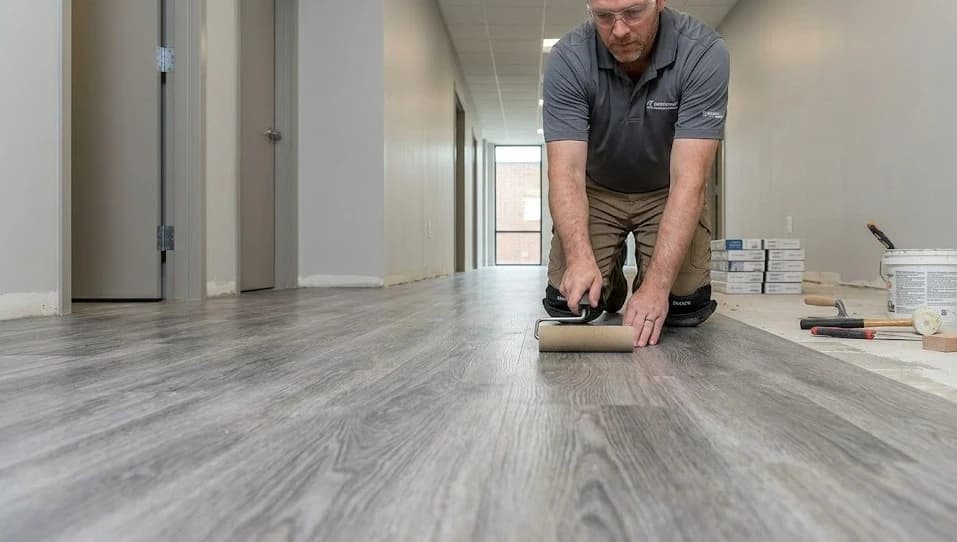
Luxury vinyl tile and plank have become extremely popular in dental practices because they can provide a warmer, less institutional appearance while remaining relatively easy to maintain.
We use one word deliberately, though: commercial.
Residential LVP selected because it looks attractive in a showroom is not the same thing as a commercial resilient floor designed around heavy traffic and rolling loads. You can see the difference in the spec sheet long before you see it in the floor: wear layer stated in mil, a rolling-load rating, a commercial warranty class, and an adhesive named by the manufacturer rather than left to the installer.
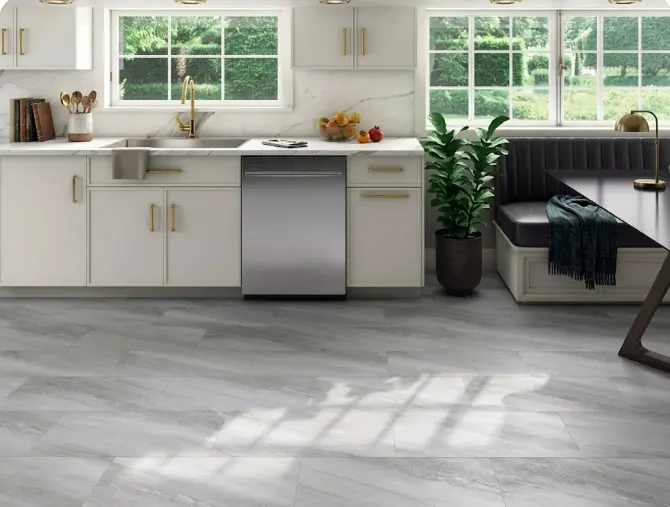
Twenty-mil wear layers are common among commercial LVT products intended for demanding spaces, and 20 mil is the figure most often recommended for commercial dental applications. Manufacturers such as Shaw and Mannington offer commercial 20-mil products using direct-glue installation, and some specify particular adhesive systems where heavy rolling loads are present.
But wear-layer thickness should never be the entire specification.
A 20-mil floor installed over a poorly prepared slab with the wrong adhesive can still fail.
We look at the wear layer, total construction, rolling- and static-load performance, indentation resistance, finish, chemical resistance, edge construction, adhesive system, substrate condition and the manufacturer’s intended-use limitations together.
If you want to see the construction differences up close, our luxury vinyl plank and tile collections page carries the product detail, wear layers included, and our luxury vinyl installation page explains how subfloor flatness, slab moisture and glue-down against floating are handled on site. For a practice choosing between soft and hard surface in the non-clinical half of the suite, our carpet against LVP comparison sets out the trade-offs.
Why We Are Cautious About Floating and Click-Lock Floors
Commercial rated does not automatically mean appropriate for every area of a practice.
This is one of the areas where experience in dental projects matters.
Floating floors are attractive because installation can be fast and some products require less adhesive. But an operatory places unusual stresses on a locking system.
Think about the movement of a clinician’s stool. It is not simply travelling in one direction down a corridor. The wheels stop, turn, pivot and reverse over the same few feet of floor throughout the working day.
Flooring professionals discussing a failed dental-office installation described a click-lock floor that was being replaced after only two years. The concentrated rolling and twisting movement between the patient’s chair and cabinetry was identified as a major concern.
Other experienced installers in the same discussion recommended commercial glued-down resilient flooring rather than floating products for clinical areas.
That is much closer to how we approach these projects.
We would generally rather have a correctly prepared substrate and a fully adhered commercial flooring system in a heavily used operatory than rely on a floating locking mechanism to handle years of concentrated caster movement.
There can be exceptions, and manufacturer approvals always matter, but commercial rated does not automatically mean appropriate for every area of a dental practice. A floating floor also has a second disadvantage that matters in a clinical room: every perimeter needs an expansion gap, and a gap under a base or a transition strip is a detail to clean rather than a coved surface to wipe.
What About Carpet in a Dental Office?
Not bad flooring, but highly dependent on where it is used.
Carpet is not necessarily bad flooring. It is simply highly dependent on where it is used.
Its major advantages are acoustic control, warmth and comfort.
That can be valuable in a dental practice. Hard finishes reflect sound, and dental offices already contain equipment, conversations and treatment noise. Practices that have moved from carpet to vinyl frequently raise the extra echo as the one thing they did not anticipate.
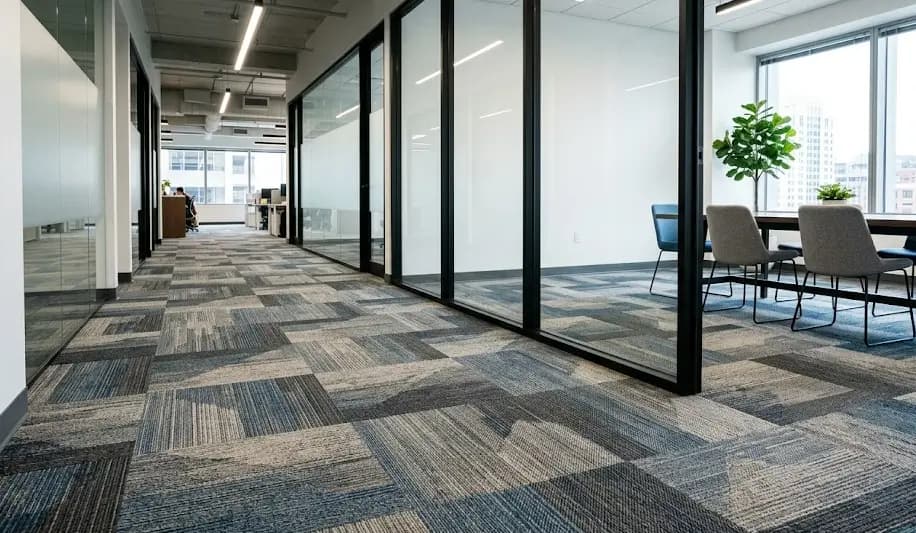
Commercial carpet tile can therefore make sense in private offices, consultation spaces, staff areas and, depending on local requirements and the practice’s cleaning strategy, some waiting areas.
Carpet tile also has a practical advantage over broadloom: individual tiles can be replaced after staining or damage rather than replacing an entire room. Keep a box of attic stock from the same dye lot and a coffee spill in reception becomes a five-minute repair.
We would not normally specify carpet in an active clinical treatment or decontamination area. In the UK, HTM 01-05 expressly says carpets should not be used in clinical-care and decontamination areas.
Where acoustics are important but carpet is unsuitable, there are other ways to control noise through ceilings, wall treatments, furnishings and acoustic resilient flooring. Acoustic sheet-vinyl systems are also available specifically for healthcare and waiting-area applications.
If a practice is taking carpet out of clinical rooms, the removal itself is a scope item worth pricing properly. Glued-down commercial carpet leaves adhesive residue that has to come off before a resilient floor goes down, which is exactly what our carpet removal service handles, and our commercial carpet and carpet tile page covers the replacement side.
Is Rubber Flooring Good for Dental Practices?
An excellent healthcare floor when the design brief allows it.
Commercial rubber can be an excellent healthcare floor.
It is resilient underfoot, relatively quiet and available in products designed for demanding clinical applications. That can make it attractive where staff stand for long periods, such as sterilization areas and lab benches.
The tradeoff is usually design preference and project cost.
For a practice trying to create a residential or hospitality-inspired interior, wood-look LVT may provide the desired appearance more easily. In highly clinical spaces, however, performance can be more important than reproducing a timber aesthetic.
Healthcare sheet rubber can also be considered alongside homogeneous sheet vinyl for higher-specification environments where the selected product and installation system meet the project’s requirements. Two practical notes: some rubber products need a specific cleaning regime and are damaged by the wrong chemistry, and a new rubber floor has a noticeable initial odor that is worth scheduling around.
What About Epoxy and Resinous Flooring?
A system, not a coating that can be painted over an existing slab.
A properly designed resinous flooring system can create a seamless, durable surface with an integral cove.
That makes resinous flooring worth considering in procedure rooms, laboratories, sterilization areas and other demanding healthcare environments.
However, epoxy by itself is not a specification.
Resin formulation, substrate moisture, crack movement, surface preparation, installer experience, slip characteristics and the required cleaning regime all affect the result.
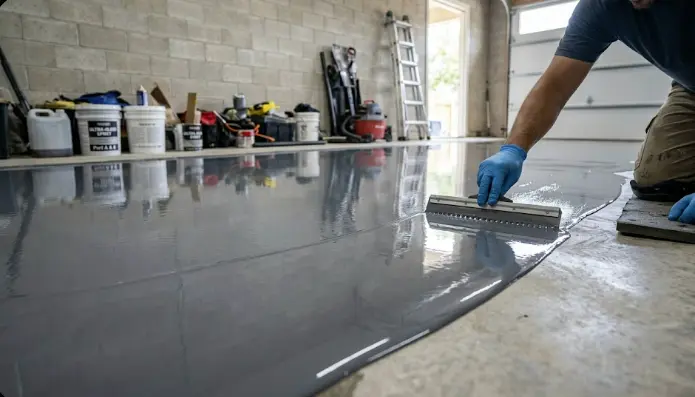
For that reason, we regard resinous flooring as a system rather than simply a coating that can be painted over an existing slab. Our epoxy floor coating page explains how we build one, from grinding and moisture mitigation through to the coved base and the topcoat.
VCT Can Last, But Consider the Maintenance
A low material price and a maintenance program that runs for the life of the floor.
Vinyl composition tile has been used successfully in healthcare for decades.
It is durable and individual tiles can be repaired, but traditional VCT usually relies on a maintenance program involving finish, periodic stripping and refinishing or burnishing.
That may make the initial material price attractive while increasing lifecycle maintenance. It is the same lifecycle trap we set out for facility managers in our guide to the best flooring for schools, where the cheapest floor to buy is one of the most expensive to own across twenty years.
Experienced commercial installers make the same point: VCT can last extremely well when properly maintained, but the finish and maintenance program are critical.
For many modern independent dental practices, a no-polish commercial LVT or sheet-vinyl system is easier to manage, because it removes a recurring after-hours contractor visit from the operating budget.
Ceramic and Porcelain Tile: Durable, But Not Always Our First Choice
Exceptionally hard-wearing, but it is the joints that decide it.
Porcelain tile is exceptionally hard-wearing and resistant to many stains.
Its disadvantage in a clinical environment is not necessarily the tile itself. It is everything between the tiles.
Grout introduces additional joints and maintenance. Tile is also hard underfoot, can increase reflected sound and requires careful detailing wherever equipment, transitions or penetrations occur.
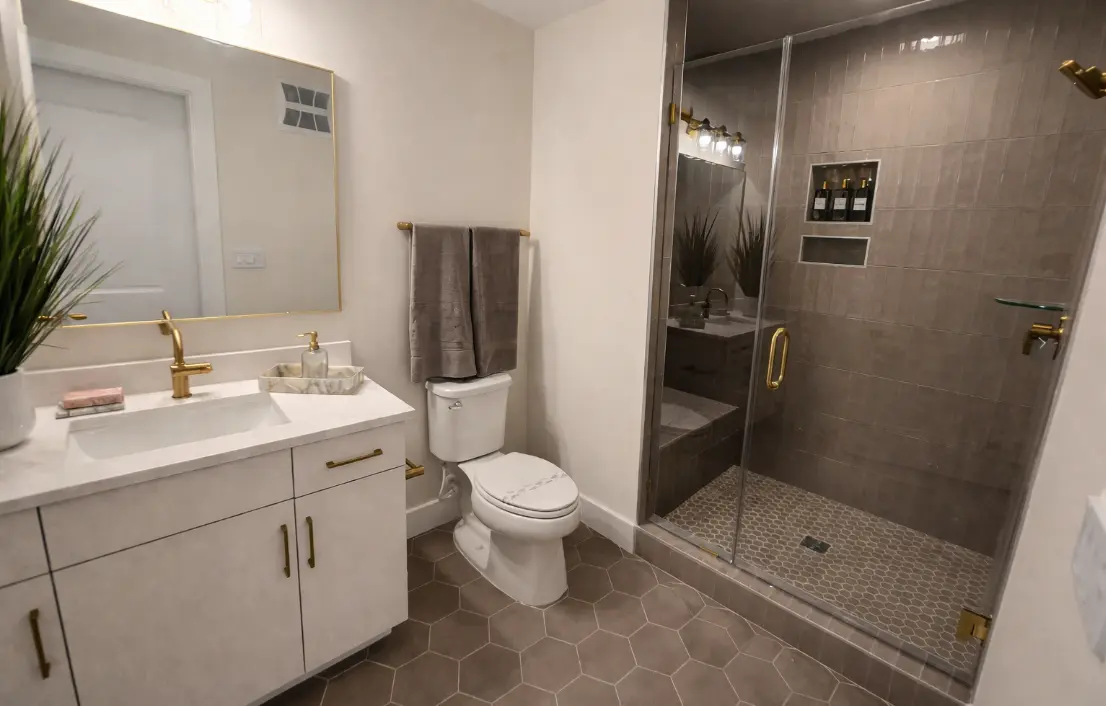
It can work very well in selected lobbies, bathrooms or architectural feature areas, and a slip-rated porcelain tile is a sound choice for a practice restroom or an entry that takes four months of DMV road salt. Our commercial tile work covers those areas.
We are much less likely to choose it as the default floor directly around dental chairs.
The Floor Has to Work With Your Cleaning Products
Waterproof tells you very little about chemical compatibility.
Dental flooring is cleaned far more frequently than most residential flooring.
The selected product therefore needs to tolerate the actual detergents and disinfectants used by the practice.
This is one area where vague descriptions such as waterproof tell you very little. A floor can resist water but still be damaged, stained or dulled by a specific chemical. Quaternary ammonium products, accelerated hydrogen peroxide, alcohol and phenolics do not all behave the same way on the same finish, and neither does a bleach dilution mixed stronger than the label says.
The CDC’s dental infection prevention guidance is explicit that cleaning and disinfecting solutions should be prepared and used according to the manufacturer’s recommendations (see CDC best practices for environmental infection prevention and control in dental settings). HTM 01-05 makes the same point for practices working to UK guidance. That instruction cuts both ways: the flooring manufacturer also publishes a maintenance specification, and using a product outside it is how warranties are lost.
Before specification, we want to know how the practice intends to clean the floor and confirm that the flooring manufacturer approves that maintenance regime. It takes one conversation and it prevents a dull, streaked or discoloured floor in year two.
Dental Flooring Does Not Need to Be Marketed as Sterile
A cleanable floor is important. A sterile floor is marketing.
There is a lot of questionable marketing around hygienic flooring.
A cleanable floor is important, but the floor of a normal dental operatory should not be described as though it were a sterilized instrument.
The CDC classifies floors as housekeeping surfaces. They have a limited risk of disease transmission compared with clinical-contact surfaces and can be decontaminated with less rigorous methods, with additional cleaning or disinfection where visible contamination occurs.
That is actually a better reason to specify flooring intelligently.
The objective is to provide a durable surface that staff can effectively maintain, that does not introduce unnecessary dirt traps and that remains intact despite years of use. An antimicrobial additive in a wear layer is a secondary feature at best. A welded seam, a coved base and a floor that is still bonded to the slab in year ten do far more for a practice.
Slip Resistance and Accessibility Matter Too
Patients leaving treatment are not always steady on their feet.
Patients using a dental office may include older adults, people using walkers, canes or wheelchairs and people whose balance is temporarily affected after treatment.
The flooring should therefore be selected for the conditions in which it will actually be used.
In the United States, ADA accessibility standards require accessible floor and ground surfaces to be stable, firm and slip resistant. As the US Access Board guidance on floor and ground surfaces explains, the standards do not prescribe one universal coefficient-of-friction number, because no consensus rating method has been settled on. Compliance instead means choosing materials, textures and finishes that minimise slipperiness under the conditions the surface will actually see.
Transitions between materials also deserve attention. A beautiful reception floor is not much use if a poorly detailed threshold creates a wheelchair obstacle or trip hazard. Where two flooring systems meet, we would rather level the substrate so the surfaces finish flush than rely on a thick ramped strip through a corridor people push equipment along.
Subfloor Preparation May Matter More Than the Flooring Brand
The most expensive flooring failures we see start underneath the finished floor.
Some of the most expensive flooring failures we see start underneath the finished floor.
The slab may be too wet. Old adhesive may remain. Cracks may be moving. Patching may be poor. The floor may not be sufficiently flat. Plumbing trenches and equipment services may have left multiple repairs through an existing concrete slab, which is extremely common in a suite that has been re-planned once or twice.
Putting premium flooring over a bad substrate does not make the problem disappear.
Commercial resilient-floor specifications commonly require careful substrate preparation and concrete-moisture evaluation. ASTM F2170 relative-humidity testing and ASTM F1869 moisture-vapor testing are among the methods referenced by flooring-system manufacturers.
| Prep item | Why it belongs in the proposal |
|---|---|
| Concrete moisture and pH testing | Required by most resilient flooring warranties before any adhesive goes down. |
| Old adhesive and existing floor removal | Layered vinyl, cutback adhesive and glued carpet all change the prep scope. |
| Patching and self-leveling | Plumbing and equipment trenches leave repairs that telegraph through sheet goods. |
| Coving, transitions and thresholds | Coved base, cap strip and flush transitions are line items, not assumptions. |
| After-hours and phased work | Most practices cannot close, so operatories get sequenced around the schedule. |
This is why we are wary of quotes based only on a square-foot material price.
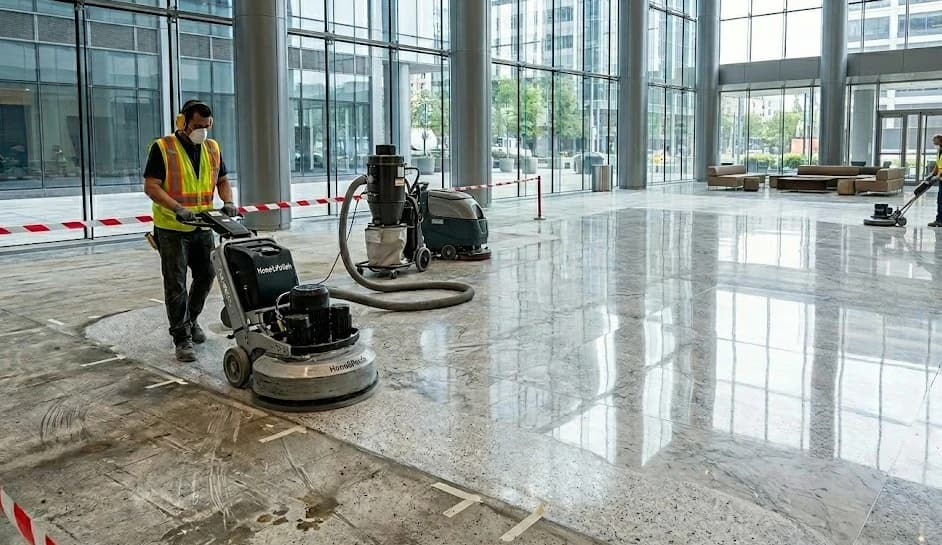
A dental-flooring project should include an assessment of what is underneath the floor, not simply a selection of what will be visible when the job is finished. Where an existing floor has to come up first, that is its own scope: see carpet removal, tile and stone removal and commercial floor restoration where the existing floor can be saved instead.
What Dental Office Flooring Costs in the DMV
Planning ranges for dental projects in Maryland, Washington DC and Northern Virginia.
Installed pricing depends on the product, the area, the prep, the amount of coving and welding, equipment coordination and whether the work runs after hours. For planning purposes, these are realistic ranges on dental and medical projects in this market.
| Flooring system | Installed cost / sq ft | Where we use it | Watch-outs |
|---|---|---|---|
| Commercial sheet vinyl, heat-welded with coved base | $9 to $16 | Operatories, sterilization, decontamination, labs | Welding and coving are skilled labor, not an upgrade line |
| Commercial glue-down LVT or LVP (20 mil) | $7 to $13 | Corridors, reception, many standard operatories | Needs a flat slab and the adhesive the maker specifies |
| Commercial carpet tile | $5 to $11 | Private offices, consult rooms, staff areas | Keep it out of clinical and decontamination space |
| Commercial rubber sheet or tile | $10 to $18 | Standing zones, sterilization, corridors | Narrower design range and an initial product odor |
| Resinous system (epoxy or urethane, coved) | $9 to $20 | Labs, procedure rooms, sterilization, back of house | Slab moisture and crack movement decide the build |
| VCT with a finish program | $4 to $8 | Budget back-of-house | Stripping and refinishing for the life of the floor |
| Porcelain tile | $12 to $25+ | Restrooms, entries, feature areas | Grout joints, movement joints, hard underfoot |
DMV planning ranges. Figures exclude major floor prep, moisture mitigation, equipment disconnection and after-hours labor unless noted. Final pricing depends on site conditions.
A note on comparing bids. On a dental floor, the line items that separate two proposals are almost never the material. They are moisture testing, adhesive, old-adhesive removal, self-leveling, coved base, welding, transitions, equipment coordination and after-hours premium. A bid that omits them is not cheaper, it is incomplete.
Planning a dental fit-out, operatory addition or refurbishment in Maryland, Washington DC or Northern Virginia? We walk the suite room by room, test the slab, and bid each area on its own scope.
Get a Line-Item QuoteThe Best Flooring by Area of a Dental Practice
The key word is appropriate.
For a typical practice, we would normally begin with commercial sheet vinyl in treatment, decontamination and sterilization areas where maximum cleanability and controlled seams matter.
Commercial glue-down LVT is an excellent option for corridors, reception areas and many standard operatories when the product, adhesive and local clinical requirements permit it.
Carpet tile is better reserved for non-clinical areas where acoustic comfort matters.
Higher-specification procedure and operating rooms should be treated separately rather than assuming the specification used in the waiting room can simply continue through the entire building.
The key word is appropriate.
The best dental floor is not necessarily the most expensive floor or the product with the thickest wear layer. It is the flooring system appropriate to that room, correctly prepared and correctly installed.
What We Would Avoid in a Dental Flooring Specification
Good flooring design puts the performance where it is needed.
- Residential-grade plank or sheet in clinical areas. Specified for household traffic, not for casters and constant disinfection.
- Floating click systems in heavily used operatories. Concentrated twisting caster movement works joints loose over time.
- Broadloom carpet around patient treatment. Difficult to clean after a spill and impossible to replace in one square.
- Heavily textured or deeply embossed surfaces. Texture that holds soil is texture the staff has to fight every evening.
- Untreated wood in wet or chemical-exposure areas. Finish breaks down, edges swell, and repairs mean sanding in a clinical room.
- Any product chosen without checking rolling-load and cleaning limits. The manufacturer states both, and both decide whether the warranty applies.
We are equally cautious about overspecification.
A reception desk does not necessarily require operating-theatre flooring. A private office does not need to be designed like a sterilization room.
Good flooring design puts the performance where it is needed.
Who You Are Taking This Advice From
Nearly a dozen healthcare facilities across the DMV in the last five years.
2020 Flooring has been installing flooring across Maryland, Washington DC and Northern Virginia since 1997. Over the last five years we have completed flooring work in nearly a dozen healthcare facilities, dental and medical practices among them, and references are available on request.
What that experience actually buys a practice owner:
- We survey before we price. Slab moisture, flatness, existing layers and old adhesive get established up front, because those are the items that turn a fixed-price floor into a change order halfway through.
- We phase around patients. Most practices cannot close. Operatories get sequenced in evenings and weekends, with adhesive cure time planned against the next day’s schedule rather than discovered on it.
- We coordinate with the equipment vendor. Chairs, delivery units and cabinetry are fixed to the slab. Who disconnects, who re-sets, and on which night, belongs in the schedule from day one.
- We bid each area on its own scope. Sheet with welded seams and a coved base in the sterilization room, commercial LVT down the corridor, carpet tile in the private office, each priced separately so you can see what you are paying for.
- We are a dealer, not a single-brand outlet. Mannington, Shaw, Mohawk, Daltile and others, which means the specification can follow the room rather than the sample book we happen to carry.
- Licensed, bonded and insured in Maryland, DC and Virginia, with in-house crews rather than day labour, and a two-year labor warranty alongside the manufacturer’s.
You can see the range of our commercial flooring services, browse completed commercial projects, or read our guide to commercial office flooring in the DMV for the wider commercial picture. Samples of every system named on this page can be seen at our showroom at 5550-F Nicholson Lane in North Bethesda.
Dental Office Flooring FAQs
The questions practice owners, architects and dental equipment reps ask us most.
Is LVP good for a dental office?
Yes, provided it is genuinely commercial LVP or LVT and appropriate for the area. In heavily used spaces we generally prefer glue-down products over residential-style floating systems. Product wear layer, adhesive, rolling-load performance, substrate preparation and maintenance requirements all matter.
What wear layer should dental-office LVT have?
A 20-mil wear layer is a common starting point for heavy commercial LVT and is frequently recommended for dental practices. However, wear-layer thickness alone does not determine whether the floor is suitable for an operatory. The core construction, adhesive, rolling-load rating and substrate condition matter just as much.
Can you use carpet in a dentist's office?
Carpet or carpet tile can work well in selected non-clinical areas because it reduces reflected sound and feels warmer underfoot. We would normally keep it out of treatment, sterilization and decontamination spaces. Carpet tile is the better format because a stained tile can be swapped rather than replacing a whole room.
What flooring is best around dental chairs?
Commercial sheet vinyl and properly specified commercial glue-down LVT are normally among our first options. The repetitive rolling and swivelling of dental stools makes rolling-load performance and adhesive selection particularly important around the chair.
Does dental flooring need to be seamless?
Not every room requires a monolithic floor. Requirements become stricter as the clinical classification of the room increases. Sheet flooring with welded seams and coved edges is particularly useful in higher-hygiene spaces, while true operating rooms may have specific monolithic floor and base requirements.
Should a dental practice use the same flooring everywhere?
Usually not. Using different flooring systems for clinical rooms, public areas and staff spaces lets the practice balance cleanability, rolling-load performance, acoustics, appearance and budget more intelligently.
How long does a dental office flooring installation take?
A single operatory refit is usually a short, tightly sequenced job once equipment is disconnected, while a full suite is normally phased room by room over evenings and weekends so the practice keeps treating patients. Substrate repairs, moisture mitigation and adhesive cure times drive the schedule far more than the size of the floor.
Can flooring be replaced without removing dental chairs?
Usually not in the operatory itself. Chairs, delivery units and cabinetry are fixed to the floor or slab, so the equipment vendor normally disconnects and re-sets them around our work. That coordination belongs in the schedule from the start, because it decides which rooms can be done on which nights.
Planning New Flooring for a Dental Practice?
Specify around the room, not around the price per square foot.
A dental floor should be specified around more than color and price.
Before recommending a product, we look at how each room is used, where stools and equipment will roll, existing substrate conditions, moisture, cleaning requirements, transitions, downtime and any applicable healthcare requirements.
That approach helps prevent the situation nobody wants: a beautiful new floor that starts opening at the joints or moving beneath dental stools two years later.
For a refurbishment, expansion or new dental fit-out, speak to a commercial flooring contractor before the flooring product is finalized. A small amount of technical planning at specification stage can prevent a much more expensive flooring replacement later.
Talk to a Dental Flooring Contractor
2020 Flooring brings licensed installation, in-house crews, healthcare project experience and a North Bethesda showroom to dental practices across Maryland, Washington DC and Northern Virginia. We walk the suite, test the slab, coordinate with your equipment vendor and hand you a line-item proposal per area.
Call (301) 881-1115 or visit 5550-F Nicholson Lane, North Bethesda, to see commercial sheet vinyl, LVT, carpet tile and porcelain samples in person. Free on-site assessments throughout the DMV.
Related reading and services: commercial vinyl and LVT, commercial carpet and carpet tile, commercial tile, luxury vinyl installation, epoxy floor coating, carpet removal, and our guides to commercial office flooring and linoleum against LVP and LVT.
Sources & standards
- CDC, Best Practices for Environmental Infection Prevention and Control (dental settings) on floors as housekeeping surfaces and on following manufacturer instructions for cleaning and disinfecting solutions.
- US Access Board, ADA guidance on floor and ground surfaces on the requirement that accessible surfaces be stable, firm and slip resistant, and on the absence of a prescribed coefficient-of-friction value.
- ASTM F2170 and ASTM F1869, concrete relative-humidity and moisture-vapor-emission test methods referenced by resilient flooring manufacturers.
- NHS England HTM 01-05 (decontamination in primary care dental practices) on impervious, easily cleanable, welded and coved flooring in clinical-care and decontamination areas, and on carpet exclusion. FGI Guidelines for Design and Construction of Health Care Facilities on monolithic floor and base assemblies in operating rooms.

Written by
Jason Brown
Flooring Specialist
Jason Brown has 14 years of flooring sales and installation experience across the DC, Maryland, and Virginia area.