Institutional Guide · 2020 Flooring · Serving DC, MD & VA Since 1997
Choosing school flooring is not about finding the toughest material — it is about matching each space to its duty cycle and then paying for the floor across twenty years, not one purchase order. In the DMV the winning mix is layered walk-off matting at entrances, rubber or commercial LVT in hallways, commercial LVT or carpet tile in classrooms, rubber or welded sheet vinyl in cafeterias, and porcelain tile in restrooms. This guide gives you the room-by-room comparison up front, an honest lifecycle cost model, and the contractor-level realities — asbestos abatement, slab moisture, summer scheduling — that decide whether a school flooring project actually lands.
A cafeteria needs spill resistance and sound control. An entrance has to stop water and grit before they reach the rest of the building. A classroom introduces a third set of problems entirely — chairs dragging six hours a day, speech that has to stay intelligible at the back row, and a cleaning crew with limited hours. No single product wins all three.
Most school flooring advice online is written by manufacturers, and it ends where the product selection ends. That is the least useful part of the decision. The hard parts are what sits underneath the floor, what happens to the building calendar while it is installed, and what the custodial budget will owe every year for the next two decades.
At 2020 Flooring, our licensed and insured in-house crews have installed commercial and institutional floors across Maryland, Washington DC, and Northern Virginia since 1997 — a region packed with 1950s and 1960s school buildings that hide asbestos tile, unsealed slabs, and forty years of layered flooring. This guide covers the best flooring for every school space, what it costs installed and over twenty years, and how a project gets planned so the building opens on time in August.
Quick Answer: Best School Flooring by Area
The recommendations first — the reasoning is in the sections below.
| School area | Best overall | Budget alternative | Main concern |
|---|---|---|---|
| Entrances & vestibules | Heavy-duty walk-off carpet + recessed grate | Surface-laid entrance matting | Water, snowmelt salt, tracked-in grit |
| Hallways & corridors | Rubber or commercial LVT | VCT | Traffic volume, rolling carts, maintenance labor |
| Classrooms | Commercial LVT or carpet tile | VCT | Acoustics, chair scrape, spills near sinks |
| Cafeteria & commons | Rubber or slip-resistant welded sheet vinyl | Commercial LVT | Grease, dropped trays, chair drag, noise |
| Restrooms & locker rooms | Porcelain tile with epoxy grout | Welded commercial sheet vinyl | Standing water, chemical cleaning, slip risk |
| Library & media center | Carpet tile | Acoustic-backed LVT | Sound control above everything else |
| Gymnasium | Maple sport floor or poured urethane | Sheet vinyl sport surface | Ball bounce, shock absorption, court lines |
| Weight & fitness rooms | Rolled athletic rubber, 8 mm+ | Interlocking rubber tile | Dropped plates, point loads, vibration |
| Art, science & STEM labs | Welded sheet vinyl | Chemical-rated commercial LVT | Solvents, glaze and dye stains, kiln heat |
| Administration & offices | Carpet tile | Commercial broadloom | Chair casters, speech privacy |
Every one of these recommendations shifts with budget, custodial staffing, and building conditions. The sections below explain when to move off the default.
The School Flooring Zone Plan
Eight zones, eight different jobs for the floor to do. The fill pattern in each block is the material family that wins there.
The most common and most expensive mistake we see in DMV school projects is letting one zone’s logic leak into another — carpet extended into the cafeteria because it worked in the library, or a polished, low-slip finish carried from a lobby into a restroom where it becomes a liability. Zone the building first, then pick products.
What School Flooring Has to Withstand
What a school floor is actually being asked to survive — and why residential logic does not transfer.
- Traffic density, not traffic volume: A corridor at a 900-student elementary school takes its entire population past a single point six to eight times a day, concentrated into four-minute bursts. That is a duty cycle no residential product is rated for.
- Abrasive grit, tracked in on shoes: Sand and de-icing salt are what actually kill a floor finish. They act like sandpaper under every footstep, which is why walk-off matting protects more square footage than any product upgrade.
- Rolling loads: AV carts, lunch carts, custodial machines and mobile furniture apply concentrated point loads all day. Soft resilient products with thin wear layers dent and telegraph within a year.
- Spills and standing water: Cafeteria trays, drinking fountains, classroom sinks, and restroom overflow. Water finding a seam is the single most common route to a failed school floor.
- Aggressive cleaning chemistry: School floors get disinfected on a schedule that no home floor sees. Products have to tolerate quaternary and peroxide cleaners without hazing or softening.
- Acoustics: Hard surfaces raise reverberation time, and reverberation is what makes a teacher hard to understand from the back of the room. This is the one performance metric that argues for carpet.
- A brutally short installation window: Nine or ten weeks in the summer, or a single week at spring break — with a hard, non-negotiable reopening date on the other side.
The accessibility floor everyone forgets. School floors are part of an accessible route, so the finish schedule is a code document, not just a design one. Under the ADA Standards, carpet on an accessible route must be securely attached, have a firm backing or no pad, use a level loop or level cut pile texture, and cap pile height at ½ inch. Changes in level up to ¼ inch may be vertical; between ¼ and ½ inch they must be beveled at no steeper than 1:2; anything more becomes a ramp. In practice that governs every transition strip between a corridor and a carpeted classroom, and it is where value-engineered transitions get flagged at inspection.
Installed Cost vs. 20-Year Cost of Ownership
The purchase order is not the price. Here is what each floor costs to own for twenty years.
This is the chart that changes school flooring decisions. VCT has the lowest installed cost of anything in the building — and, because stripping and re-waxing never stops, one of the highest total costs over twenty years. Rubber and porcelain look expensive on the bid tab and then never ask for anything again.
Installed cost ranges in the DMV
| Flooring type | Installed cost / sq ft | Best use in a school | Watch-outs |
|---|---|---|---|
| VCT (vinyl composition tile) | $4 – $6 | Tight-budget corridors and classrooms | Requires stripping and waxing for life — the cheapest floor to buy, the priciest to own |
| Polished concrete | $5 – $10 | Commons, corridors, shops, back of house | Only works if the existing slab is sound; loud, hard, and unforgiving underfoot |
| Commercial carpet tile | $6 – $11 | Libraries, classrooms, admin, media centers | Spot-replaceable — buy attic stock from the same dye lot on day one |
| Commercial LVT / LVP (glue-down) | $8 – $13 | Corridors, classrooms, commons | Needs a flat, moisture-tested slab; specify a 20 mil or thicker wear layer |
| Welded sheet vinyl | $9 – $14 | Cafeterias, labs, health rooms, restrooms | Heat-welded seams and coved base are what make it watertight — do not value-engineer them out |
| Rubber flooring | $11 – $19 | Corridors, cafeterias, weight rooms, stair towers | Highest upfront cost, lowest lifetime cost; needs ventilation time after install |
| Porcelain tile | $14 – $28+ | Restrooms, locker rooms, entry lobbies | Specify a wet-rated slip finish and epoxy grout, not standard cement grout |
| Maple sport floor | $16 – $30+ | Main gymnasium | Needs a vapor retarder, subfloor system, and a recoat budget every 1–2 years |
Installed planning ranges for Maryland, Washington DC and Northern Virginia. Excludes asbestos abatement, moisture mitigation, self-leveling, furniture handling and after-hours premiums.
The line items that move a school bid
Two proposals for the same building can differ by 40 percent and both be honest. The difference is almost never the goods — it is what the scope admits it has to do first:
- Removal and legal disposal of the existing floor — and asbestos abatement if the building predates the early 1980s
- Full mastic and adhesive residue removal down to a bondable substrate
- Slab moisture testing, and mitigation if the readings come back high
- Self-leveling or grinding to bring the slab inside the manufacturer’s flatness tolerance
- Furniture, casework and equipment moving, storage and reset
- Transition strips and thresholds that meet ADA level-change limits
- New coved or wall base, which is a real cost at school-sized linear footage
- Phasing, night and weekend labor, and protection along the haul route
A bid that is silent on prep is not a lower bid — it is an incomplete one, and the difference reappears as a change order in week three of a nine-week summer. If you want to sanity-check material quantities before proposals arrive, our flooring waste calculator gives you the overage percentages estimators actually use.
Planning a summer flooring project for a school in Maryland, Washington DC, or Northern Virginia? We walk the building, test the slabs, and hand you a phased, line-item scope built around your calendar.
Get a Line-Item ScopeBest Flooring for Each School Area
Where each material earns its place — and where it turns into a work order.
Entrances and vestibules
Entrance flooring is a building-wide decision disguised as a small one. Almost all of the abrasive soil inside a school walks in on shoes, and once it is past the door it grinds into every finish behind it. The fix is a layered walk-off system rather than a single mat: an exterior scraper grate, a scrape-and-wipe surface in the vestibule, and heavy-duty walk-off carpet inside the doors, totaling 12 to 15 feet in the direction of travel. Recessed grates are worth the slab work — surface-laid mats curl, slide, and become their own trip hazard.
In the DMV this matters more than in most markets: our winters produce repeated freeze, thaw and re-salt cycles rather than one long frozen season, so schools track in wet salt slurry from December through March. Salt residue dulls floor finish and attacks adhesive at seams. If you upgrade one thing in a building this year, upgrade the entrance.
Hallways and corridors
Corridors are where the lifecycle argument gets decided, because they are the largest continuous square footage in the building and the most expensive to maintain. Two answers hold up:
Rubber — the long play
- Slip-resistant wet or dry, which matters on a rainy January morning
- Quietest hard surface available — meaningful outside classroom doors
- No wax, no strip, no burnish — ever
- Absorbs rolling-cart impact instead of denting under it
- 25–30 year service life; lowest cost per year in the building
Commercial LVT — the value play
- Roughly half the installed cost of rubber
- Wood and stone visuals a design committee will approve
- No coating program if you spec a factory-finished wear layer
- One damaged plank is a 20-minute repair, not a corridor shutdown
- Requires a flat, moisture-tested slab — this is the whole risk
VCT remains the budget answer and there is no shame in it — but only if the district genuinely has the custodial staff and equipment to keep waxing it. When a school specs VCT and then cuts custodial hours, the floor looks worse in three years than a carpet tile corridor would have. Our luxury vinyl plank and tile and commercial vinyl pages cover the glue-down systems institutional projects actually specify.
Classrooms
The classroom is the one room where the right answer is often both. Hard surface handles the sink, the cubbies, the art table and the door threshold; carpet tile handles the instructional area where acoustics matter and younger students sit on the floor. A hard-surface perimeter with a carpet tile field is a common and genuinely good specification in DMV elementary schools.
If the room has to be one material, commercial LVT is the safer default: it tolerates spills, cleans on a schedule custodial staff can actually keep, and does not create the moisture risk carpet does near sinks. If you go all-carpet, keep it away from the wet zones — EPA guidance for schools is explicit that carpet should not go where there is a perpetual moisture problem, such as by drinking fountains, classroom sinks, or on concrete floors with leaks or frequent condensation, and that a wet carpet has to be extracted and dried within 24 hours to avoid mold.
On acoustics: a hard-surface classroom is a louder classroom, and reverberation is a measurable barrier to speech intelligibility for young students, English learners, and anyone with a hearing impairment. If a district goes hard-surface across the board, the acoustic budget has to reappear somewhere — ceiling treatment, wall panels, or area rugs in the reading corner. Carpet tile is simply the cheapest place to buy it. If indoor air quality is driving the specification, our guide to hypoallergenic and low-VOC carpet covers the certifications worth writing into a spec.
Cafeteria and commons
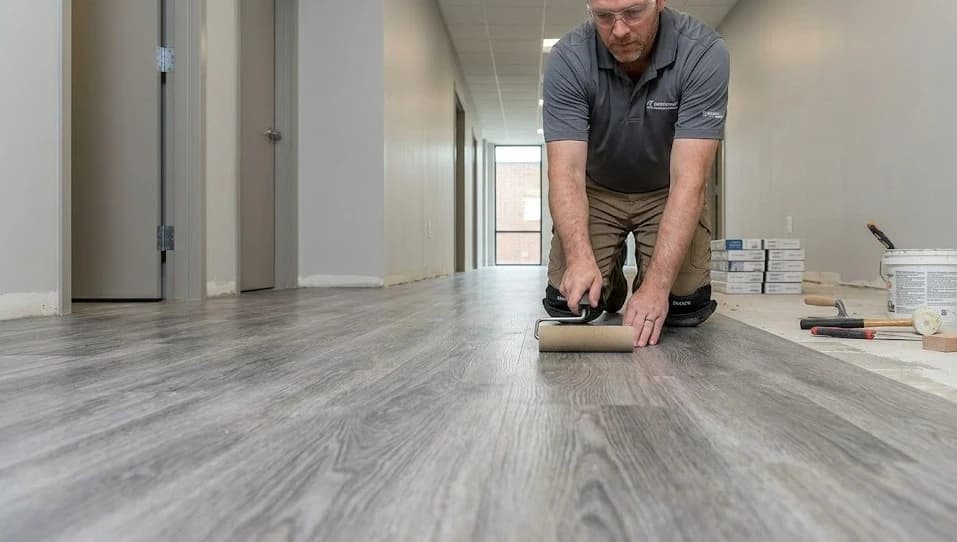
Cafeterias combine every stressor in the building at once: grease and food acids, dropped trays, standing spills that sit until the period ends, hundreds of chairs dragged twice a day, and a noise level that makes supervision harder. Rubber is the strongest answer — it is quiet, slip-resistant when wet, and takes chair drag without scarring. Slip-resistant welded sheet vinyl is the close second and often the better value: the heat-welded seams and coved base make the room a continuous waterproof tray, which is exactly what you want when a milk carton goes over at the far wall. Our commercial sheet vinyl installation page walks through the welding, flash cove and slab testing that make it work.
Commercial LVT is the workable budget choice, with two caveats. Specify a 20 mil or thicker wear layer, and require chair glides on every seat — unglided steel-frame chairs will scar any resilient floor, and a cafeteria has hundreds of them. Avoid carpet outright, and avoid VCT unless the wax program is genuinely funded, because cafeteria wax fails fastest of anywhere in the building.
One detail that gets value-engineered out and should not be: the transition at the serving line and dish room. That is where standing water lives, and where a butted seam instead of a welded one turns into a subfloor problem within two years.
Restrooms and locker rooms
Porcelain tile with epoxy grout, over a waterproofing membrane, with a tile or coved base. Nothing else survives standing water plus hourly chemical cleaning for decades. The two specifications that matter are slip rating — use a textured, wet-rated finish, never a polished one — and epoxy grout, because standard cement grout in a school restroom discolors within a year and becomes permanently unsanitary-looking. Welded commercial sheet vinyl with an integral coved base is a legitimate budget alternative and installs far faster, which matters in a compressed summer. Our commercial tile installation team specifies to wet-area slip standards by default.
Library and media center
Carpet tile, and it is not close. The library is the one room in a school whose primary performance requirement is quiet, and carpet is the cheapest sound absorption per square foot available. Choose a solution-dyed commercial construction so bleach-based cleaners do not lift the color, and buy attic stock from the same dye lot on day one — a replaced tile from a later run will never quite match. Acoustic-backed LVT is the alternative when a district has a no-carpet policy, but it buys back only part of the acoustic performance.
Gymnasium, weight room and fitness spaces
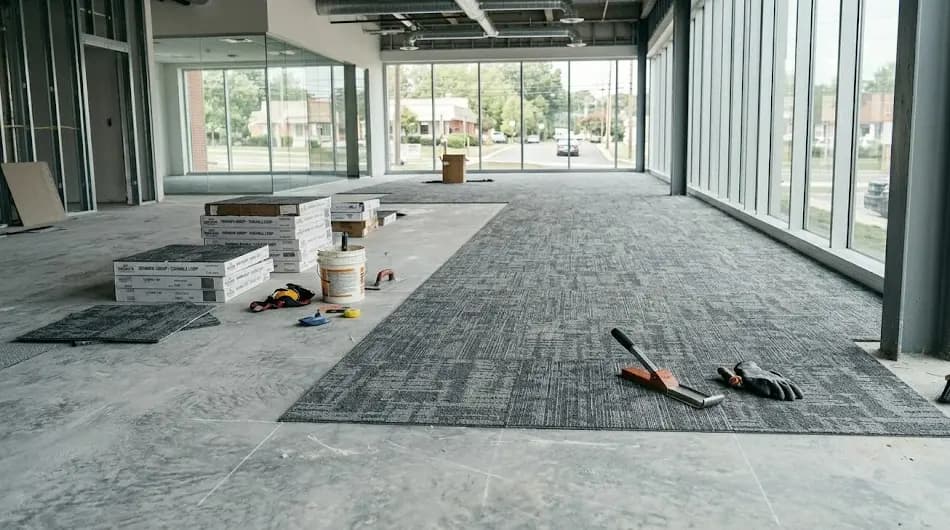
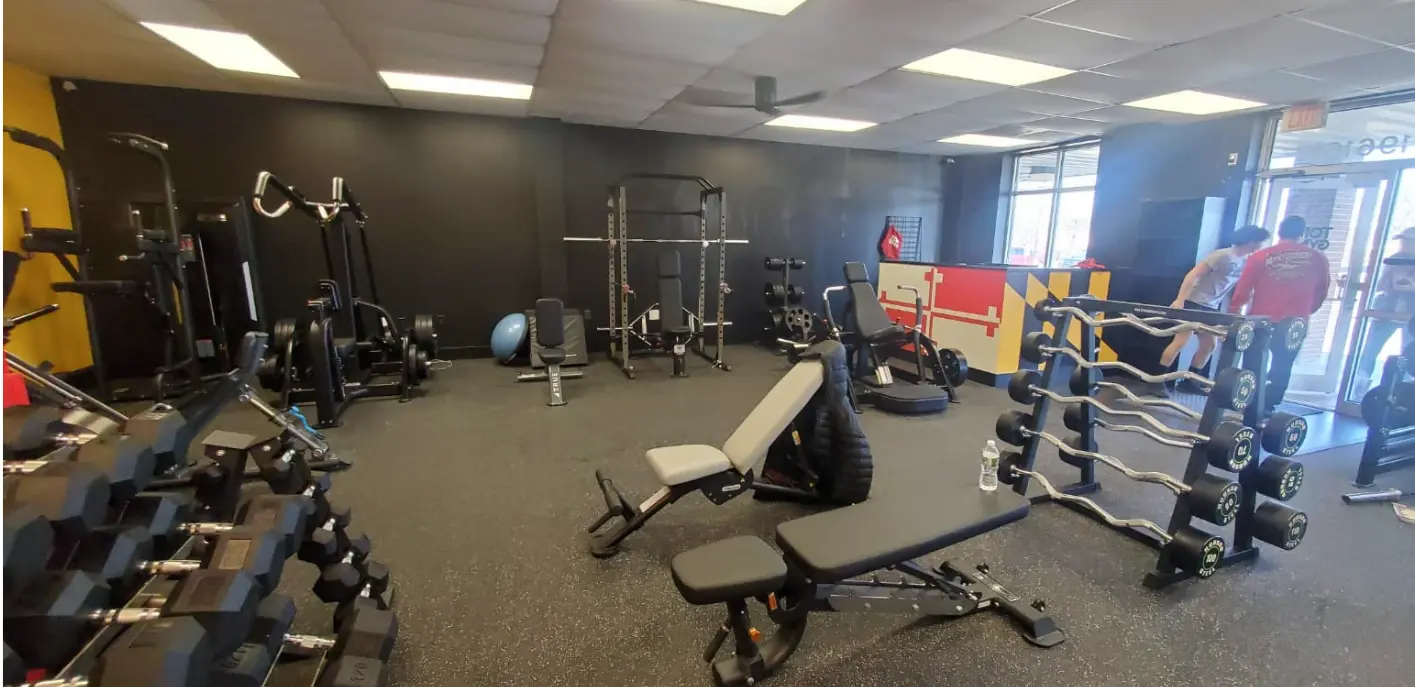
The main gym floor is a specialty trade: maple sport flooring over a subfloor system, or a poured urethane surface, both with proper vapor retarders and a recoat and re-line budget. Weight rooms are a different animal — that is rolled athletic rubber, 8 mm minimum and thicker where free weights are dropped, and it should run wall to wall rather than floating as mats that shift under racks.
If your gym floor is maple and still structurally sound, refinishing is almost always the right call over replacement — our Maryland hardwood refinishing cost guide walks through how sand-and-recoat pricing works, and our commercial floor restoration crews handle institutional recoats between seasons.
Art, science and STEM labs
Welded sheet vinyl with a coved base. These rooms see solvents, glazes, dyes, acids and kiln heat, and the seams are where all of it eventually goes. A chemical-rated commercial LVT works where the chemistry is mild, but in a genuine chemistry lab or ceramics room the continuous welded sheet is the specification that holds up, so it is what we install as heat-welded sheet vinyl in school labs. Sealed or coated concrete is reasonable in shop and maker spaces where heavy equipment is anchored to the slab — our epoxy floor coating service covers those installations.
Administration and offices
Carpet tile again, for the same acoustic reason plus one more: front offices handle confidential conversations, and hard surfaces carry sound down a corridor. Use a chair-caster-rated construction under desks. The considerations here are essentially the same as any commercial workplace — our DMV commercial office flooring guide covers carpet tile versus LVT in office settings in more depth.
Planning a summer flooring project for a school in Maryland, Washington DC, or Northern Virginia? We walk the building, test the slabs, and hand you a phased, line-item scope built around your calendar.
Plan My Building's FlooringMaterial Trade-Offs, Honestly
No material wins everywhere. Here is where each one is genuinely the wrong answer.
Commercial LVT / LVP
Best for
Corridors, classrooms and commons that need a hard surface with no wax program. Wood and stone visuals, spot-replaceable planks, and quiet enough for most classrooms with the right backing.
Watch out for
Gouging from unglided furniture, telegraphing of every slab imperfection, and adhesive failure when the slab was never moisture-tested. Thin wear layers (6–12 mil) fail fast in a school.
Choose it when
You want to get maintenance staff out of the strip-and-wax cycle and the slab is flat and dry.
Avoid it when
The room is a wet area, the slab has active moisture, or the space needs real sound absorption.
VCT (vinyl composition tile)
Best for
Stretching a limited capital budget across a lot of square footage, and for districts with in-house floor crews and existing burnishing equipment.
Watch out for
The wax program. Stripping and re-waxing is chemical-heavy, labor-heavy, and never ends. It is also the reason VCT ends up costing more than LVT over twenty years.
Choose it when
Capital dollars are the binding constraint, operations budget is stable, and staff are already equipped and trained to maintain it.
Avoid it when
Custodial staffing is being cut, or the space is a cafeteria, lab, or anywhere with standing moisture.
Commercial carpet tile
Best for
Libraries, classrooms, media centers and admin suites — anywhere speech intelligibility matters. It is the cheapest acoustic treatment in the building, and damaged squares swap out in minutes.
Watch out for
Moisture and cleaning discipline. Carpet cannot go anywhere with a chronic wet condition, and a spill left wet becomes a mold problem quickly.
Choose it when
Noise is a complaint, the room is dry, and the district has working extraction equipment.
Avoid it when
The area is near drinking fountains, classroom sinks, entry doors, or on a slab with known condensation.
Rubber
Best for
Corridors, cafeterias, stair towers and weight rooms. It is quiet, slip-resistant wet or dry, absorbs impact, and never needs wax.
Watch out for
Upfront cost and a narrower design palette. It also needs ventilation time after installation before a space is reoccupied.
Choose it when
You are budgeting on a 20- or 30-year horizon and the space is loud, high-traffic, or impact-heavy.
Avoid it when
The capital budget is fixed and tight, or the design team wants wood and stone visuals.
Welded sheet vinyl
Best for
Cafeterias, science and art rooms, health suites and restrooms. Heat-welded seams and a coved base turn the floor into a continuous waterproof tray.
Watch out for
Seam quality is everything, and it is entirely down to the installer. It also shows subfloor imperfections badly — flash patching is not optional.
Choose it when
The room gets wet or chemically abused and you want no joints for liquid to find.
Avoid it when
The scope cannot fund proper substrate prep, or heavy point loads will indent the sheet.
Porcelain tile
Best for
Restrooms, locker rooms and entry lobbies. The longest-lived surface in the building and effectively immune to cleaning chemicals.
Watch out for
Slip rating and grout. Polished tile in a wet room is a liability; standard cement grout in a school restroom stains within a year.
Choose it when
The space is permanently wet and you want to install once and forget it for decades.
Avoid it when
The schedule is tight — tile is the slowest trade in the building and cannot be rushed.
Polished concrete
Best for
Commons, corridors and shop spaces in newer buildings where a sound slab already exists. Lowest 20-year cost of anything in this list.
Watch out for
Acoustics and comfort. It reflects every sound in the room and is punishing to stand on. Existing slabs often hide patches, saw cuts and old adhesive that will never polish out evenly.
Choose it when
The building is new or the slab is genuinely clean, and the space is not noise-sensitive.
Avoid it when
The room is a classroom, library, or anywhere children sit on the floor.
If your project is weighing carpet against a resilient hard surface across a whole building, our carpet vs. LVP comparison goes deeper on the head-to-head, and our linoleum guide covers natural linoleum, which still shows up in school specifications where a district is chasing bio-based materials. For a broader sustainability lens, see our eco-friendly flooring guide and our eco-friendly flooring service.
Local Insights: School Flooring in DC, Maryland & Northern Virginia
The DMV's school building stock, climate, and calendar change the answer in ways generic advice never mentions.
1. Assume asbestos until testing says otherwise
A large share of school buildings across Montgomery County, Prince George’s County, Fairfax County, Arlington and DC were built during the postwar and baby-boom construction waves of the 1950s and 1960s. That era’s standard floor was 9×9 vinyl asbestos tile set in black cutback mastic — and in a lot of buildings it is still down there, under two or three later floors. Under the federal AHERA rules, school districts already maintain asbestos management plans, so the information usually exists; the mistake is not pulling it until demolition week.
Two practical consequences. First, testing and any required abatement must be scheduled months before the summer window, by a licensed abatement contractor, not a flooring crew. Second, the mastic is frequently the bigger problem than the tile: it has to come off to a bondable substrate before new adhesive goes down, and residue left behind is a leading cause of resilient floors releasing a year later.
2. The summer window is nine or ten weeks, and it is not all yours
Most DMV districts release students in mid-to-late June and reopen in the second half of August. Subtract summer school programs, camps that rent the building, custodial deep cleaning, and the other trades working the same window, and the real flooring access period is often six to eight weeks — with an immovable reopening date. That is why sequence beats speed: survey and test in winter, award in early spring, order long-lead goods before May, and phase the building so no zone waits on another.
Spring break and winter break are the underused windows. A single corridor, a cafeteria, or a wing of classrooms is very achievable in a week if the abatement and prep are already done. Districts that spread work across three breaks a year get through a building renovation without ever needing a full summer shutdown.
3. Unconditioned buildings in a Mid-Atlantic July
This is the local failure mode almost nobody plans for. Many districts set HVAC back or shut it down over summer break to save energy — during exactly the weeks flooring is being installed, in exactly the climate where July dew points sit in the seventies. Every resilient adhesive on the market specifies a temperature and relative humidity range for installation and cure. Install glue-down LVT in an 85-degree, 75-percent-RH building and the adhesive may never reach full bond, which shows up as edge lift and telegraphing by the following spring.
Write conditioned-space requirements into the contract: the building held within the adhesive manufacturer’s stated range for a set period before, during and after installation. If the district cannot run building HVAC, the scope needs temporary conditioning and dehumidification, and that is a line item, not an assumption.
4. Slab moisture in older slab-on-grade buildings
Single-story elementary schools across the region sit on slabs poured before under-slab vapor retarders were routine, on ground that holds water — Piedmont clay across Montgomery, Fairfax and Loudoun counties, and high water tables closer to the Potomac and Anacostia. Those slabs move moisture upward continuously. In-situ relative humidity testing before any resilient flooring goes down is the difference between a floor that lasts and a warranty fight, and where readings come back high, a moisture mitigation coating has to be in the budget from the start.
One tell we look for on walkthroughs: if an existing VCT field has a dull, blotchy pattern that keeps coming back after stripping, or if tiles pop loose in the same area every year, that is usually the slab talking, not the floor. See our flooring repair and waterproof flooring pages for how we handle moisture-driven failures.
5. Procurement runs on cooperative contracts and prevailing wage
Public school work in this region is rarely a simple three-bid exercise. Districts buy through cooperative purchasing agreements and existing job-order contracts, and public projects in Maryland, DC and Virginia frequently carry prevailing-wage, licensing, insurance and background-check requirements for anyone working in an occupied building. Those requirements are the reason a qualified institutional bid looks higher than a residential one — and the reason a contractor who has never done school work will struggle to deliver on schedule. Private and independent schools across Bethesda, Potomac, McLean and Northwest DC have more flexibility, and often more design ambition, but the same summer calendar pressure.
6. Winter salt is a design input, not a housekeeping problem
The DMV gets freeze-thaw cycling rather than a stable frozen winter, which means repeated salt applications and a constant slurry at every doorway from December to March. Salt residue hazes floor finish, accelerates abrasion, and attacks adhesive at seams. Schools here get more return from upgrading entrance matting and adding a mid-winter deep clean than from moving up one product grade. It is the cheapest performance upgrade in this entire guide.
How a School Flooring Project Runs
What actually happens between the purchase order and the first day of school.
1 · Survey and testing — the winter before
Walk every space, measure, pull the district asbestos management plan, core or scan where records are thin, and run in-situ relative humidity tests on slabs. Everything expensive that goes wrong in July was knowable in January.
2 · Scope, phasing and long-lead orders — spring
Zone the building, sequence the phases around summer programs and other trades, and place orders for anything with a lead time. Carpet tile dye lots and specialty rubber can run six to eight weeks; a June order is a September problem.
3 · Furniture, casework and equipment
Someone has to move it, store it, and put it back — and if the scope does not say who, it becomes a dispute in week one. Casework, lockers and lab benches may need to be detached and reset, which is its own line item.
4 · Demolition and abatement
Existing flooring out, legally disposed. If asbestos is present, licensed abatement runs first as a separate contract under containment, with clearance testing before flooring crews are allowed in.
5 · Substrate preparation
Full adhesive and mastic residue removal, grinding or shot blasting, crack and joint repair, self-leveling to bring the slab within the manufacturer’s flatness tolerance, and moisture mitigation coating where testing demands it. This is the step low bids skip.
6 · Installation and cure
Adhesive open time, working time and cure time are non-negotiable, and they are the real schedule driver. Heavy furniture and rolling loads generally have to stay off a fresh glue-down floor longer than foot traffic does — follow the manufacturer’s stated window, not the calendar.
7 · Handover, attic stock and a maintenance briefing
Written care instructions matched to the actual product, the correct cleaning chemistry, attic stock from the same dye lot, and a walkthrough with the custodial team. A school floor is destroyed more often by the wrong cleaner than by students.
The single best scheduling decision a facilities director can make is to move testing and abatement out of the summer window entirely. Abatement done over winter break turns a nine-week summer into nine weeks of actual flooring work instead of five. Nothing else in the schedule buys that much time.
Which School Flooring Is Easiest to Maintain?
Which floors are genuinely easiest to keep — the number that drives the twenty-year cost.
| Flooring | Routine care | Periodic work | Spot repair |
|---|---|---|---|
| Rubber | Dust mop, neutral cleaner damp mop | Occasional deep scrub — no coating | Sheet patching is possible but seams show |
| Commercial LVT | Dust mop, neutral cleaner damp mop | Periodic scrub; optional finish only if damaged | Swap individual planks — best-in-class |
| Porcelain tile | Sweep and damp mop | Grout cleaning; epoxy grout minimizes it | Replace individual tiles; slow but clean |
| Welded sheet vinyl | Dust mop, neutral cleaner damp mop | Periodic scrub and recoat depending on product | Weldable patches; skilled work |
| Carpet tile | Daily vacuum with strong suction and good filtration | Hot-water extraction on a schedule | Swap individual tiles — very easy |
| Polished concrete | Dust mop, auto-scrub with neutral cleaner | Re-polish or densify every several years | Patches never match; effectively permanent |
| VCT | Dust mop, damp mop, frequent burnishing | Strip and re-wax — the whole problem | Swap individual tiles, then re-wax the area |
The pattern is simple: the floors that need no coating program are the floors that stay looking new with the staffing schools actually have. That is the real case for rubber, LVT and porcelain, and the real case against VCT in a district that is cutting custodial hours.
One caution on carpet that comes straight from EPA guidance for schools: carpet needs regular vacuuming with strong suction and high-performance filtration plus periodic wet extraction to protect indoor air quality, and moisture trapped beneath it can grow mold and release spores and microbial VOCs into the room. If the vacuums do not work, carpet is the wrong specification regardless of the acoustic argument.
How to Choose a School Flooring Contractor
Questions that separate an institutional flooring contractor from a residential one bidding up.
- Do you moisture-test every slab, and what method? The answer should name in-situ relative humidity testing and include the cost in the base bid. "We will check it" is not a method.
- How do you handle asbestos findings? A qualified contractor coordinates with the district’s licensed abatement contractor and builds the clearance testing into the schedule rather than discovering it at demo.
- Show me the phasing plan against our calendar. Ask for it in writing before award, mapped to summer programs, other trades, and the reopening date — not a promise to figure it out in June.
- What is explicitly excluded from this proposal? The exclusions list tells you more than the inclusions. Look for prep, leveling, moisture mitigation, furniture, and base.
- Are your crews in-house, licensed, insured and background-checked? Working in an occupied school building carries requirements a subcontracted day crew often cannot meet.
- What warranty applies, and what voids it? Separate the manufacturer’s material warranty from the labor warranty, and get the maintenance conditions in writing — the wrong cleaner voids more warranties than defects do.
- Can I see institutional references in this region? Schools, municipal buildings, healthcare — anywhere with phasing, occupied-building logistics and hard reopening dates.
You can see the kind of institutional work we do on our commercial project gallery, and our renovation flooring page covers how we phase work in occupied buildings.
Schools We Serve Across the DMV
Public districts, charters, private and independent schools, and higher ed across the region.
Our showroom sits at 5550-F Nicholson Lane in North Bethesda, which puts most of Montgomery County within twenty minutes and the whole DMV within reach for a same-week site walk. We work with facilities teams throughout Bethesda, Rockville, Silver Spring, Gaithersburg, Potomac, College Park, Washington DC, and across Northern Virginia including Arlington and McLean. See the full list on our areas we serve page.
School Flooring FAQs
The questions facility managers, business officers and heads of school ask us most.
What’s the best flooring for K–12 school hallways and classrooms with heavy daily student traffic?
For hallways carrying heavy daily student traffic, rubber sheet or rubber tile is the best performer — it absorbs footfall noise, stays slip-resistant when wet from snowmelt and rain, resists the point loads of rolling carts and lockers, and needs no stripping or waxing for its whole service life. Where the budget will not carry rubber, glue-down commercial LVT with a 20 mil or thicker wear layer is the durability-per-dollar choice, provided the slab is moisture-tested and level and every entrance has 12 to 15 feet of layered walk-off matting to stop the grit that actually wears corridors out. For classrooms, the best answer is usually a split: commercial LVT in the wet and high-wear half of the room — by the sink, the door, the coat area — and carpet tile across the instructional half, where it cuts chair-scrape noise and keeps speech intelligible at the back row. Carpet tile also replaces one square at a time, so a stained or damaged area costs a tile rather than a room. Avoid VCT in both spaces despite its low purchase price: it is the cheapest floor to buy and one of the most expensive to own once you count twenty years of stripping and waxing, and it is the material most likely to sit over asbestos-containing tile in older DMV school buildings.
What is the most durable flooring for a school?
Porcelain tile lasts longest outright, but for the spaces that actually take the abuse — corridors and cafeterias — rubber is the most durable practical choice. It shrugs off rolling carts and dropped weight, stays slip-resistant when wet, and never needs stripping or waxing. It also has the highest installed cost, which is why many districts land on commercial LVT as the durability-per-dollar compromise.
Is LVT suitable for school hallways?
Yes, provided you spec it correctly. Use glue-down commercial LVT with a 20 mil or thicker wear layer, install over a slab that has been moisture-tested and leveled, and add walk-off matting at every entrance. Where LVT fails in schools, it is almost always one of three things: a thin residential-grade wear layer, an untested slab, or grit tracked in from an entrance with no matting.
Is carpet appropriate for classrooms?
In dry classrooms, yes — carpet tile is the least expensive way to make a room acoustically usable, and speech intelligibility is a real learning outcome. But EPA guidance is clear that carpet should not be installed where there is a perpetual moisture problem, including next to drinking fountains, classroom sinks, or on slabs with leaks or frequent condensation. Wet carpet needs to be extracted and dried within 24 hours or it becomes a mold problem. The practical answer for most schools is hard surface in the wet half of the room and carpet tile in the instructional half.
What flooring is best for school entrances?
A layered walk-off system rather than a single product: an exterior scraper grate, a scrape-and-wipe mat in the vestibule, and heavy-duty walk-off carpet inside the doors — 12 to 15 feet of continuous matting in the direction of travel. Entrance flooring is not really about the entrance. It is about keeping abrasive grit and snowmelt salt out of the hundred thousand square feet behind it.
Can flooring be installed without closing the whole school?
Almost always. Most school flooring work in the DMV runs in phases: whole-building work in the summer break, wing-by-wing or floor-by-floor over winter and spring breaks, and single-room or corridor sections on weekends and evenings during the year. Corridors are typically run in half-widths overnight so egress stays open. The constraint is usually adhesive and coating cure time, not the installation itself.
Should damaged school flooring be repaired or replaced?
Repair when the failure is local and the substrate is sound — a handful of gouged LVT planks, a stained carpet tile, a cracked tile field under 10 percent. Replace when the failure is systemic: adhesive releasing across a room, curling or telegraphing that points at slab moisture, or a floor already at the end of its wax and recoat life. The test we use is the substrate. If the slab is the problem, patching the surface just buys you a year.
How long does school flooring installation take?
For planning, budget roughly a week per 5,000 to 8,000 square feet for demolition, prep, installation and cure on a straightforward resilient job with a clean slab. Add days, not hours, for asbestos abatement, moisture mitigation, self-leveling, and tile. In a typical DMV summer window of nine to ten weeks, a mid-size elementary school can realistically be re-floored end to end — but only if the survey and abatement testing happened the previous winter.
What does school flooring cost per square foot?
Installed planning ranges in the DMV run about $4 to $6 for VCT, $6 to $11 for commercial carpet tile, $8 to $13 for glue-down commercial LVT, $9 to $14 for welded sheet vinyl, $11 to $19 for rubber, and $14 to $28 or more for porcelain tile. Those figures exclude abatement, moisture mitigation, self-leveling and furniture handling — which on an older building can add 20 to 40 percent to the total.
Which lasts longer in busy school hallways, vinyl flooring or rubber flooring?
Rubber lasts longer. In a busy corridor, homogeneous rubber sheet or tile realistically runs 25 to 30 years because the color and structure go all the way through — there is no wear layer to grind off, so scuffs and abrasion do not expose a different-looking core. Glue-down commercial LVT with a 20 mil wear layer typically runs 15 to 20 years in the same corridor, and welded sheet vinyl lands in a similar range. The trade is cost: rubber plans at about $11 to $19 per square foot installed against $8 to $13 for commercial LVT and $9 to $14 for welded sheet vinyl. Across twenty years rubber usually wins anyway, because neither material needs stripping and waxing but rubber is far less likely to need a mid-life replacement. Vinyl only closes the gap when the corridor is short, the entrances are properly matted, and the budget cannot carry rubber up front.
What flooring lasts longest in high-traffic school hallways without high maintenance costs?
Rubber. It is the only corridor material that combines a 25-to-30-year service life with a maintenance program that is nothing more than daily dust mopping and neutral-cleaner damp mopping — no stripping, no waxing, no burnishing cycle. Commercial LVT is the runner-up and has the same no-coating maintenance profile at a lower installed cost, but a shorter service life. Porcelain tile technically outlasts both, and in a corridor it is rarely the right call: it is expensive to install over a large footprint, unforgiving underfoot, and grout joints become the maintenance item. VCT is the material to avoid here — it is the cheapest floor on the bid tab and one of the most expensive to own, because the strip-and-wax cycle never ends.
Are carpet tiles or rubber flooring better for active school corridors and classrooms?
They are better at different jobs, and the honest answer is to use each where it belongs. In active corridors, rubber wins outright — it takes rolling carts, wet boots and grit without degrading, stays slip-resistant when wet, and needs no coating program. Carpet tile in a corridor takes the full abrasive load of the building and shows traffic lanes fast. In classrooms the ranking flips: carpet tile is the cheapest acoustic treatment in the building, cutting chair scrape and keeping speech intelligible at the back row, and damaged squares swap out one at a time instead of by the room. What we normally spec is rubber or commercial LVT in the corridor, then carpet tile across the instructional half of the classroom with a hard surface in the wet half — by the sink, the door, and the coat area. Keep carpet away from drinking fountains, sinks, and any slab with a known moisture problem.
What school corridor flooring helps lower long-term repair and replacement costs?
Rubber first, commercial LVT second — and layered walk-off matting ahead of both, because entrance matting is what actually determines how fast a corridor wears. Neither rubber nor LVT needs a stripping and waxing program, which is where most of a corridor’s twenty-year cost hides, and both take spot repairs: a damaged rubber tile or an LVT plank can be cut out and replaced without touching the rest of the run. Three specification decisions do most of the work on long-term cost: a moisture-tested and leveled slab so the adhesive never releases, a 20 mil or thicker wear layer if you are using LVT, and 12 to 15 feet of continuous layered matting at every entrance. Skipping any of those turns a repairable floor into a replacement.
What should facility teams compare when choosing flooring for school hallways and classrooms?
Six things, in this order. First, twenty-year cost of ownership rather than installed cost — VCT is cheapest to buy and among the priciest to own once you count the strip-and-wax cycle. Second, custodial labor: how many hours per year the floor demands, and whether your staffing level can actually deliver them. Third, the substrate — a moisture test and a flatness check on the slab, because that is what decides whether the adhesive holds. Fourth, acoustics, which matter in classrooms and libraries far more than in corridors; a hard-surface classroom pushes the acoustic budget onto ceiling and wall treatment. Fifth, code: floors on an accessible route must meet ADA rules for carpet pile height, backing and transition bevels. Sixth, the building calendar — asbestos testing and abatement in a pre-1980s building have to be scheduled months before the installation window, not during it.
What should schools and businesses compare when choosing acoustic flooring?
Compare three separate acoustic measures, because a floor can be good at one and poor at another. Impact insulation is footfall and chair-scrape noise transmitted to the room below — carpet tile and rubber both perform well here, hard surfaces do not. In-room reverberation is how much speech intelligibility you keep at the back row, and only soft surfaces meaningfully absorb sound; carpet tile is the cheapest way to buy it. Airborne sound transmission between spaces is mostly a wall and ceiling problem, not a flooring one, so do not expect a floor to fix it. Then check the trade-offs: carpet is the acoustic winner but is the wrong material anywhere with standing moisture, and acoustic-backed LVT gets you part of the impact benefit while keeping a cleanable hard surface. If you choose hard surface for a classroom or an open office, plan for the acoustic budget to reappear as ceiling treatment or wall panels.
What are the best flooring types for school cafeterias?
Rubber or slip-resistant welded sheet vinyl, with commercial LVT as the budget alternative. A cafeteria has to handle grease, spilled drinks, dropped trays and hundreds of chairs dragging twice a day, all while staying safe underfoot when the floor is wet. Rubber gives you slip resistance wet or dry, impact absorption, real noise reduction in a room that is loud by nature, and no wax program. Welded sheet vinyl is the choice when watertightness leads: heat-welded seams and a coved base turn the floor into a continuous waterproof tray with no joints for spills to reach the slab — do not let the welding or the coved base get value-engineered out, because they are the entire point. Avoid VCT and avoid standard-grout tile in the servery and dish areas, where grease and constant wet cleaning attack the joints.
Best flooring for STEM labs and science classrooms
Welded sheet vinyl is the best choice for science, art and STEM labs, with chemical-rated commercial LVT as the budget alternative. The failure modes in these rooms are different from the rest of the school: solvents, acids, dyes and glazes that stain or attack a finish, plus kiln and hot-plate heat and stools that scar a soft surface. Welded sheet vinyl handles them because the seams are heat-welded and the base is coved, so nothing gets under the floor, and the surface is chemically resistant and easy to decontaminate. Check the chemical resistance chart against what the department actually uses, not a generic spec. Carpet has no place in a wet or chemical lab, and standard cement grout under a lab bench will not survive.
What commercial flooring is most commonly used in active school environments?
The four materials you will find in almost every active DMV school are VCT, commercial carpet tile, commercial LVT and rubber. VCT is the legacy incumbent in older buildings and is being replaced on renovation because of its lifetime wax cost. Carpet tile dominates classrooms, libraries, media centers and admin suites for acoustics and spot replaceability. Commercial LVT has become the default corridor and classroom specification on new work — it is the durability-per-dollar answer. Rubber is what districts move to in corridors, cafeterias, stair towers and weight rooms once they start budgeting across twenty years instead of one purchase order. Welded sheet vinyl and porcelain tile round it out in the wet spaces: labs, health suites, restrooms and locker rooms.
What flooring are schools choosing for large hallway renovation projects?
On large corridor renovations, the choice is almost always between rubber and glue-down commercial LVT with a 20 mil or thicker wear layer. Districts that budget across twenty years pick rubber; districts working against a fixed capital number pick LVT and put the savings into entrance matting and slab prep. What has changed in the last decade is that large corridor projects rarely re-specify VCT, because the strip-and-wax labor is the line item facilities departments are trying to eliminate. Two practical constraints shape these jobs more than the material choice: on a big footprint, the slab moisture testing and any self-leveling drive the schedule, and dye lots and specialty rubber can run six to eight weeks of lead time — a June order is a September problem.
Top rated commercial linoleum for schools?
The specification most DMV school districts land on is sheet linoleum from the major commercial manufacturers — Forbo Marmoleum, Armstrong and Tarkett all make institutional-grade lines — installed as sheet with heat-welded seams rather than as click plank or tile. Linoleum is genuinely durable, made from linseed oil, wood flour, rosin and jute, and it is the material schools reach for when a district is chasing bio-based content. Two things to know before specifying it. It needs a periodic sealer or finish program to stay protected, so it is not maintenance-free the way rubber and LVT are, and it is moisture-sensitive: on an unsealed or damp slab it can discolor and the adhesive can release, which rules it out in a lot of older DMV buildings without moisture mitigation. Installed planning ranges run about $9 to $15 or more per square foot for sheet, $8 to $13 for glue-down tile. Our linoleum and Marmoleum guide covers the material in depth.
What are the lowest-maintenance flooring options for schools?
Rubber, commercial LVT, welded sheet vinyl and porcelain tile all share the same low-maintenance profile: daily dust mopping and neutral-cleaner damp mopping, with no stripping, waxing or burnishing for the life of the floor. That is the single biggest custodial variable in the building. Carpet tile is moderate — routine vacuuming plus periodic hot-water extraction — and it is the one material on this list that will typically need replacing inside a twenty-year window. VCT is the highest-maintenance floor in a school by a wide margin, because the strip-and-wax cycle plus burnishing runs every year forever. If custodial staffing is being cut, that alone is the argument for moving off VCT at the next renovation.
How school districts can reduce flooring lifecycle costs
Five moves do most of the work. First, budget on twenty-year cost of ownership instead of installed cost, so the strip-and-wax labor behind cheap VCT shows up in the comparison. Second, specify materials with no coating program — rubber, commercial LVT, welded sheet vinyl, porcelain. Third, spend on entrance matting: 12 to 15 feet of layered walk-off at every door protects the hundred thousand square feet behind it, and abrasive grit is what actually wears corridors out. Fourth, do not skip substrate work — moisture testing and leveling are what stop the premature adhesive failures that turn a twenty-year floor into an eight-year floor. Fifth, buy attic stock from the same dye lot on day one for anything spot-replaceable, particularly carpet tile, so a damaged area costs a tile rather than a room. Moving asbestos testing and abatement out of the summer window into winter break is the scheduling equivalent — it prevents the change orders that blow up a project budget.
How do I compare flooring installation options for a school renovation over summer break?
Compare on four axes, not just price. Schedule: ask each bidder for a written phase plan mapped to summer programs, other trades and the hard reopening date — a promise to figure it out in June is a red flag. Cure time: adhesive and coating cure, not the installation itself, is usually the constraint, and it is where a compressed summer breaks. Prep scope: confirm whether the bid includes demolition and legal disposal, asbestos abatement coordination, moisture mitigation, self-leveling and furniture handling, because these can add 20 to 40 percent on an older building and are the most common source of week-three change orders. Lead time: carpet dye lots and specialty rubber can run six to eight weeks. For sizing the window, budget roughly a week per 5,000 to 8,000 square feet on a straightforward resilient job with a clean slab, and add days for abatement, mitigation, leveling and tile.
Summer school flooring renovation planning guide
The summer window in the DMV is nine or ten weeks between mid-June and late August, and it is not all yours — subtract summer school programs, camps renting the building, custodial deep cleaning and other trades. The planning sequence that works: survey and test the building the previous fall, including asbestos sampling in anything pre-1980s and slab moisture testing; complete abatement over winter break as a separate contract under containment with clearance testing, so the summer is nine weeks of flooring rather than five; place orders in late winter for anything with a six-to-eight-week lead time; zone the building and sequence phases in spring; then run demolition, prep, installation and cure over the summer with a fixed reopening date. One more DMV-specific item: buildings often shut HVAC down over summer break to save energy, during exactly the weeks adhesives need controlled temperature and humidity to cure — get conditioning written into the plan.
A guide to flooring replacement planning for multi-campus school districts
Multi-campus planning is a portfolio problem rather than a project problem. Start with a district-wide condition survey — material, age, remaining service life and known substrate issues per building — so replacement is scheduled against condition instead of complaints. Standardize the palette across campuses: one corridor material, one classroom material, one wet-area material means shared attic stock, one maintenance procedure for custodial training, and volume pricing. Sequence campuses across multiple summers with the highest-risk buildings first, and move all asbestos testing and abatement into the winter breaks preceding each summer, which is the single biggest schedule lever a facilities director has. Consolidate procurement so dye lots and lead times are handled once for the whole cycle. Finally, model the twenty-year cost across the portfolio, not per building — that is where eliminating strip-and-wax on shared corridor square footage shows up as real custodial labor savings.
What slip-resistant flooring do schools in DC use?
In the wet spaces — cafeterias, serveries, restrooms, locker rooms, entrance vestibules and health suites — DC schools use rubber, slip-resistant welded sheet vinyl, and porcelain tile with a wet-rated slip finish and epoxy grout. Rubber is the one material that stays slip-resistant wet or dry without any coating, which is why it shows up in cafeterias and stair towers. For porcelain, specify a textured, wet-rated finish and epoxy grout rather than standard cement grout, and never carry a polished lobby finish into a restroom. The most under-specified slip control in any school is not the floor at all: it is 12 to 15 feet of layered walk-off matting at every entrance, which stops the water and snowmelt that create the slip risk in the first place.
What is the best flooring for middle schools, high schools and colleges?
The zone logic is the same at every grade level — layered walk-off at entrances, rubber or commercial LVT in corridors, commercial LVT or carpet tile in classrooms, rubber or welded sheet vinyl in cafeterias, porcelain in restrooms — but the loads shift as students get older. Middle and high schools put more weight on the floor: lockers, heavier rolling equipment, athletic traffic through corridors, and shop, lab and weight-room spaces that need chemical-resistant sheet vinyl or rolled athletic rubber. Elementary buildings need more soft surface, because younger students sit on the floor and acoustics carry more of the learning outcome. Colleges add long-hour common spaces and study areas where acoustics and appearance retention both matter, which usually means carpet tile or acoustic-backed LVT. Weight rooms at any level get 8 mm or thicker rolled rubber for dropped plates.
Final Recommendation
Zone the building, budget across twenty years, and move the hard work out of the summer.
For schools in Maryland, Washington DC and Northern Virginia, start from the zone plan: layered walk-off matting at every entrance, rubber or commercial LVT in hallways, commercial LVT with carpet tile where acoustics matter in classrooms, rubber or welded sheet vinyl in the cafeteria, porcelain with epoxy grout in restrooms, and carpet tile in the library and front office.
Then make the three decisions that actually determine whether the floor lasts: budget across twenty years instead of one purchase order, test the slabs and pull the asbestos records the winter before, and require the building to be conditioned during installation and cure. Districts that do those three things rarely have flooring failures. Districts that skip them are back on the same corridor in five years.
Explore our commercial flooring services, including commercial carpet & carpet tile, commercial vinyl & LVT, commercial tile, and floor restoration across the DMV.
Schedule an On-Site School Flooring Assessment
2020 Flooring brings licensed and insured in-house crews, a North Bethesda showroom, and more than 25 years of DMV commercial installation experience to school projects across Washington DC, Maryland and Northern Virginia. We walk the building room by room, test the slabs, flag what the abatement records say, and hand you a phased, line-item scope your business office can put out to bid or award directly.
Call (301) 881-1115 or visit the showroom at 5550-F Nicholson Lane, North Bethesda, to compare corridor rubber, commercial LVT, carpet tile and slip-rated porcelain samples side by side. Free on-site assessments throughout the DMV — and the best time to book next summer’s work is this fall.
Sources & Standards
- U.S. Environmental Protection Agency — Indoor Air Quality Tools for Schools: Does carpet cause indoor air quality problems in schools? — Federal guidance on where carpet should not be installed in schools, the 24-hour drying rule for wet carpet, and the vacuuming and extraction regimen carpet requires to protect indoor air quality.
- U.S. Access Board — ADA Standards, Chapter 3: Floor and Ground Surfaces — The accessible-route requirements that govern school floors: carpet pile height of ½ inch maximum with a firm backing and level pile texture (§302.2), and changes in level limited to ¼ inch vertical or ½ inch beveled at 1:2 (§303).

Written by
Jason Brown
Flooring Specialist
Jason Brown has 14 years of flooring sales and installation experience across the DC, Maryland, and Virginia area.