If your hardwood floors look dull, scratched, or gray in the traffic lanes, refinishing can make them look brand new for a fraction of the cost of replacement. But how much does hardwood floor refinishing actually cost in Maryland? The honest answer is that it depends on your wood, its condition, and whether you change the color — but the ranges are predictable, and this guide gives you the real 2026 numbers.
We refinish floors every week across Montgomery County and the wider Maryland–DC–Virginia region, so the prices below reflect what homeowners here are genuinely paying in 2026 — not a national average that ignores our higher labor rates and older housing stock.
The Short Answer · 2020 Flooring · Serving MD, DC & VA Since 1997
In 2026, a standard hardwood refinish in Maryland costs about $3.75–$5.50 per square foot (full sand plus two coats of polyurethane, no color change), or $5.00–$8.00 per square foot with a custom stain. A lighter buff-and-recoat — when the wood is not yet exposed — runs just $1.25–$2.50 per square foot. A typical 800 sq ft main level lands around $3,500–$6,000; a 1,500–2,000 sq ft whole-home project usually runs $6,500–$12,000.
Want an exact number for your floor? The only way to price refinishing accurately is to see the wood. Get a free in-home refinishing quote →
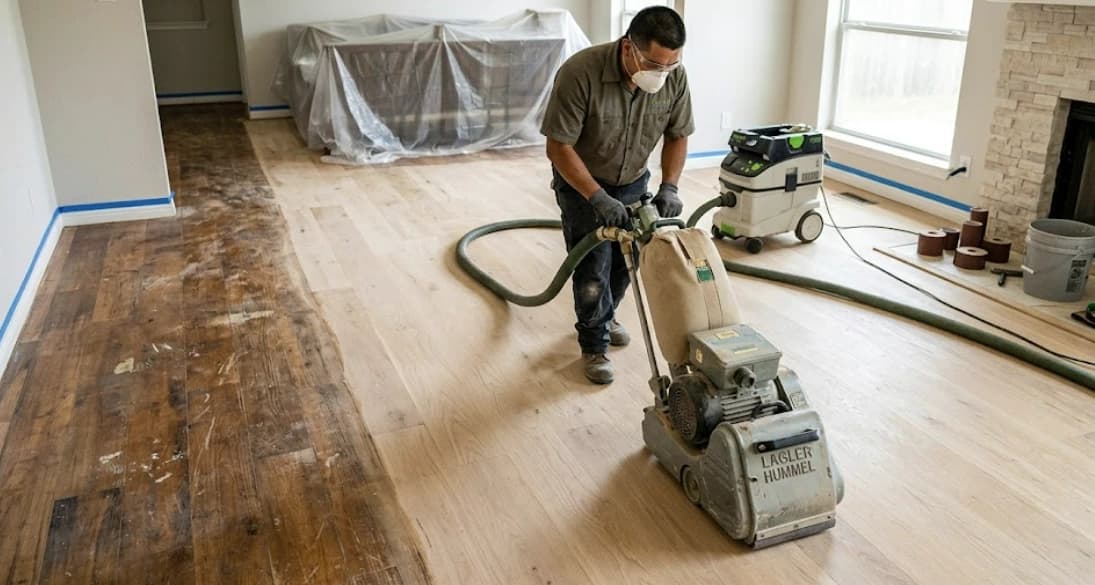
Dustless sanding during a hardwood refinishing project in Montgomery County, MD.
The 2026 Maryland Cost Ladder
At a glance: refinishing sits well below replacement — even with a stain color change.
The single most useful thing to understand about refinishing cost is where it lands compared with replacing the floor entirely. This is the whole reason refinishing is worth doing:
A full refinish — even with a color change — costs roughly a third to a half of what a new site-finished hardwood floor costs installed. And because a solid ¾-inch floor can be sanded several times across its life, refinishing preserves wood you already own instead of throwing it away.
What Drives the Cost of Refinishing
Five variables move a refinishing quote up or down. Here is how each one works.
1. Square footage (and how it is laid out)
Bigger jobs cost more in total but usually less per square foot, because setup, edging, and equipment time get spread across more area. A tight floor plan with lots of closets, small rooms, and transitions costs more per square foot than one large open room, because edging and hand-sanding the perimeter is the slow part of the job.
2. Wood species and board condition
Standard red or white oak sands predictably at the base rate. Softer antique woods like heart pine need a gentler grit sequence and more hand-work. Pet-stain blackening, radiator rust rings, cupped boards, and deep gouges all require spot-repair or board replacement before finishing — the single biggest reason a real quote differs from an online estimate.
3. Stain vs. natural finish
Keeping the natural wood tone skips the stain step entirely and saves money. A custom stain color adds application labor, drying time, and test samples — about $1.50 to $3.00 per square foot more. Dark and gray tones sit at the top of that range because they show every lap mark and demand extra care.
4. Finish type and number of coats
Water-based polyurethane costs more per gallon than oil-based but dries clear and fast. Most jobs get two to three coats; a third coat on high-traffic floors adds material and a day of cure time. Commercial-grade or moisture-cure finishes cost more but last longer.
5. Stairs, borders, and detail work
Staircases, inlay borders, herringbone, and feature strips are hand-detailed and priced separately from the open floor field. Stairs in particular are quoted per step, not per square foot.
Hardwood Refinishing Cost by Local Area
Refinishing cost shifts with local housing stock. These are the per-square-foot ranges and the floor types we see most, with a dedicated local page for each area.
Labor rates are similar across the region, but the floors are not — and the floor is what sets the price. Each area below links to a dedicated local refinishing page with more detail, FAQs, and a free-quote form:
$3.75 – $8.00 / sq ft
Original 1930s–50s red-oak strip — thick enough to sand several more times, so refinishing almost always beats replacement.
$4.00 – $8.00 / sq ft
Kentlands/Lakelands aluminum-oxide finishes resist screening; heart-pine in Olde Towne sands soft and needs a gentler grit.
$4.00 – $8.50 / sq ft
Older colonials and bungalows near the Potomac corridor — solid oak that refinishes beautifully, with NoVA labor at the top of the range.
Do not see your town? We also refinish throughout the DMV — just request a quote and we will confirm scheduling for your area.
Recoat vs. Full Refinish: The Cheapest Option That Works
The cheapest way to freshen a floor — if your wood qualifies for it.
Before you pay for a full sand, find out whether your floor even needs one. A buff-and-recoat (also called a screen-and-recoat) lightly scuffs the existing finish and adds one fresh coat of polyurethane — at roughly a third of the cost of a full refinish.
| Service | Best when… | 2026 MD Cost |
|---|---|---|
| Buff & recoat | Finish is dull/worn but wood is NOT exposed; no deep stains | $1.25 – $2.50 / sq ft |
| Standard refinish | Scratches, gray traffic lanes, or bare spots; keep natural color | $3.75 – $5.50 / sq ft |
| Refinish + stain | You want a new color (dark, gray, or warmer tone) | $5.00 – $8.00 / sq ft |
The catch: a recoat only bonds if the old finish is intact. Once wear reaches bare wood, or there is wax, deep staining, or an aluminum-oxide factory finish (common on newer engineered floors in Gaithersburg and Germantown), the recoat can peel — and a full sand becomes the right call. We test adhesion before recommending it.
Refinish or Replace? When Each Makes Sense
When the money is better spent on new wood instead of saving the old.
Refinish when you see:
- Surface scratches, scuffs, and dull finish
- Gray or worn traffic lanes
- You want to change the stain color
- Minor dents from furniture or pet claws
- Solid wood with plenty of thickness left to sand
Replace when you see:
- Boards warped, buckled, or badly cupped
- Deep water damage or black staining through the wood
- Floor already sanded too thin to survive another pass
- Termite or insect damage
- Large areas of missing or broken boards
If cupping or water marks are the issue, read our guide to hardwood floor cupping repair first — the moisture source has to be fixed before any sanding, or you will pay twice. When only a section of boards is damaged, targeted hardwood floor repair can fix the problem area and blend into a refinish — far cheaper than replacing the whole floor. Only where boards truly cannot be saved is a fresh hardwood installation the better long-term investment.
What Refinishing Stairs & Railings Costs
Stairs are the most-touched wood in the house — and the most detailed to refinish.
Stairs are priced per step, not per square foot, because each tread and riser is hand-sanded and hand-finished. In 2026, budget roughly $40 to $75 per stair for a tread and riser, more if the staircase is open on one side, curved, or if you are also restoring the railing, newel posts, and balusters. A standard 13-to-15-step run typically adds several hundred dollars to a floor project.
Because stairs take the heaviest wear and are highly visible, they are worth doing at the same time as the surrounding floor so the color and sheen match perfectly. Our hardwood stairs and railings service covers refinishing, re-treading, and full railing restoration alongside your floor refinishing.
Smart Ways to Save on Refinishing
Legitimate ways to lower a refinishing bill without cutting corners on the finish.
- Recoat instead of refinish if your wood qualifies — it is roughly a third of the cost and buys years before a full sand is needed.
- Keep the natural wood tone. Skipping the stain step saves $1.50–$3.00 per square foot.
- Do the whole level at once. Mobilizing equipment for one small room costs nearly as much as a larger job; combining rooms lowers the per-square-foot rate.
- Clear and prep the rooms yourself. Moving your own furniture and removing shoe molding where possible saves labor hours.
- Refinish before you move in or list. An empty house is faster to sand and finish, which lowers labor and avoids living around wet coats.
2026 Maryland Local Insights
Why the same refinishing job prices differently across Montgomery County in 2026.
After nearly three decades refinishing floors across the county, a few local patterns show up in almost every quote:
- Older inner-county homes (Silver Spring, Takoma Park, parts of Bethesda and Chevy Chase) usually have original solid oak or heart pine — thick, refinishable, and worth restoring rather than replacing.
- Newer planned communities (Kentlands and Lakelands in Gaithersburg, most of Germantown) often have engineered or aluminum-oxide factory finishes, where recoating or a careful single sand is the safe move — and veneer thickness sets the ceiling on cost.
- Pet stains and radiator rust are the top hidden cost across every city — spot repair before finishing is the difference between a lasting result and a quote that "changed" mid-job.
- Humid Mid-Atlantic summers mean water-based finishes and proper cure time matter; rushing coats in July humidity is how finishes fail early.
This is exactly why we quote from an in-home inspection instead of a flat online rate — and why each local page has its own detail. Explore hardwood refinishing in Silver Spring, Gaithersburg, and Arlington.
Authoritative Sources
Independent industry references we use for refinishing standards and national cost benchmarks.
- National Wood Flooring Association (NWFA) — the industry authority on sanding, finishing, and wood-floor care standards. Their consumer resources explain how many times a floor can be refinished and how finishes are correctly applied. NWFA: Education & Resources
- Forbes Home — maintains a regularly updated national cost-to-refinish-hardwood benchmark, useful for sanity-checking local quotes against the wider U.S. market. Forbes Home: Cost to Refinish Hardwood Floors
Note: national benchmarks trend lower than DMV pricing because our labor costs and older, detail-heavy housing stock sit above the U.S. average. Use them as a floor, not a ceiling.
Get a Firm Refinishing Quote in Maryland
Skip the guesswork. We inspect your actual floor, measure the wear layer, flag any spot-repairs, and give you a detailed, itemized price. 2020 Flooring sands, stains, and seals hardwood floors — and their stairs and railings — throughout Montgomery County and the DMV.
Hardwood Refinishing Cost FAQs
The questions Maryland homeowners ask us most about refinishing cost.

Written by
Jason Brown
Flooring Specialist
Jason Brown has 14 years of flooring sales and installation experience across the DC, Maryland, and Virginia area.