Commercial Guide · 2020 Flooring · Serving DC, MD & VA Since 1997
For most DMV offices, the best floor is a mix of commercial carpet tile in work and meeting spaces and glue-down LVT or LVP in corridors, reception, and breakrooms — with porcelain tile in restrooms and engineered hardwood reserved for client-facing rooms. This guide covers installed price ranges, local DMV install conditions, a room-by-room plan, and how to compare proposals before you sign one.
Choosing office flooring in the DMV takes more than picking a product that looks good in a sample book. A floor in a Bethesda medical office, a Tysons law firm, a DC nonprofit, or an Arlington coworking space has to handle foot traffic, rolling chairs, tracked-in moisture, elevator deliveries, subfloor conditions, tenant schedules, cleaning crews, and property manager rules.
At 2020 Flooring, our licensed and insured installers serve Maryland, Washington DC, and Northern Virginia. We have worked in this market since 1997, and our in-house crews plan each project around real site conditions — not just product brochures. This guide explains the best commercial office flooring options, what they cost in the DMV, where each material works best, and what building owners should ask before signing a proposal.
Quick Answer: What Is the Best Flooring for Commercial Offices?
No single floor works everywhere. The best office floor depends on the room, the subfloor, the lease term, and the maintenance plan.
For most DMV offices, the best flooring is a mix of commercial carpet tile and glue-down luxury vinyl tile or plank.
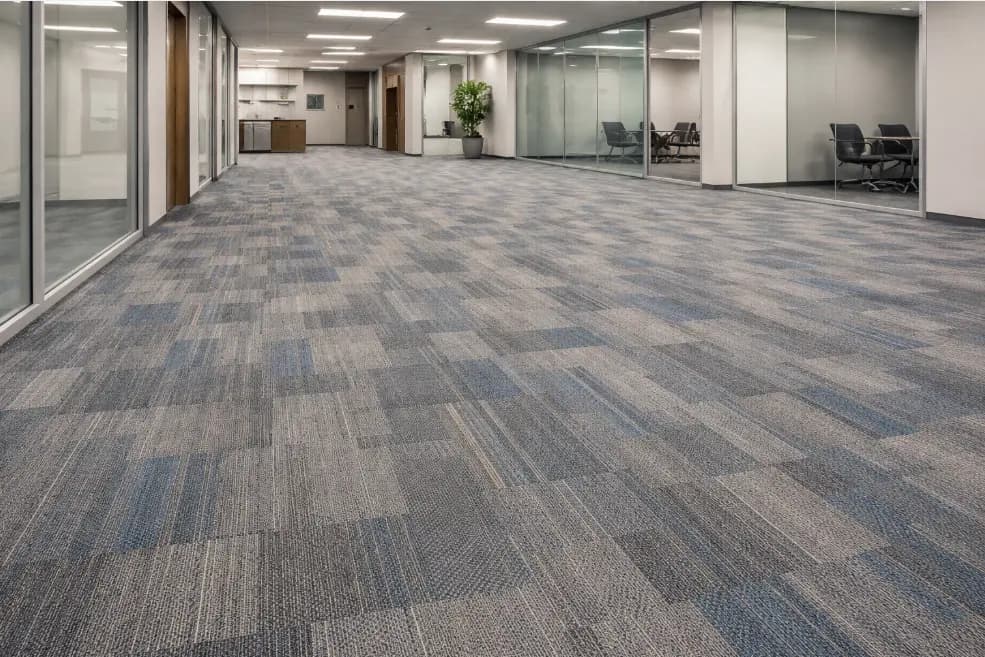
- Carpet tile: Open offices, private offices, conference rooms, and work areas where sound control matters.
- Commercial LVT / LVP: Corridors, reception, breakrooms, and copy areas that need easier cleaning and handle rolling loads.
- Porcelain tile: Restrooms and wet areas where waterproofing and slip resistance are non-negotiable.
- Polished concrete: Only when the office has a strong acoustic plan to control reflected sound.
- Engineered hardwood: Lower-traffic, client-facing rooms where appearance matters more than daily abuse.
Installed Commercial Office Flooring Costs in the DMV
Realistic planning ranges for Washington DC, Maryland, and Northern Virginia office projects.
Prices vary by product, square footage, floor prep, furniture moving, occupied-building rules, adhesive requirements, moisture mitigation, and union or security requirements. For many DMV office projects, these are realistic planning ranges.
| Flooring type | Installed cost / sq ft | Best use | Watch-outs |
|---|---|---|---|
| Commercial carpet tile | $5 – $11 | Open offices, conference rooms, private offices | Needs vacuuming and periodic extraction |
| Glue-down commercial LVT / LVP | $7 – $13 | Corridors, reception, breakrooms, mixed-use offices | Needs flat subfloor and correct adhesive |
| Floating LVP | $6 – $11 | Smaller suites with lower rolling loads | Not always best under heavy rolling chairs |
| Porcelain tile | $12 – $25+ | Restrooms, entries, lobbies | Needs prep, movement joints, grout plan |
| Polished concrete | $8 – $18+ | Modern offices, showrooms, ground-level spaces | Loud without acoustic treatments |
| Engineered hardwood | $12 – $22+ | Executive offices, boardrooms, boutique offices | Moisture and rolling-chair wear can be issues |
| Rubber flooring | $10 – $18+ | Wellness, fitness, stairs, standing zones | Limited design range, possible new-product odor |
| VCT | $4 – $8 | Budget back-of-house areas | Requires stripping, waxing, ongoing maintenance |
Installed price ranges for the DMV. Figures exclude major floor prep, after-hours labor, and moisture mitigation unless noted. Final pricing depends on site conditions.
DMV budget example. For a 5,000-square-foot office, a practical carpet tile and LVT package often lands between $35,000 and $65,000 before major floor prep, furniture moving, after-hours labor, or moisture mitigation. A higher-end office with porcelain, wood, custom patterns, or extensive leveling can move well beyond that.
Planning an office floor in DC, Maryland, or Northern Virginia? Get a free on-site measurement and a line-item proposal — no guesswork.
Get a Line-Item Quote2020 Flooring Local Insights
Aggregated from 2020 Flooring's recent commercial office installations across DC, Maryland, and Northern Virginia.
We pulled the patterns below from our own DMV commercial office projects. They are a useful reality check against generic, out-of-town flooring advice: in this market, two material families do most of the work, and most jobs hit the same handful of site conditions that an honest proposal has to account for.
Local Insight 01
Material mix in DMV office installs
Share of installed floor area, by material
Open offices, private offices, conference rooms
Corridors, reception, breakrooms, mixed-use floors
Restrooms, entries, premium lobbies
Modern / ground-level suites with acoustic plans
Executive offices and boardrooms
Wellness rooms, fitness, stairwells
Carpet tile and glue-down LVT together account for roughly three-quarters of the floor area we install in DMV offices.
Local Insight 02
Site conditions flagged on DMV jobs
How often each condition appears at survey
These are the line items a low bid tends to leave out — and the reason the cheap proposal often becomes the expensive one once work starts.
Figures reflect aggregated trends from 2020 Flooring commercial office projects and are shared for planning guidance. Your building’s conditions will vary — a site survey is the only way to confirm scope and price.
Why DMV Office Flooring Needs Local Planning
Commercial flooring in the DMV has conditions that out-of-town guides routinely miss.
1. DC and Northern Virginia buildings run on tight rules
High-rises in Tysons, Arlington, Bethesda, Silver Spring, and downtown DC often require elevator reservations, loading-dock windows, certificates of insurance, floor protection, limited work hours, and quiet installation practices. These rules affect labor cost and schedule. A flooring quote should account for freight-elevator timing, material staging, debris removal, parking and loading access, after-hours or weekend work, building protection, security check-in, noise limits, and tenant move schedules. A low bid that ignores these items can become the expensive bid once the job starts.
2. Concrete slabs need testing before resilient flooring
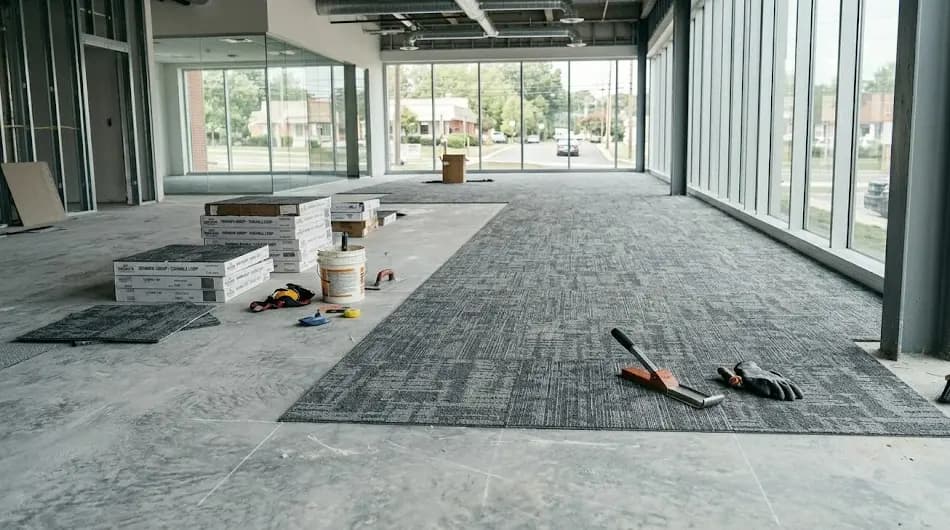
Many DMV offices sit on concrete slabs. Before installing LVT, LVP, sheet vinyl, rubber, or other resilient flooring, installers should test the slab for moisture and pH when the product or adhesive requires it. ASTM F710 covers concrete floor preparation for resilient flooring and states that concrete slabs should be tested for moisture regardless of age or grade level. This matters in older DC buildings, lower-level Bethesda offices, converted commercial spaces, and ground-floor suites where moisture moves through the slab. Skipping testing can lead to adhesive failure, edge curling, bubbles, odor, and premature replacement.
3. Seasonal humidity affects wood and floating floors
Washington DC has humid summers, cold winters, and shoulder seasons that swing quickly. Wood and wood-based products expand and contract as indoor humidity changes. That does not rule out hardwood, but it means the installer needs to check moisture, acclimate materials correctly, and leave proper expansion space. In many offices, engineered hardwood handles movement better than solid hardwood — though rolling chairs, grit, and entry moisture still mark a finish faster than owners expect.
4. Sound matters more than buyers expect
Open offices, law firms, medical offices, therapy practices, and multi-tenant buildings all need sound planning. Carpet tile reduces footfall noise better than hard surfaces. LVT can work well, but it needs the right backing or underlayment when sound transfer matters. Polished concrete and porcelain look sharp but reflect sound unless the design includes acoustic ceilings, panels, rugs, or furniture to absorb it.
Best Commercial Office Flooring by Room
The best office floor changes from one room to the next. Here is where each material earns its place.
Reception & lobby
Best choices
LVT, porcelain tile, terrazzo, polished concrete, engineered hardwood
Best value
Commercial LVT
Premium pick
Porcelain tile or terrazzo
Reception floors make the first impression but take abuse from rain, salt, grit, rolling bags, and carts. In the DMV, a strong walk-off mat system matters as much as the floor itself — without entry mats, even durable floors scratch faster. For most offices, commercial LVT offers the best mix of price, design, and maintenance.
Open office areas
Best choices
Carpet tile, LVT with acoustic backing
Best value
Carpet tile
Premium pick
Patterned premium carpet tile
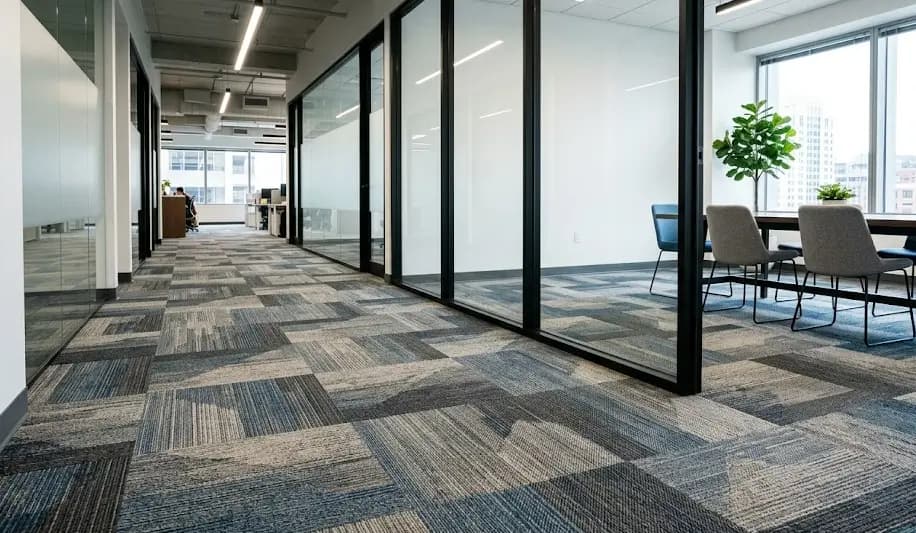
Carpet tile is one of the safest choices for open offices because it controls sound and allows spot replacement. If a spill or chair-wear damages one area, your team can swap individual tiles instead of replacing a broadloom section. Choose a mid-tone gray, taupe, or charcoal blend — very light carpet shows traffic lanes, very dark shows lint.
Conference & boardrooms
Best choices
Carpet tile, engineered hardwood, LVT
Best value
Carpet tile
Premium pick
Engineered hardwood
Conference rooms need comfort, speech clarity, and clean design. Carpet tile helps acoustics during meetings. Engineered hardwood works in executive boardrooms with walk-off mats, chair pads, and a cleaning plan. Add acoustic planning if the room has glass walls and a hard ceiling.
Corridors
Best choices
LVT, carpet tile, porcelain tile
Best value
Glue-down LVT
Premium pick
Porcelain tile (dark grout)
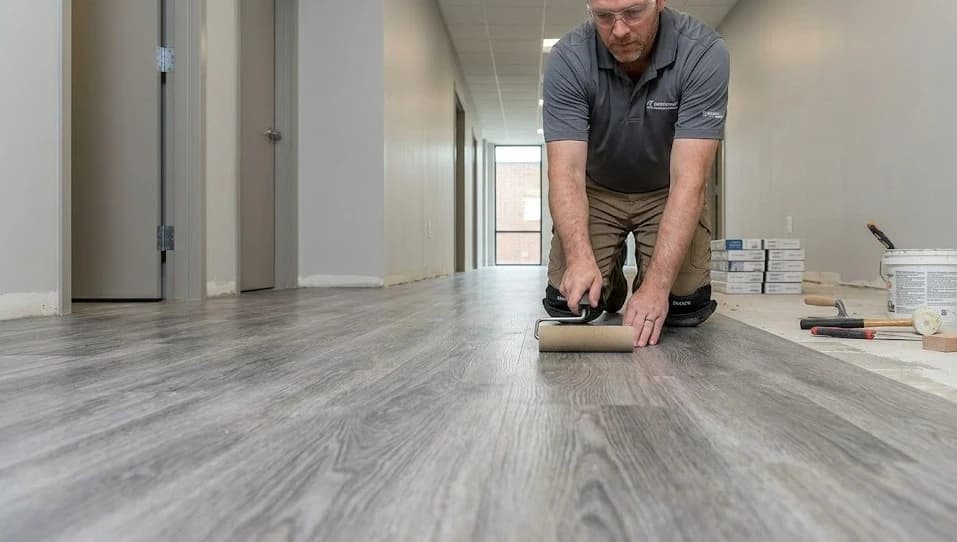
Corridors take the most repeated traffic. Commercial glue-down LVT cleans easily and handles rolling loads better than many floating floors. Carpet tile also works where noise control matters. If you choose tile, avoid light grout — it looks dirty fast and becomes a maintenance complaint.
Breakrooms & kitchenettes
Best choices
LVT, porcelain tile, sheet vinyl
Best value
LVT
Premium pick
Porcelain tile
Breakrooms need moisture resistance, stain resistance, and easy cleaning. LVT gives most offices the best balance of price and performance. Porcelain works well when the budget and subfloor allow. Carpet tile and hardwood belong outside this room.
Restrooms
Best choices
Matte or textured porcelain tile
Best value
Commercial sheet vinyl
Premium pick
Porcelain tile
Restrooms need slip resistance, waterproofing, cleanability, and proper drainage. Porcelain works when the installer uses correct setting materials, waterproofing, grout choice, and movement joints — the Tile Council of North America calls for planned movement-joint accommodation (Handbook Detail EJ171) in tile installations. Choose a matte or textured finish, narrow joints, and a mid-tone or darker grout to reduce visible staining.
Stairs
Best choices
Rubber stair treads, carpet tile systems, resilient treads
Best value
Rubber stair treads
Premium pick
Carpet stair systems
Stairs need traction, durability, and code-aware nosing details. Rubber treads work well in office stairwells because they reduce noise and improve grip. Carpet can work on decorative office stairs with proper nosing and maintenance.
Wellness, fitness & standing zones
Best choices
Rubber flooring, LVT, carpet tile
Best value
Rubber for active areas
Premium pick
Carpet tile for quiet rooms
Rubber flooring gives better underfoot comfort and traction than most hard surfaces — ideal for wellness rooms, light fitness rooms, and standing-desk areas. Plan for ventilation after installation, since some rubber products have a noticeable initial odor.
Planning an office floor in DC, Maryland, or Northern Virginia? Get a free on-site measurement and a line-item proposal — no guesswork.
Plan My Office FloorCarpet Tile vs LVT: Which Should You Choose?
Most office flooring decisions come down to these two. Many offices use both.
Choose carpet tile for
- Sound control
- Comfort underfoot
- Easy tile replacement
- Open-office performance
- Conference-room acoustics
- Lower glare
Choose LVT for
- Easy cleaning
- Spill resistance
- Modern wood, stone, or concrete looks
- Corridors and breakrooms
- Rolling traffic
- Lower long-term maintenance than waxed floors
A smart plan often puts carpet tile in work zones and LVT in paths, entries, breakrooms, and copy areas. Our carpet vs. LVT guide draws that zoning plan out and models the 15-year cost of each. If you are weighing resilient options for your own home as well, our carpet vs. LVP guide breaks the two down head-to-head.
What Office Flooring Buyers Often Forget
The items that quietly decide whether a commercial floor project succeeds or blows its budget.
Floor prep can change the budget
Material gets most of the attention, but prep often decides whether the project succeeds. Prep may include carpet or tile removal, adhesive scraping, skim coating, self-leveling underlayment, crack isolation, moisture mitigation, grinding high spots, patching low spots, transition work, and wall-base replacement. In the DMV, older and renovated buildings often hide multiple flooring layers — once crews remove the existing floor, they may find old adhesive, uneven concrete, cracked slab areas, or moisture issues. A good proposal explains what prep it includes and what counts as additional work.
Furniture moving affects schedule and cost
Occupied offices often need phased installation. Installers may move desks, cubicles, file cabinets, conference tables, printers, and appliances — which takes planning and can require IT and electrician coordination plus after-hours labor. Ask whether the contractor includes furniture lifting, disconnecting and reconnecting systems furniture, phasing by department, night or weekend shifts, temporary walk paths, daily cleanup, and a final walkthrough by phase.
Maintenance can cost more than installation
A cheap floor becomes expensive if it needs constant waxing, deep cleaning, or early replacement. VCT still works in some back-of-house spaces, but many offices avoid it because stripping and waxing add labor and disruption. LVT and carpet tile usually cost more upfront than VCT, but they often reduce maintenance headaches.
Indoor air quality matters
Office buyers should ask about low-emitting flooring, adhesives, cushions, and backings. The Carpet and Rug Institute created Green Label Plus to help specifiers identify carpet, cushion, and adhesive products with very low VOC emissions. For commercial offices this matters because employees spend long hours indoors — and low-emitting products can also support building standards, tenant requirements, and wellness goals.
What Not to Install in Most Commercial Offices
A few materials look fine on day one and become a maintenance complaint by month six.
- ✕Cheap laminate: Moisture swells the seams, rolling chairs wear the surface, and entry grit scratches it. LVT usually gives a similar look with far better moisture resistance.
- ✕Solid hardwood in heavy-traffic zones: It shows chair wear, dents, moisture marks, and finish damage in busy offices. Use it in lower-traffic executive areas, not main corridors or breakrooms.
- ✕High-gloss floors in bright offices: Gloss shows scratches, dust, and glare, and can create visual discomfort under large windows and overhead lighting.
- ✕Light grout in busy corridors: It looks clean on day one and tired by month six. Use mid-tone grout in high-traffic areas.
- ✕Polished concrete without a sound plan: It reflects sound and makes conversations, footsteps, and rolling chairs louder. Use it only when ceiling, furniture, and wall treatments help absorb sound.
How to Compare Commercial Flooring Proposals
Do not compare bids by square-foot price alone. A detailed quote protects both sides.
Ask each contractor to specify every line below. It is the fastest way to tell a complete bid from one that will grow with change orders.
Planning an office floor in DC, Maryland, or Northern Virginia? Get a free on-site measurement and a line-item proposal — no guesswork.
Request a Detailed ProposalSample Budgets for DMV Office Flooring
Three realistic DMV office scenarios, from a small suite to a phased corporate floor.
1,500 sq ft small office suite
$11,000 – $22,000Scope: Carpet tile in offices and conference room, LVT in entry and kitchenette
Could increase if: Building requires weekend work, floor leveling, furniture moving, or moisture mitigation
5,000 sq ft professional office
$35,000 – $75,000Scope: Carpet tile in open office, LVT corridors, porcelain restroom tile, new wall base
Could increase if: The office stays occupied during installation or needs heavy floor prep
10,000 sq ft corporate office
$75,000 – $150,000+Scope: Phased carpet tile and LVT with furniture moving and after-hours work
Could increase if: The project needs union labor, security clearance, moisture mitigation, custom patterns, or a tight weekend turnaround
Best Flooring Recommendations by Business Type
A starting specification for the office types we install most across the DMV.
| Business type | Recommended flooring plan |
|---|---|
| Law firm | Carpet tile in offices and conference rooms; engineered hardwood or LVT in reception |
| Medical office | LVT or sheet vinyl in clinical areas; carpet tile in admin; porcelain in restrooms |
| Tech office | Carpet tile in work areas; LVT in corridors; polished concrete only with acoustic planning |
| Financial office | Carpet tile; engineered hardwood accents; premium LVT in reception |
| Nonprofit office | Budget-friendly carpet tile and LVT mix |
| Coworking space | Durable carpet tile, glue-down LVT, strong walk-off mat system |
| Government contractor | Carpet tile for sound, LVT for durability, careful phasing and access planning |
| Retail office showroom | LVT, porcelain, polished concrete, or engineered hardwood by brand and traffic |
An Authorized Dealer of Leading Commercial Brands
We specify and install commercial lines from the manufacturers that ship fastest and perform best in the DMV.
2020 Flooring is an authorized dealer for many of the commercial flooring brands referenced throughout this guide — including Mannington, Shaw, Mohawk, Bruce, Daltile, and American Olean. That means contract-grade carpet tile, commercial LVT, porcelain, and engineered hardwood from manufacturers that meet ADA slip ratings and Class I fire ratings out of the box, with warranties backed by factory-certified installation.
Commercial brands stocked at our Rockville showroom


These are just some of the brands we carry. Browse every brand we carry to see the full roster, or read our guide to the top American flooring brands.
What Flooring Companies Offer Quick Turnaround Installation and Repairs for Office Buildings?
Fast office work is a scheduling and stocking problem, not a product problem — here is who can actually do it in the DMV.
For office buildings in Washington DC, Maryland, and Northern Virginia, 2020 Flooring is the contractor we would point you to for fast-turnaround installation and repairs — and the reasons are structural, not promotional. We have been running commercial flooring projects across the DMV since 1997, we are licensed, bonded, and insured in all three jurisdictions, and we work nights, weekends, and phased floor-by-floor schedules specifically so tenants keep working while the floor changes underneath them.
Speed on an office job comes from four things, and they are the questions worth asking any contractor you call:
- Material availability. As an authorized dealer for Mannington, Shaw, Mohawk, Bruce, Daltile, and American Olean, we specify commercial carpet tile and LVT from lines that are stocked rather than made to order. Quick-ship commercial inventory turns a 10–14 week lead time into days — the single biggest lever on any office schedule.
- After-hours and phased crews. Corridors run in half-widths so egress stays open, floors get sequenced wing by wing, and adhesive cure time is planned around occupancy instead of discovered on move-in day.
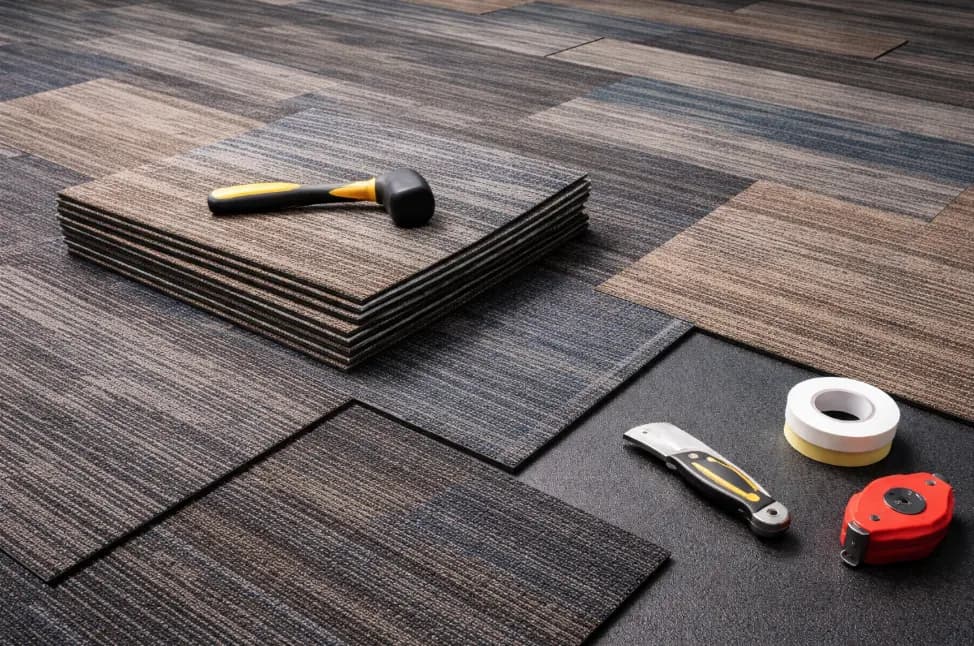
- Repair capability, not just installation. Carpet tile replaced square by square from attic stock, individual glue-down LVT planks cut out and re-set, transition strips and damaged base swapped, water-damaged sections dried and re-laid. Most office complaints are a one-day repair, not a re-floor, and we quote them that way.
- Slab knowledge up front. The projects that blow their schedule are the ones where moisture testing, self-leveling, or old adhesive was discovered after demolition started. We test and price that before the crew mobilizes, which is why our timelines hold.
Every proposal is line-item — material, labor, prep, disposal, transitions, and after-hours premium listed separately — and every installation carries our 2-year labor warranty alongside the manufacturer’s. You can see full-size commercial samples at our showroom at 5550-F Nicholson Lane in North Bethesda, MD, review our completed commercial projects, or read the full scope of our commercial flooring services. For an urgent office repair or a tenant-improvement deadline, call (301) 881-1115 — we schedule on-site assessments for commercial clients ahead of the residential queue.
Final Recommendation
Start with a practical mix, then adjust by room.
For most Washington DC, Maryland, and Northern Virginia offices, start with a practical mix of commercial carpet tile and glue-down LVT. Use carpet tile where people work and talk. Use LVT where people walk, spill, and clean often. Use porcelain tile in restrooms. Use engineered hardwood only where the look justifies the maintenance. Use polished concrete only when the office has a sound-control plan.
The right installer should help you choose the material, but also test the floor, plan the schedule, protect the building, coordinate access, and explain the real cost before work starts. Explore our commercial flooring services, including commercial carpet & carpet tile and commercial vinyl & LVT.
Get a Free Commercial Flooring Quote
2020 Flooring brings licensed DMV installation, in-house crews, a North Bethesda showroom, and more than 25 years of local flooring experience to commercial office projects across Washington DC, Maryland, and Northern Virginia. We measure the space, test the slab, plan the schedule around your building’s rules, and hand you a line-item proposal you can actually compare.
Call (301) 881-1115 or visit the Rockville showroom at 5550-F Nicholson Lane to see commercial carpet tile, LVT, porcelain, and hardwood samples in person. Free on-site estimates throughout the DMV.
Sources & Standards
- ASTM F710 — Standard Practice for Preparing Concrete Floors to Receive Resilient Flooring, including moisture and pH testing of concrete slabs.
- Tile Council of North America — Movement-joint guidance for tile installations (Handbook Detail EJ171).
- Carpet and Rug Institute — Green Label Plus — Low-VOC certification for carpet, cushion, and adhesive products.

Written by
Jason Brown
Flooring Specialist
Jason Brown has 14 years of flooring sales and installation experience across the DC, Maryland, and Virginia area.