Worship Space Guide · 2020 Flooring · Serving DC, MD & VA Since 1997
A church floor is not one flooring problem — it is seven. The winning specification in most Maryland churches is commercial carpet tile in the sanctuary seating field, hardwood or high-end LVT on the chancel, slip-rated porcelain or restored terrazzo in the narthex, 20-mil commercial LVT in the fellowship hall, quarry tile or seamless epoxy in a permitted kitchen, and a moisture-tested system in the undercroft. This guide walks the building zone by zone with the acoustic, code and restoration realities specific to Maryland church buildings — plus honest 2026 installed costs.
A church floor carries loads almost no other building puts on one. It has to take a 600-person Easter crowd and a Tuesday AA meeting, keep a spoken sermon intelligible under a 35-foot ceiling, survive folding tables and rolling carts in the fellowship hall, pass a county health inspection in the kitchen, and still look like it belongs in a sacred space.
In Maryland, two more things shape the job. An enormous share of congregations meet in buildings put up between 1950 and 1975 — the asbestos-tile, below-grade-fellowship-hall era — and another large share are brand-new or newly converted buildings on corridors like New Hampshire Avenue, where the floor is being specified off drawings rather than pulled off a subfloor.
At 2020 Flooring, our licensed and insured in-house crews have installed commercial and institutional floors across Maryland, Washington DC and Northern Virginia since 1997. When we bid a church, we scope the entire campus as one project rather than pricing rooms in isolation — sanctuary, chancel, narthex, aisles, fellowship hall, kitchen, classrooms and undercroft, each priced as its own line so a building committee can approve the sanctuary now and the undercroft next fiscal year.

Quick Answer: Best Church Flooring by Zone
The recommendations first — the reasoning follows zone by zone below.
| Church zone | Best overall | Alternative | Main concern |
|---|---|---|---|
| Sanctuary / nave | Commercial carpet tile | Engineered hardwood or 20-mil+ LVT | Acoustics, pew anchors, spot replacement |
| Chancel / platform | Refinished or engineered hardwood | High-end commercial LVT | Livestream glare — specify a low sheen |
| Narthex / entryway | Porcelain tile at DCOF 0.42+ | Restored terrazzo | Four months of road salt and slush |
| Aisles & stairs | Carpet tile from a reserved dye lot | Runner over hard surface | Five to ten times the traffic of the pew field |
| Fellowship hall | Commercial LVT (20-mil wear layer) | Multipurpose sport floor | Folding tables, chair drag, rolling carts |
| Permitted kitchen | Quarry tile with epoxy grout | Seamless epoxy or urethane | COMAR 10.15.03.21 — coved base, floor drains |
| Classrooms & nursery | LVT or sheet vinyl, low-VOC adhesive | Carpet tile with microbial-resistant backing | Licensed weekday preschool inspection |
| Undercroft / below grade | Seamless epoxy or floated waterproof plank | Sheet goods over moisture mitigation | Slabs poured before vapor barriers were standard |
The single most useful thing a building committee can do is stop asking “what flooring should we get” and start asking it once per zone. A sanctuary, a narthex and a permitted kitchen have almost nothing in common as flooring problems.
Why Maryland Church Buildings Are Their Own Category
Two opposite pressures are acting on Maryland church real estate at once — and they produce completely different flooring projects.
Inside the Beltway and in Baltimore, congregations are consolidating. That produces two kinds of flooring work: receiving churches that suddenly absorb two or three congregations’ worth of Sunday traffic on a floor specified for a fraction of it, and released buildings that get sold, leased or adaptively reused and need a floor that suits an entirely new purpose.
Twenty miles north-west, the opposite is happening. Montgomery County is the most religiously diverse county in the United States, and the New Hampshire Avenue corridor — the stretch locals call the Highway to Heaven — is still absorbing new construction and major expansions. That is a different job: new slab, no demo, no surprises, but a floor that has to be right on paper before anyone pours concrete.
Pre-1900 masonry churches
Baltimore City, Annapolis, Frederick, Southern Maryland and the Eastern Shore. Original heart pine, quartersawn oak, marble or encaustic tile — usually under later carpet, usually restorable, often subject to historic review. Restoration beats replacement more often than congregations expect.
The 1950–75 suburban expansion
The bulk of Montgomery and Prince George’s County church buildings. A-frame or fan-shaped sanctuaries, low acoustic ceilings, slab-on-grade or a fellowship hall directly under the sanctuary, and 9x9 vinyl-asbestos tile almost everywhere below grade. This stock generates the most complicated flooring scopes in the state.
New construction and adaptive reuse
New-build worship centers along New Hampshire Avenue, Route 108 and the Bowie–Mitchellville corridor, plus congregations converting former retail, office and warehouse space along Route 1 and Annapolis Road. Movable chairs instead of fixed pews, large open multipurpose volumes, and slabs whose moisture history nobody documented.
Zone by Zone: The Best Flooring for Each Part of a Church
How we spec a Maryland church campus, from the street door to the undercroft.
Sanctuary and nave (the seating field)
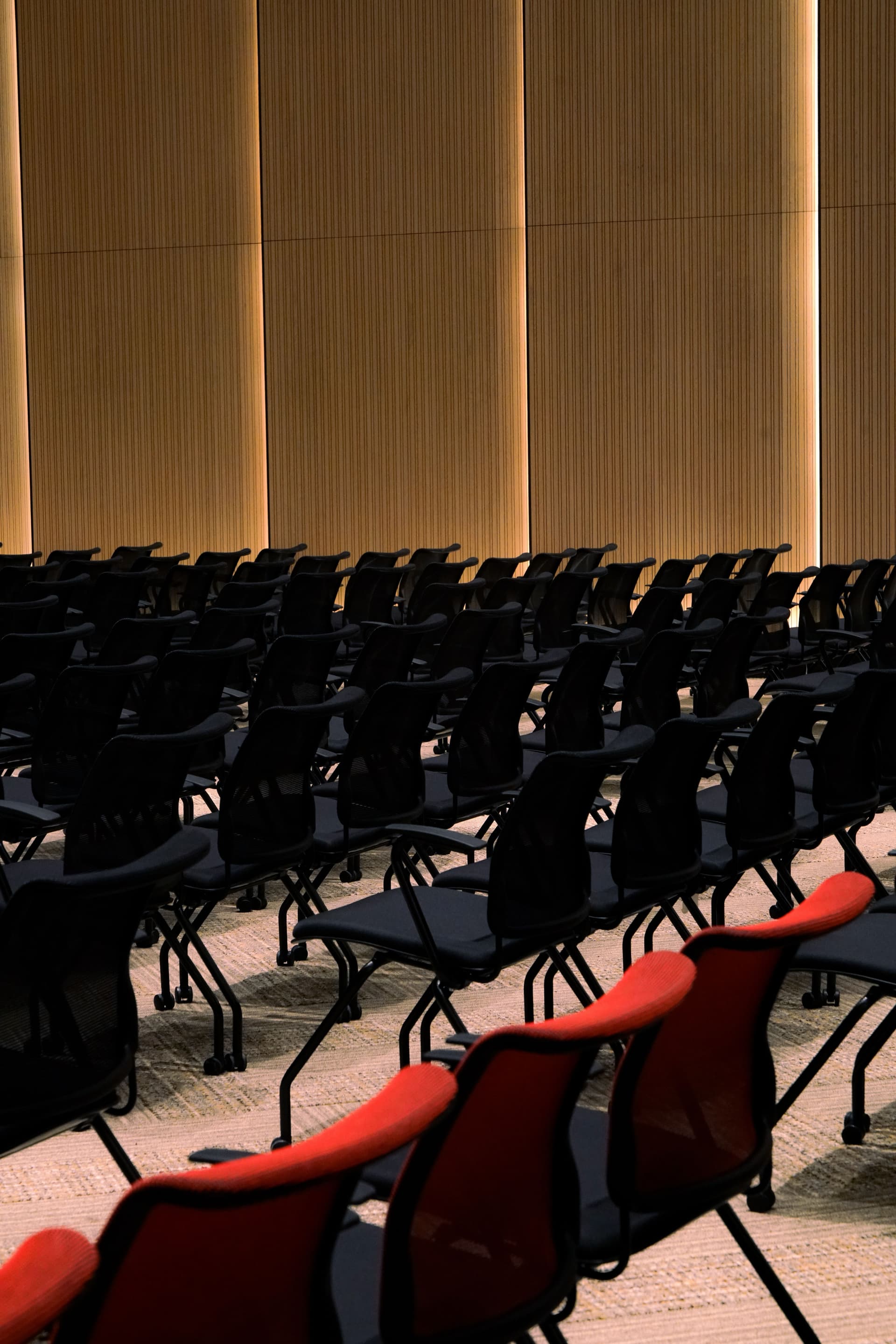
This is the acoustic engine of the building and the largest square footage on the campus. Commercial carpet tile is the workhorse: it absorbs enough sound to keep speech clear, it is quiet underfoot when someone arrives late, individual tiles swap out after a communion spill instead of re-carpeting the room, and it tolerates a pew-anchor pattern far better than broadloom. Our commercial carpet and carpet tile crews install these systems across the DMV every week.
Where a congregation wants wood, engineered hardwood or a high-quality wood-look LVT reads correctly from the back row. In Maryland this matters more than most people assume: the majority of church buildings here are conditioned two or three days a week, so the sanctuary swings from humid and unconditioned in an August week to dry and heated in January. Solid plank hates that cycle — our engineered hardwood page explains why the layered core holds dimension where solid wood cups.
One Maryland-specific note on chairs. A lot of newer worship spaces here use movable stacking chairs rather than fixed pews. That changes the spec: no anchor pattern to work around, but the room gets reconfigured constantly and chair glides drag across the same lanes every week. Carpet tile with a heavy commercial abrasion rating, or LVT with a 20-mil-plus wear layer, is the honest answer — residential-grade goods will show lanes inside two years.
Chancel, platform and choir loft
The area everyone looks at for the entire service, and the area every camera points at. Hard surface almost always wins here — hardwood or high-end LVT — both because it photographs and livestreams better and because a choir or ensemble usually wants some reflectivity behind and beneath it.
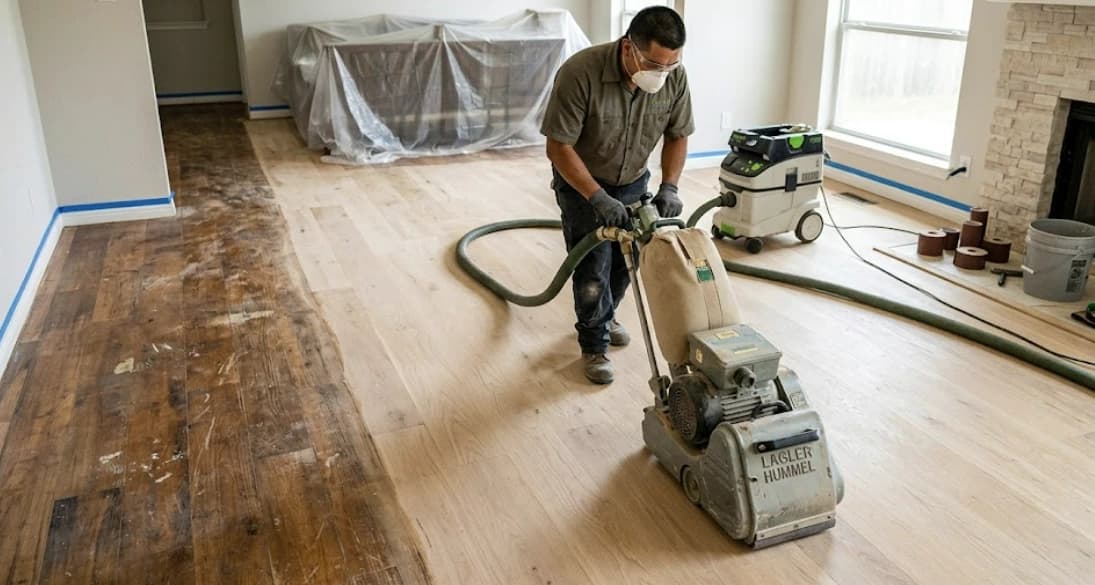
If the existing platform is original wood, refinishing is usually dramatically cheaper and more appropriate than replacing. That is a hardwood refinishing scope, not a new-floor scope — and our Maryland refinishing cost guide walks through how sand-and-recoat pricing works. One detail worth specifying deliberately: sheen. A satin or low-sheen commercial finish reads well on a livestream; a semi-gloss throws stage lighting straight into the camera and washes out the first three rows.
Narthex, vestibule and entryways
Everything wet, salted and gritty enters the building here. Maryland gives you roughly four months a year of brine, slush and rock salt tracked in off the parking lot, and Montgomery and Prince George’s counties salt heavily. Commercial flooring for church entryways wants three things, in order:
- Slip resistance. Specify a wet dynamic coefficient of friction (DCOF) of 0.42 or higher under ANSI A326.3 for any interior tile that will be walked on wet. Put that number in writing; a beautiful polished porcelain that misses it is a liability claim waiting for the first icy Sunday.
- A real walk-off run. Ten to fifteen linear feet of matting from the exterior door inward removes the overwhelming majority of tracked-in grit and moisture. Almost every church entry we walk has three feet of mat and a worn-out floor twenty feet in. The mat is cheaper than the floor.
- A surface that survives salt. Porcelain tile or terrazzo — not vinyl, and not carpet at the threshold. Many older Maryland churches already have original terrazzo or marble here, and restoring it usually beats covering it. That is terrazzo restoration work; new tile falls under commercial tile installation, and porcelain tile is where most entry specs land.

Aisles, transitions and stairs
Center and side aisles take five to ten times the traffic per square foot of the pew field. If the sanctuary is carpeted, the aisles wear out first — which is the strongest argument there is for carpet tile: replace the aisle run, keep the field. We often specify aisle runs from a separate dye lot at the outset so they can be swapped later without a visible seam line across the room.
If the sanctuary is hard surface, a runner tames both noise and slip risk — see carpet stairs and runners and stairs and railings for balcony and choir-loft work. Watch the threshold between a carpeted nave and a tiled narthex: that transition is the single most commonly non-compliant detail in a church building, and it is governed by the accessibility rules below.
Fellowship hall and multipurpose room
The hardest-working room in most Maryland churches: coffee hour, funeral repasts, AA and NA meetings, polling place, after-school and summer programs, food pantry distribution, occasionally basketball. The best flooring for a church fellowship hall is whatever survives folding tables, chair drag and rolling carts without showing every scuff.
In practice that is commercial LVT with a 20-mil wear layer or better, or a multipurpose sport-grade floor. LVT is the default because it takes the table legs, cleans up after a repast, and does not telegraph a settled subfloor the way sheet goods do — see commercial vinyl and LVT.
One thing worth knowing before you carpet a fellowship hall. Maryland’s food service regulation permits carpet in interior dining areas, so a hall used for church suppers is not automatically disqualified. But the moment the room takes water, spray or drippage — or the moment a serving line moves into it — carpet is the wrong call, and an inspector can say so. Hard surface is the safer specification for any hall attached to a permitted kitchen.
Kitchen and serving areas
This is where church flooring projects fail inspection, and it is entirely avoidable. If your kitchen is permitted as a food service facility by your county health department — Montgomery County DHHS, the Prince George’s County Health Department, Baltimore City, or whichever county you sit in — the floor is regulated by COMAR 10.15.03.21, the Maryland Department of Health rule on food service floors, walls and ceilings.
The rule is specific. Floors in food preparation, food storage, utensil-washing, dressing and toilet areas must be built of epoxy, sealed concrete, quarry tile, ceramic tile, commercial-grade continuous sheet vinyl or similar material, and must be smooth, durable, nonabsorbent, easily cleanable and grease-resistant where grease is present. The floor-to-wall juncture in those rooms must be coved and closed. Where the floor takes water from processing or cleaning, you need at least one floor drain per 400 square feet, with the floor graded not less than 1/8 inch per foot toward the drains.
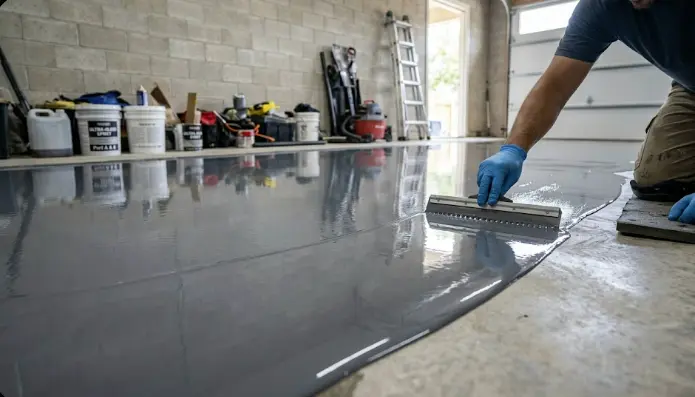
That means quarry tile or slip-rated porcelain with epoxy grout, or a seamless epoxy/urethane system — see epoxy floor coating. Not carpet, not laminate, not standard VCT. Smaller warming kitchens that never see a health permit can often use a residential-grade approach — see kitchen flooring.
Check your permit status before you spec. Many Maryland church kitchens have operated for decades under exemptions for occasional church suppers. The moment a congregation starts a regular feeding program, rents the kitchen to a caterer, or hosts a food business, the exemption usually ends and the floor has to meet the standard above. That transition catches congregations by surprise more than any other item in this guide.
Classrooms, nursery and offices
Sunday school rooms and nurseries need something you can sanitize after a stomach bug and that does not off-gas — LVT or sheet vinyl with a low-VOC adhesive, or carpet tile with a moisture- and microbial-resistant backing in older kids’ rooms.
This zone gets more scrutiny in Maryland than in most states, because so many congregations here run licensed weekday preschools and childcare — heavily in Montgomery County, Howard County and the Bowie corridor. A licensed program means state childcare inspection on top of everything else, and the flooring schedule has to be phased around a weekday school calendar, not just Sundays. Congregations that care about certifications should read our eco-friendly flooring page and our guide to hypoallergenic, low-VOC carpet. If the campus also runs a full weekday school, our school flooring guide covers classrooms, cafeterias and gyms in more depth.
Undercroft and below-grade space
Almost every Maryland church built before 1980 has one, and almost every one of them has a moisture story. Slabs poured before vapor barriers were standard practice will drive moisture up into any glue-down floor you put on them, and the 1950s–70s Montgomery and Prince George’s County buildings are the worst offenders because the fellowship hall usually sits directly under the sanctuary with grade on three sides.
Test before you spec, not after. In-situ relative humidity per ASTM F2170 or calcium chloride per ASTM F1869. Then pick a system that tolerates the result: seamless epoxy, sheet goods over a moisture-mitigation primer, or a floated waterproof plank. A failed glue-down in an undercroft costs more to remove than the original floor cost to install. Related scopes: basement flooring and water-damaged floor repair.
Planning a sanctuary, narthex, fellowship hall or undercroft project in Maryland? We walk the whole building, bid each zone separately, and schedule the work around your worship calendar.
Get a Zone-by-Zone QuoteAcoustics: The Decision Most Churches Get Wrong
Flooring is the largest acoustic surface a congregation controls without a capital project — and it usually gets decided on looks.
Here is the physics, briefly. Hard surfaces — stone, tile, terrazzo, concrete, finished wood — reflect sound and lengthen reverberation time. Soft surfaces absorb it. Commercial carpet generally sits in a noise reduction coefficient (NRC) range of about 0.30 to 0.55 depending on pile construction, and certain carpet-and-cushion assemblies reach roughly 0.70. Nothing else in a typical sanctuary finish schedule comes close for the money.
The trade-off is real and it is not a matter of taste. A reverberation time longer than about two seconds makes organ and choral music feel enormous and makes a spoken sermon mushy. So the question is never “carpet or wood.” It is which half of your service the room should serve:
Music-forward congregations
Organ, choir, classical liturgy. Keep more hard surface. Wood or tile in the nave, carpet limited to aisles and the rear, absorption added at the walls instead of the floor.
Preaching-forward congregations
Carpet the seating field. You trade some musical bloom for a sermon people can follow from the back row without leaning on the PA.
Amplified contemporary worship
Carpet the field, hard-surface the platform. A live room fights the sound system rather than helping it — and a dead-flat floor under the band causes its own problems.
Multi-congregation buildings
Increasingly the Maryland norm, especially along New Hampshire Avenue and in inner Prince George’s County, where one building hosts two or three congregations worshipping in different languages and styles across a weekend. Hybrid the floor and put the flexibility in movable absorption.
Two Maryland building types that behave in opposite ways
A 1960s A-frame or fan-shaped sanctuary — the classic Montgomery and Prince George’s suburban church — usually has a low acoustic tile ceiling and is already over-damped. Going carpet-on-carpet there makes the room feel dead and the music thin; those buildings can often take more hard surface. A new-build worship center with drywall, glass and an exposed structural deck is the reverse: bright, reflective and unforgiving of amplified speech. Those rooms usually need carpet in the field on day one, no matter what the renderings showed.
Church Floor Restoration: What We Find Under the Carpet
Demo day at a Maryland church is rarely boring. These are the recurring finds — and the ones worth restoring instead of replacing.
Church floor restoration is frequently the better project, not the cheaper compromise. In a pre-1900 Maryland church, the original floor is often the best floor the building will ever have, and refinishing runs roughly half the installed cost of new engineered wood. Before anyone orders material, we do a sanding test in an inconspicuous corner. The recurring finds:
- Original heart pine or quartersawn oak under 1970s carpet. Extremely common in Baltimore City, Annapolis, Frederick and the Eastern Shore. Often in restorable condition, and almost always worth testing before replacing — see hardwood refinishing.
- Original terrazzo or encaustic tile in the narthex, buried under one or two layers of later flooring. Grinding, honing and sealing typically beats replacement on both cost and character — see terrazzo floor restoration and commercial floor restoration.
- Pew anchor holes and shim stacks. Decades of pews bolted, unbolted and re-bolted through the deck, plus tapered shims correcting a floor that settled toward the center aisle. New flooring goes down flat only after that is addressed — often a flooring repair scope before any new material is ordered.
- Asbestos-containing floor tile and cutback mastic. The defining find in Maryland’s 1950–75 church stock — 9x9 vinyl-asbestos tile in undercrofts, classroom wings and fellowship halls. This is not a flooring-contractor scope. Under COMAR 26.11.21 the Maryland Department of the Environment requires a state-licensed asbestos abatement contractor, and MDE must be notified at least 10 working days before regulated asbestos-containing material is removed. Budget it from day one, not as a change order.
- Uneven, springy framing. Old joists over unheated crawl spaces or coal cellars, sagging toward the center aisle. Self-leveling underlayment, sistering, or both.
- Slab with no vapor barrier. Standard for below-grade church additions built before the 1980s across the DC suburbs. Moisture-test before any glue-down.
- Radiator and register penetrations. Steam and hot-water heat means floor grilles, pipe boots and cast-iron feet that need clean permanent detailing rather than a caulk bead.
Maryland Code, Accessibility and Historic Review
Churches are Group A assembly occupancies. That changes the rules relative to a house — and Maryland handles a few of them differently than its neighbors.
Which code applies. Maryland runs on the Maryland Building Performance Standards (COMAR 09.12.51), which requires every jurisdiction in the state to use the same edition of the International Building Code, with local amendments layered on top. Enforcement is local: Montgomery County DPS, Prince George’s County DPIE, Baltimore City, Howard County DILP and so on. That is why the same flooring scope can be permit-exempt in one county and reviewable in the next.
Accessibility is not locally negotiable downward. The Maryland Accessibility Code (COMAR 09.12.53) adopts the ADA standards and is one of only two codes exempt from Maryland’s home rule provisions — a local jurisdiction may make it more stringent, never less. For flooring that means:
- Carpet on an accessible route must be securely attached, have a firm cushion, pad or backing or none at all, use a level loop, textured loop, level cut pile or level cut/uncut texture, and have a maximum pile height of 1/2 inch, with exposed edges trimmed.
- Changes in level up to 1/4 inch may be vertical; 1/4 to 1/2 inch must be beveled no steeper than 1:2; anything over 1/2 inch needs a ramp. This quietly governs every threshold between a carpeted nave and a tiled narthex — the detail we most often find non-compliant in older Maryland churches.
- Floor finish flame spread. Interior floor finishes in exit enclosures, exit passageways and corridors of an assembly occupancy must meet a critical radiant flux classification tested to NFPA 253 — Class I is 0.45 W/cm² or greater, Class II is 0.22 to under 0.45 W/cm² — with the applicable class depending on location and whether the building is sprinklered. Ask your supplier for the rating in writing. Commercial goods carry it; residential goods often do not.
- Slip resistance. Wet DCOF of 0.42 or higher (ANSI A326.3) for tile at entries, narthex, restrooms and any serving area.
Permits and historic review
A like-for-like finish floor replacement is generally exempt from permit in most Maryland jurisdictions — but church projects cross the line far more often than residential ones, because altering a chancel platform, changing egress width, reworking an accessible route or touching structure is not finish-only work. If the building is individually listed in the National Register, a contributing resource in a district, or locally designated, exterior and permitted work goes to your county or municipal historic preservation commission, measured against the Secretary of the Interior’s Standards for Rehabilitation. Interior finish work usually clears without review — but “usually” is not a plan. Call before you schedule demo.
Maryland Funding a Lot of Congregations Do Not Know About
Two state programs regularly touch church flooring budgets. One of them has a rule that can disqualify a project after the fact.
Maryland runs the Historic Revitalization Tax Credit through the Maryland Historical Trust. The small commercial tax credit is worth 20% of eligible rehabilitation expenses, capped at $50,000 over a 24-month period, on projects between $5,000 and $500,000. Buildings must be certified historic structures — individually listed in the National Register, a contributing resource in a National Register district, or locally designated and determined eligible — and MHT explicitly allows rehabilitation for commercial use “which can include use by nonprofits.” Interior finish restoration, including flooring, is a listed eligible expense.
Two rules do the damage, and both are worth reading twice before you sign anything:
- !Work begun before MHT reviews and approves it does not qualify — and can jeopardize the credit for the entire project. Apply first. Demo second.
- !“Carpeting over historic flooring” is explicitly listed as ineligible. If your sanctuary has original wood under the existing carpet, re-carpeting it is not a creditable expense, but refinishing it may be. That single line has flipped more than one Maryland congregation from replacement to restoration.
Maryland also runs the African American Heritage Preservation Program, though grants to religious properties are generally limited to structural and exterior work rather than interior worship spaces.
Church Floor Coverings Compared
What we specify where, and why it holds up in a Maryland church building.
| Material | Best zone | Why it works in a Maryland church |
|---|---|---|
| Commercial carpet tile | Sanctuary seating field, classrooms, offices | Best acoustic absorption per dollar, quiet underfoot, spot-replaceable after spills, forgiving over pew-anchor patterns and chair-glide lanes. |
| Broadloom commercial carpet + cushion | Sanctuary, aisles, balcony | Highest noise reduction coefficient on this list, and the seamless traditional look formal sanctuaries expect. |
| Commercial LVT / LVP (20-mil+) | Fellowship hall, chancel, classrooms, corridors | Waterproof, chair- and cart-tolerant, and gives a wood look without solid wood’s humidity problems in an intermittently heated building. |
| Engineered hardwood | Chancel, platform, formal nave | Real wood that survives a sanctuary conditioned two or three days a week far better than solid plank. |
| Refinished original wood | Historic naves and platforms | Usually about half the cost of replacement, always more appropriate in a designated building, and a creditable expense under the state historic tax credit where carpeting over it is not. |
| Porcelain tile (DCOF 0.42+) | Narthex, entryways, restrooms, serving areas | The best tile for a church entry: handles four months of road salt and rain, slip-rated wet, effectively permanent. |
| Terrazzo (restored or new) | Narthex, corridors, grand entries | Original to many pre-war Maryland churches; restoration usually beats replacement on both cost and character. |
| Seamless epoxy / urethane | Kitchen, undercroft, mechanical and storage | No grout joints to fail, integral coved base, meets the COMAR cleanability standard, tolerates a damp below-grade slab. |
| Quarry tile + epoxy grout | Permitted commercial kitchens | The traditional code-compliant kitchen floor — grease-, heat- and chemical-resistant, and named directly in the Maryland food service regulation. |
| Multipurpose sport flooring | Gyms, youth halls, activity rooms | Takes basketball on Thursday and banquet tables on Saturday — a common need on Prince George’s County and Bowie campuses. |
Maryland Regions and the Churches We Work In
Where a congregation sits tells us most of what the job will involve before we walk the building.
We work Maryland’s DC-side counties day to day — Montgomery and Prince George’s especially — from our showroom at 5550-F Nicholson Lane in North Bethesda, and travel further out for larger campus projects. The regional patterns below hold up remarkably well.
New Hampshire Avenue — Hillandale, White Oak, Colesville, Cloverly
The “Highway to Heaven,” and the densest concentration of houses of worship in the state, running from I-495 north toward MD 198. A mix of 1960s and 70s buildings needing undercroft and fellowship hall work, plus genuine new construction. Large parcels, real parking and easy staging make these the friendliest church projects in Maryland to schedule — we cover the corridor from our Silver Spring service area.
Cloverly, Olney, Ashton and Sandy Spring
The strongest new-construction arc in the region right now, along Ednor Road, Norwood Road, Muncaster Mill Road and MD 108. New build means we spec off drawings, coordinate with the slab pour, and moisture-test before anything goes down — the same sequence our new construction flooring crews run on any ground-up project.
Silver Spring, Takoma Park and Wheaton
Dense, older, and full of congregations sharing buildings. Small footprints, tight parking, and frequently two or three congregations in one building across a weekend — which makes phasing, not material, the hard part of the job. See Takoma Park and Silver Spring.
Hyattsville, Bladensburg, Landover and Lanham
Inner Prince George’s County: a very large base of independent, Black Protestant, Pentecostal and immigrant congregations, many in converted commercial space along Annapolis Road, Baltimore Avenue and Kenilworth Avenue. Moisture testing on inherited commercial slabs and health-department kitchen compliance drive most of these scopes. Nearby: College Park.
Bowie, Mitchellville and Glenn Dale
Large suburban campuses along Church Road, Mount Oak Road and Glenn Dale Road rather than closely spaced roadside buildings. Big narthex atriums, full-size multipurpose halls and gyms, and institutional procurement timelines. Square footage is the story here — see Bowie.
Rockville, Gaithersburg, Bethesda and Potomac
Upper Montgomery County congregations with active weekday preschools and day programs. Classroom and nursery specs, and phasing around a school calendar rather than just Sundays. Our home turf: Rockville, Gaithersburg, Bethesda and Potomac, all minutes from the North Bethesda showroom.
Laurel, Columbia and Howard County
A significant multicultural religious growth area — Korean, Muslim and other congregations moving from rented space into permanent campuses. Columbia’s shared interfaith centers add a scheduling wrinkle: multiple tenant congregations, one floor. See Laurel.
Annapolis and Anne Arundel County
Some of the oldest congregations in the country in some of the oldest buildings, inside the Annapolis Historic District. Original stone, brick and wood floors worth restoring rather than covering, and design review over anything visible. See Annapolis.
Washington DC and Northern Virginia
We work both sides of the line. DC parishes bring historic review and near-zero staging space; Arlington, Alexandria, Falls Church and McLean congregations bring mid-century buildings with the same undercroft moisture story as their Maryland neighbors. See Washington DC and our Northern Virginia hub.
See the full list on our areas we serve page.
Installing Around a Worship Calendar
Every church project we run is scheduled backwards from Sunday. That constraint is stricter than most commercial deadlines because it does not move.
- Monday-start, Saturday-finish weeks — the standard for sanctuary work, with pews or chairs out Monday and back in Friday or Saturday.
- Zone phasing — narthex one week, nave the next, so there is always a clean path from the parking lot to a usable worship space.
- Material choice as a scheduling tool — carpet tile and click LVT are usable immediately; glue-down goods, wet-set tile and epoxy need cure time that has to fit between services.
- The whole calendar, not just Sundays — weddings, funerals, Holy Week, preschool, AA and NA meetings, food pantries, ESL classes and polling days all live in these buildings. We build the sequence around the room-use schedule your administrator actually keeps.
- Multi-congregation buildings — increasingly common in Montgomery and Prince George’s County, where a Saturday Sabbath congregation, a Sunday morning English service and a Sunday afternoon Spanish or Amharic service share one sanctuary. There is no dark day, so those buildings get zone phasing by default.
- Emergencies — when a supply line lets go the week before Easter, that is an emergency floor repair call, and the sequence changes entirely.
2026 Installed Costs for Church Flooring in Maryland
Itemized, zone by zone, so a building committee can approve the sanctuary now and the undercroft next fiscal year.
| Scope | Installed cost |
|---|---|
| Commercial carpet tile (sanctuary, classrooms) | $4–$9 / sq ft |
| Broadloom commercial carpet + cushion | $5–$10 / sq ft |
| Commercial LVT / LVP (fellowship hall, corridors) | $6–$12 / sq ft |
| Engineered hardwood (chancel, nave) | $11–$19 / sq ft |
| Refinishing original heart pine or oak | $4.50–$8 / sq ft |
| Porcelain tile (narthex, entryways, restrooms) | $11–$20 / sq ft |
| Terrazzo restoration | $8–$18 / sq ft |
| Seamless epoxy (undercroft, kitchen) | $8–$16 / sq ft |
| Quarry tile + epoxy grout (permitted kitchen) | $12–$22 / sq ft |
| Multipurpose sport flooring | $7–$16 / sq ft |
| Self-leveling underlayment — where the subfloor needs it | $2–$5 / sq ft |
| Moisture mitigation coating — below-grade slabs that fail an ASTM F2170 test | $2.50–$6 / sq ft |
| Pew removal, storage and reset | Priced per pew at walkthrough |
| Asbestos abatement — through a Maryland-licensed abatement contractor | Budgeted separately |
| After-hours / phased install premium — when the building cannot go offline | +10–25% |
Ranges reflect 2026 Maryland pricing for commercial-grade goods installed by licensed crews. Final numbers depend on subfloor condition, access and phasing.
Three budget notes specific to Maryland churches. First, pew work is often the second-largest line item after material — a 400-seat sanctuary is a lot of unbolting, hauling, storing and re-shimming, and a quote that does not mention it is not a real quote. Second, pricing inside the Beltway runs close to DC rates; outer Montgomery, Frederick and Howard County jobs usually come in lower on labor because staging and parking are easy. Third, a phased campus plan almost always beats a single big bid — doing the narthex and sanctuary this year and the undercroft next year keeps the congregation in the building and lets you fund it in stages. We hold pricing on the later phases when we scope it all at once.
Planning a sanctuary, narthex, fellowship hall or undercroft project in Maryland? We walk the whole building, bid each zone separately, and schedule the work around your worship calendar.
Request a Phased Campus QuoteChurch Flooring FAQs
The questions building committees, trustees and church administrators ask us most.
What is the best flooring for a church sanctuary in Maryland?
Commercial carpet tile is the best all-round choice for most Maryland church sanctuaries. It gives you the acoustic absorption a room with amplified speech needs, it is quiet underfoot, individual tiles can be replaced after a spill instead of re-carpeting the room, and it works over pew anchor patterns and chair-glide lanes. If the congregation wants wood, use engineered hardwood or a 20-mil-plus wood-look LVT rather than solid plank, because most Maryland church buildings are only conditioned two or three days a week and solid wood moves badly through that cycle.
Should a church sanctuary be carpeted or have hard flooring?
It depends on which half of your service the room needs to serve, not on taste. Music-forward congregations with organ and choir should keep more hard surface and add absorption at the walls. Preaching-forward and amplified contemporary congregations should carpet the seating field and hard-surface the platform, because a reverberation time over about two seconds makes a spoken sermon hard to follow from the back row. A 1960s A-frame sanctuary with a low acoustic ceiling is often already over-damped and can take more hard surface; a new-build worship center with drywall and an exposed deck usually needs carpet in the field from day one.
What is the best flooring for a church fellowship hall?
Commercial LVT with a 20-mil or thicker wear layer is the best flooring for most church fellowship halls. It takes folding tables, chair drag and rolling carts without showing every scuff, cleans up after a repast, and does not telegraph a settled subfloor the way sheet goods do. Churches running real athletic programming should use a multipurpose sport-grade floor instead. Maryland food service rules do allow carpet in interior dining areas, but hard surface is the safer specification for any hall attached to a permitted kitchen.
What is the best flooring for a church entryway or narthex?
Porcelain tile or terrazzo with a wet dynamic coefficient of friction of 0.42 or higher under ANSI A326.3, paired with ten to fifteen linear feet of walk-off matting from the exterior door inward. Maryland gives you roughly four months of road salt, brine and slush a year, and the entry is where all of it enters the building. Many older Maryland churches already have original terrazzo or marble here, and restoring it usually beats covering it on both cost and appearance.
What are the best tiles for a church floor?
Slip-rated porcelain is the best tile for church entryways, narthexes and restrooms because it survives road salt and meets the 0.42 wet DCOF threshold. Quarry tile with epoxy grout is the right tile for a permitted commercial kitchen, since it is grease-, heat- and chemical-resistant and is named directly in the Maryland food service regulation. Avoid polished tile anywhere people arrive wet, and avoid natural stone at exterior thresholds unless it has been specifically tested for wet slip resistance.
How much does church flooring cost in Maryland?
In 2026, expect roughly $4 to $9 per square foot installed for commercial carpet tile, $6 to $12 for commercial LVT, $11 to $19 for engineered hardwood, $11 to $20 for porcelain tile and $8 to $16 for seamless epoxy. Refinishing original wood runs about $4.50 to $8 per square foot, typically half the cost of replacement. Add pew removal and reset priced per pew, self-leveling or moisture mitigation where the subfloor needs it, and a 10 to 25 percent premium for after-hours or phased work. Pricing inside the Beltway runs close to DC rates; outer county jobs are usually lower on labor.
Is church floor restoration cheaper than replacement?
Usually, yes. Refinishing original heart pine or quartersawn oak typically costs about half of new engineered hardwood installed, and restoring original terrazzo usually beats replacing it. There is also a Maryland-specific reason to check: the state historic tax credit lists interior finish restoration including flooring as an eligible expense, while carpeting over historic flooring is explicitly ineligible. Before ordering material on any pre-1900 Maryland church, do a sanding test in an inconspicuous corner to see what is actually under the carpet.
Do you need a permit to replace flooring in a Maryland church?
A like-for-like finish floor replacement is generally permit-exempt in most Maryland jurisdictions, but church projects cross that line more often than residential ones. Altering a chancel platform, changing egress width, reworking an accessible route or touching structure is no longer finish-only work and will need a permit from your county — Montgomery County DPS, Prince George’s County DPIE, Baltimore City or your local equivalent. If the building is designated historic, permitted and exterior work also goes to your local historic preservation commission. Call before you schedule demo.
Can church flooring be installed without cancelling Sunday services?
Yes, in almost every case. The standard approach is a Monday-start, Saturday-finish week with pews or chairs out Monday and back in by Saturday, or zone phasing where the narthex is done one week and the nave the next so there is always a clean path from the parking lot to a usable worship space. Material choice is a scheduling tool: carpet tile and click LVT are walkable immediately, while glue-down goods, wet-set tile and epoxy need cure time that has to fit between services. Multi-congregation buildings with no dark day get zone phasing by default.
What flooring is required in a Maryland church kitchen?
If the kitchen is permitted as a food service facility by your county health department, COMAR 10.15.03.21 requires floors in food preparation, storage, utensil-washing and related areas to be built of epoxy, sealed concrete, quarry tile, ceramic tile, commercial-grade continuous sheet vinyl or similar material — smooth, durable, nonabsorbent, easily cleanable and grease-resistant. The floor-to-wall juncture must be coved and closed. Where the floor takes water, you need at least one floor drain per 400 square feet with the floor graded not less than 1/8 inch per foot toward it. Carpet, laminate and standard VCT are not acceptable.
Can a Maryland church get help paying for floor restoration?
Possibly. The Maryland Historical Trust’s small commercial historic tax credit is worth 20 percent of eligible rehabilitation expenses up to $50,000 over 24 months, on projects between $5,000 and $500,000, and rehabilitation for use by nonprofits can qualify. The building must be a certified historic structure, and interior finish restoration including flooring is a listed eligible expense. Two rules matter: work started before MHT reviews and approves it does not qualify and can jeopardize the whole credit, and carpeting over historic flooring is explicitly ineligible. Maryland also runs the African American Heritage Preservation Program, though grants to religious properties are generally limited to structural and exterior work rather than interior worship spaces.
What flooring works in a church with an active preschool or daycare?
Use LVT or sheet vinyl with a low-VOC adhesive in nurseries and toddler rooms so surfaces can be sanitized after an illness, and carpet tile with a moisture- and microbial-resistant backing in older children’s classrooms. This zone gets extra scrutiny in Maryland because so many congregations here run licensed weekday programs, which means state childcare inspection on top of building code and a schedule that has to work around a weekday school calendar rather than just Sundays.
Final Recommendation
Zone the building, test the slab, and schedule backwards from Sunday.
For churches in Maryland, start from the zone plan: commercial carpet tile in the sanctuary seating field, hardwood or high-end LVT on the chancel, slip-rated porcelain or restored terrazzo in the narthex with a real walk-off run, 20-mil commercial LVT in the fellowship hall, quarry tile or seamless epoxy in a permitted kitchen, and a moisture-tested system in the undercroft.
Then make the three decisions that actually determine whether the floor lasts: test what is under the carpet before you order material, budget abatement and pew work from day one rather than as change orders, and phase the campus so the congregation stays in the building. Congregations that do those three things rarely have flooring failures.
Explore our commercial flooring services, including commercial carpet & carpet tile, commercial vinyl & LVT, commercial tile, floor restoration, terrazzo restoration and epoxy floor coating across Maryland, DC and Northern Virginia.
Free Church Flooring Walkthrough & Quote
We walk your whole building — sanctuary, chancel, narthex, fellowship hall, kitchen, classrooms and undercroft — and bid each zone separately at no charge. Zone-by-zone, phase-friendly pricing; acoustic guidance rather than just samples; historic building, ADA and county health experience; and a schedule built around your worship calendar.
Call (301) 881-1115 or visit the showroom at 5550-F Nicholson Lane, North Bethesda, to compare commercial carpet tile, 20-mil LVT, engineered hardwood and slip-rated porcelain samples side by side. Free on-site assessments throughout Maryland, Washington DC and Northern Virginia.
Sources & Standards
- COMAR 10.15.03.21 — Maryland Department of Health, Food Service Facilities: Floors, Walls and Ceilings — The material list, coved-and-closed base requirement, and floor drain and grading rules that govern any permitted church kitchen in Maryland.
- Maryland Department of the Environment — Asbestos Contractor Licensing (COMAR 26.11.21) — State licensing requirement for abatement contractors and the 10-working-day notification before regulated asbestos-containing material is removed.
- Maryland Historical Trust — Small Commercial Historic Revitalization Tax Credit — 20% credit up to $50,000 over 24 months, eligibility for nonprofit use, interior finish restoration as an eligible expense, and the prohibition on carpeting over historic flooring.
- U.S. Access Board — ADA Standards, Chapter 3: Floor and Ground Surfaces — Carpet pile height of ½ inch maximum with firm backing and level pile texture (§302.2), and changes in level limited to ¼ inch vertical or ½ inch beveled at 1:2 (§303) — adopted in Maryland through COMAR 09.12.53.

Written by
Jason Brown
Flooring Specialist
Jason Brown has 14 years of flooring sales and installation experience across the DC, Maryland, and Virginia area.