The short answer
Generally, no. Replacing finish flooring does not need a building permit anywhere in Maryland we work.
Maryland does not write its own residential code. It adopts the International Residential Code statewide through the Maryland Building Performance Standards (currently the 2021 edition, effective May 29, 2023), and counties and cities enforce it with local amendments. The IRC's permit exemptions, § R105.2, expressly exempt:
“Painting, papering, tiling, carpeting, cabinets, counter tops and similar finish work.”
Montgomery County's Department of Permitting Services says the same thing in plain language: floor coverings, including hardwood, tile and carpet, need no permit if no structural changes are performed. So a clean tear-out and re-install of hardwood, engineered wood, laminate, LVP, tile or carpet is not permit work, even if you change from one material to another.
Two things Maryland adds that DC does not: the contractor installing hard flooring must hold an MHIC license, and several cities, including Rockville and Gaithersburg, run their own permit offices separate from the county.
2020 Flooring is an MHIC-licensed home improvement contractor and has installed floors across Montgomery County and the rest of Maryland from our North Bethesda showroom since 1997. Everything below is what we check on every Maryland job before work starts.
The framework
How Maryland building codes actually work
The Maryland Building Codes Administration, inside the Maryland Department of Labor, adopts each new edition of the IBC, IRC and IECC within 18 months of its release. That statewide baseline is the Maryland Building Performance Standards ( COMAR 09.12.51). The state does not issue residential permits itself. The “local jurisdiction”, the county or municipality that enforces the code, does, and it has 12 months to adopt local amendments to each edition.
Local jurisdictions may modify most of the code to suit local conditions (the energy code and the Maryland Accessibility Code can only be made stricter). That is why the answer to “do I need a permit?” depends on who issues permits at your address, not just which county you live in. In Montgomery County, for example, a Bethesda address goes to county DPS while a Rockville address goes to the City of Rockville.
For finish flooring the local variations do not change the outcome: every jurisdiction below keeps the finish-work exemption. They differ on the edges: which repairs count as “ordinary”, how basements and floodplains are handled, and where you call to confirm.
Montgomery County
Montgomery County (DPS): floor coverings need no permit
Montgomery County's Permits Required / No Permits Required list and its Home Improvements guidance place floor coverings alongside cabinets, gutters and patios as work that can be installed, repaired or replaced without a permit. DPS adds the qualifier that matters: installing hardwood, tile or carpet needs no permit if no structural changes are performed.
That covers the bulk of our work in Bethesda, Potomac, Silver Spring, Chevy Chase, Olney and Germantown. Where DPS does require a residential alteration permit is when the flooring job grows into a remodel: removing or adding walls, finishing a basement or attic, adding a bathroom, or structural repair. Electrical work beneath the floor, such as a new circuit for electric radiant heat, is a separate electrical permit even when the floor itself is exempt.
Historic districts in Montgomery County
Takoma Park, Kensington, Garrett Park, parts of Chevy Chase and dozens of individual sites are designated historic resources. Owners often assume that means review for everything. It does not: Montgomery Planning states that a Historic Area Work Permit is not required for interior work or ordinary maintenance. HAWPs govern exterior change. Interior floors in a historic house follow the ordinary DPS rules, and a HAWP never replaces a building permit where one is otherwise needed.
Original heart pine and early oak in these neighborhoods is often worth saving. Our guide to old wood floors in Montgomery County covers when to refinish, repair or replace, and our Maryland refinishing cost guide prices the refinishing route.
City of Rockville
Rockville runs its own permit office
This is the most common Maryland mix-up we see. The City of Rockville is inside Montgomery County but issues its own building and trade permits through its Inspection Services Division, under the 2021 I-Codes as amended by Rockville's own local amendments . A DPS answer does not bind a Rockville address, and MC311 routes Rockville permit questions to the city.
For flooring, the outcome is the same as in the county. Rockville requires no application for ordinary repairs, and its code defines what ordinary repairs are not:
- cutting away any wall, partition or portion of one;
- removing or cutting any structural beam or load-bearing support;
- removing or changing a required means of egress;
- adding, altering, replacing or relocating any water supply, sewer, drain, gas, vent or similar piping, electrical wiring, or mechanical work affecting public health or safety.
A finish-floor replacement does none of those. Sistering a joist under that floor, cutting a new stair opening, or moving a toilet flange during a bathroom tile job does. Rockville asks owners to confirm with Inspection Services first (240-314-8240, permits@rockvillemd.gov). Neighborhoods such as King Farm and Fallsgrove add HOA architectural rules on top, though those rarely reach interior floors.
Other Montgomery municipalities
Gaithersburg and the other cities with their own rules
The City of Gaithersburg also issues its own permits. Its Residential Improvement Permit applies to finishing a basement, remodeling a kitchen or bathroom, changing a room to a bedroom, replacing roof sheathing and enlarging windows or doors. Gaithersburg does not list finish-floor replacement as permit work, but a floor that is part of a full kitchen or bath remodel will ride on that remodel's permit, and interior renovations carry a sprinkler-requirement worksheet.
Other incorporated towns, Takoma Park among them, generally rely on county DPS for building permits while adding their own local ordinances. If your tax bill lists a municipality, call it before structural or trade work.
Practical rule
Beyond Montgomery
Howard, Prince George's, Anne Arundel and Baltimore
Every county below enforces the 2021 IRC under the state standards with its own amendments, and none removes the finish-work exemption. What differs is the office, the paperwork for work that does need a permit, and the local hazards.
| Jurisdiction | Issues permits | Finish floor only | Nuance |
|---|---|---|---|
| Montgomery County (unincorporated) | Department of Permitting Services (DPS) | No permit | DPS lists floor coverings as no-permit work “if no structural changes are performed”. Covers Bethesda, Potomac, Silver Spring, Wheaton, Olney, Germantown and most of the county. |
| City of Rockville | Rockville Inspection Services Division | No permit (ordinary repair) | Separate permit office from DPS, with its own local amendments to the 2021 I-Codes. Confirm with Inspection Services before structural or trade work. |
| City of Gaithersburg | Gaithersburg Permits & Inspections | No permit for finish-only work | Kitchen and bathroom remodels, basement finishes and room-use changes need a Residential Improvement Permit, and interior renovations carry a sprinkler worksheet. |
| Howard County | Department of Inspections, Licenses & Permits (DILP) | No permit for finish-only work | Enforces the 2021 IRC with county amendments. Interior permits need no plot plan. Columbia, Ellicott City and Clarksville all fall under DILP. |
| Prince George's County | Department of Permitting, Inspections & Enforcement (DPIE) | No permit for finish-only work | Several municipalities (e.g. Bowie, Laurel, College Park) layer their own requirements on top of DPIE. Check the city as well as the county. |
| Anne Arundel County & Annapolis | County Inspections & Permits; City of Annapolis separately | No permit for finish-only work | Large mapped floodplain and Critical Area along the Bay. Waterfront homes should check substantial-improvement rules before a large interior renovation. |
| Baltimore City & County | Baltimore City DHCD; Baltimore County PAI | No permit | Baltimore City publishes its own “Permits Not Required” list. |
Howard County
Howard County's Department of Inspections, Licenses and Permits (DILP) handles Columbia, Ellicott City and the rest of the county. Finish flooring is exempt under the IRC baseline. When the job does need a permit, for example a basement finish or structural repair, DILP's residential permit checklist requires construction drawings but not a plot plan for interior-only work. Ellicott City's historic district and its flood history make the floodplain section below especially relevant there.
Prince George's County
DPIE issues county permits, but cities such as Bowie, Laurel and College Park add municipal requirements. Check both levels for anything beyond finish work.
Anne Arundel County and Annapolis
County Inspections and Permits and the City of Annapolis issue permits separately. Finish flooring is exempt in both, but a large share of waterfront property sits in a mapped floodplain, where the county uses a substantial-improvement worksheet for larger renovations.
Baltimore City and County
Baltimore City DHCD publishes its own Permits Not Required list, and floor coverings are no-permit work in Baltimore County as well.
Where it changes
When the job becomes structural
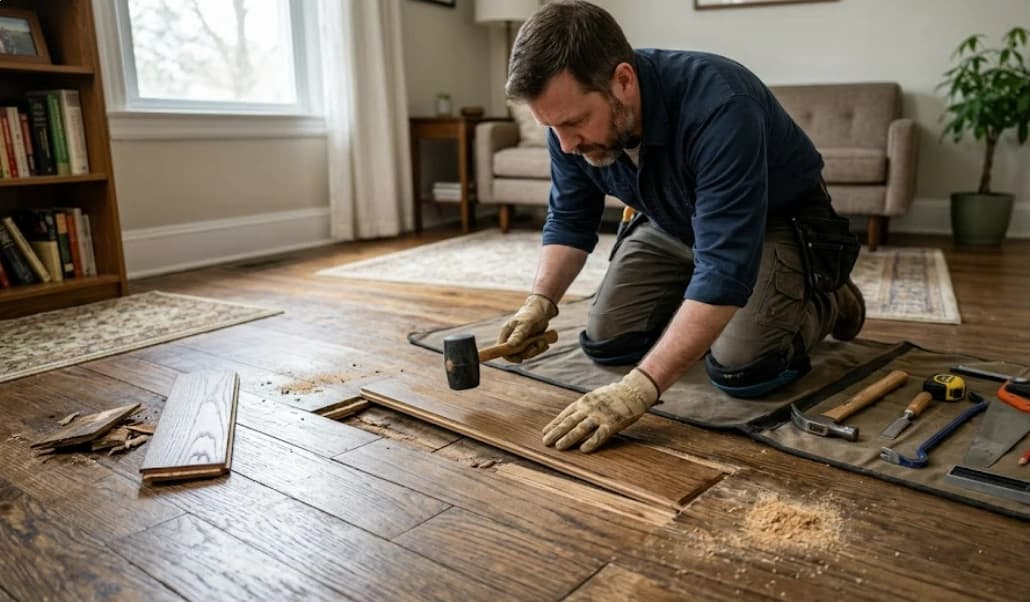
The finish-work exemption is about the surface. It stops covering you once the job reaches the floor system underneath. Treat any of these as a permit question for your local office:
- repairing, sistering or replacing joists, beams, girders or posts;
- cutting or enlarging an opening in the floor, including a stair opening;
- reframing caused by rot, termites, settlement or water damage;
- rebuilding stairs or changing riser heights and tread depths;
- anything that changes a required exit or egress path.
Swapping a few damaged subfloor panels is generally treated as repair. Replacing structural sheathing over a large area, or anything that involves the framing, is another matter, and the line depends on scope, so get the office's view rather than assume. Pre-war homes in Bethesda, Chevy Chase and Takoma Park are where this comes up: the old floor comes up and a cut joist or termite damage comes to light, or a squeaky floor turns out to be a framing problem. When it does, we stop, show you, and price the structural repair separately.
Separate permits
Electrical, plumbing and mechanical work
The finish-floor exemption never stretches to the trades. In Montgomery County, Rockville and every other Maryland jurisdiction, electrical, plumbing, gas and mechanical work are their own permits, usually pulled by a licensed master electrician or plumber. On a flooring job the usual triggers are:
- a new dedicated circuit or thermostat for electric radiant floor heat;
- moving a toilet, floor drain or tub drain during a bathroom floor replacement;
- relocating a floor register or ductwork;
- moving a gas line for a range in a kitchen re-floor.
Pulling a toilet and resetting it on a new floor at the same location is ordinary practice. Moving the flange is plumbing.
Below grade
Basements and floodplain property
Re-flooring a basement that is already finished is finish work. Finishing an unfinished basement is not: Montgomery County, Rockville and Gaithersburg all treat it as permit work because it adds habitable space, walls, wiring and egress. If your project is turning a slab into a family room, the floor is part of a permitted job. Our basement flooring page and waterproof basement flooring guide cover the moisture side.
Floodplain property is the other exception. Maryland floodplain ordinances follow the federal “substantial improvement” rule: when the cost of repair, reconstruction or improvement equals or exceeds 50 percent of the building's market value, the work needs floodplain approval and the building may have to be brought into compliance, including elevation of the lowest floor. A floor alone rarely reaches that figure, but a gut renovation after a flood can. Rockville and Anne Arundel both publish floodplain forms for this reason. If water is the reason you are replacing floors, see our emergency floor repair page.
Maryland-specific
No permit does not mean no license: MHIC
This is where Maryland differs most from DC. Under Business Regulation § 8-101, adding to or remodeling an existing residence is “home improvement”, and anyone doing it for a homeowner must hold a Maryland Home Improvement Commission license. The MHIC says plainly that installing tile, wood or other flooring requires a license. Wall-to-wall carpet installation is the one flooring carve-out.
That has practical teeth. An MHIC-licensed contractor must use a written contract with specific disclosures, and homeowners who hire a licensee can claim against the state's Guaranty Fund if the work is abandoned or unworkmanlike. Hiring an unlicensed installer to save money on a no-permit floor gives that protection up. Ask for the MHIC number and check it on the Maryland Department of Labor license lookup before you sign. 2020 Flooring holds an MHIC home improvement license, and we are glad to share the number with any quote.
Regulated materials
Asbestos tile, mastic and lead paint
A permit exemption does not waive environmental law. Nine-inch vinyl floor tile, sheet vinyl backing and black cutback adhesive installed before the 1980s can contain asbestos, and they are common under carpet in Montgomery County split-levels and ramblers.
The Maryland Department of the Environment's homeowner guidance distinguishes two cases in a single-family home. Non-friable material, intact tile that cannot be crumbled by hand, may be removed by the homeowner, a non-licensed contractor or a licensed asbestos contractor. Material that is or will be made friable (sanded, ground, broken up or scraped to powder) should be removed by an MDE-licensed asbestos contractor. Multi-family and commercial buildings fall under MDE renovation rules that require notification at least 10 working days before regulated asbestos work begins.
Our practice is simpler than the rule: if a pre-1985 resilient floor or its adhesive is coming up, we have it tested before anyone touches it.
Lead is the other one. In pre-1978 homes, painted baseboards, shoe molding and door casings are often removed during a floor job. Disturbing more than six square feet of painted interior surface brings the work under the EPA Renovation, Repair and Painting rule, which requires an RRP-certified firm and lead-safe work practices. Maryland rental properties built before 1978 also carry state lead-risk-reduction obligations for the owner.
Private rules
Condos and HOAs: approval you may still need
No county permit does not mean no paperwork. Many Maryland condominium associations require board or management approval before hard flooring replaces carpet, and specify a minimum acoustic underlayment, commonly an IIC rating of 50 or higher, to protect the unit below. Some also set work hours, elevator reservations and certificate-of-insurance requirements for contractors. These rules come from your declaration, bylaws and house rules, not the building code, and they are enforceable. Read them, or send them to us, before ordering material: the underlayment choice changes the price.
Contractor tip
Scope before you assume “no permit”
The finish-floor exemption is reliable for a clean tear-out and re-install. It stops applying when the job touches framing, egress, a trade system, a basement finish or floodplain property, and it never covers licensing or regulated materials. After nearly three decades of Maryland installs, when we measure a floor we check the subfloor and framing where we can see it, identify who issues permits at the address, note asbestos-era materials and condo rules, and flag any of it before work starts. If the scope changes once the old floor is up, we tell you before we continue.
Bottom line
Bottom line
No building permit is normally required in Maryland when the work is limited to removing and installing finish flooring or refinishing an existing floor. That holds in Montgomery County, the Cities of Rockville and Gaithersburg, Howard, Prince George's, Anne Arundel and Baltimore.
A permit or other review becomes necessary when the project affects structural framing or egress, involves electrical, plumbing, gas or mechanical work, is part of a basement finish or larger remodel, or sits in a floodplain at substantial-improvement scale. Separately, hard-flooring installers must hold an MHIC license, asbestos and lead rules apply regardless of permits, and condo associations may require approval. When in doubt, ask the office that issues permits at your address. It is free, and faster than undoing unpermitted structural work at resale.
For most homeowners, that means the project you are planning is a straightforward scheduling question rather than a paperwork one. Whether it is hardwood floor installation, bringing an old floor back with hardwood refinishing, residential carpet installation in bedrooms or on stairs, luxury vinyl plank installation, laminate installation or a bathroom tile floor, the floor itself is finish work.
References
Sources
- Maryland Department of Labor — Maryland Building Codes (Maryland Building Performance Standards)
- Montgomery County DPS — Permits Required / No Permits Required (2024)
- City of Rockville — Apply for a Building or Trade Permit
- Maryland Code, Business Regulation § 8-101 (definition of "home improvement")
- Maryland Department of the Environment — Asbestos FAQs for Homeowners (2025)
This guide summarises published government guidance as of October 2026 and is not legal advice. Codes and local amendments change; the office that issues permits at your address has the final word.
Good questions
Maryland Flooring Permit FAQs
Do you need a permit to replace flooring in Maryland?
Usually not. Maryland adopts the International Residential Code statewide through the Maryland Building Performance Standards, and IRC § R105.2 exempts "painting, papering, tiling, carpeting, cabinets, counter tops and similar finish work" from permits. Montgomery County DPS lists floor coverings among work that needs no permit when no structural changes are made. A permit becomes necessary when the job touches joists or structural subfloor, wiring or plumbing, a basement finish, or a floodplain property.
Do I need a permit to replace flooring in Montgomery County, MD?
No, not for finish flooring alone. Montgomery County DPS lists floor coverings, including hardwood, tile and carpet, among home improvements that do not require a permit if no structural changes are performed. Note that Rockville, Gaithersburg and a few other municipalities inside the county run their own permit offices, so those addresses follow city rules instead of DPS.
Does the City of Rockville require a permit for new floors?
Not for ordinary, non-structural flooring replacement. Rockville issues its own building permits through the Inspection Services Division rather than Montgomery County DPS, and its rules exempt ordinary repairs. Ordinary repairs exclude cutting structural beams or load-bearing supports, changing a required means of egress, and altering piping, wiring or mechanical work. Rockville asks owners to confirm with Inspection Services at 240-314-8240 or permits@rockvillemd.gov.
Does a flooring contractor need a license in Maryland?
Yes, for most flooring. Installing wood, tile, laminate, vinyl and other hard flooring on an existing home is "home improvement" under Maryland Business Regulation § 8-101, so the contractor needs a Maryland Home Improvement Commission (MHIC) license. Wall-to-wall carpet installation is carved out of the definition. Licensing is separate from permitting: a job can need no permit and still require an MHIC-licensed contractor.
Is refinishing hardwood floors permit work in Maryland?
No. Sanding and refinishing an existing hardwood floor is finish work that does not touch structure, wiring or plumbing, so it falls inside the finish-work exemption in every Maryland jurisdiction we work in.
Do I need a permit to put flooring in my basement?
Replacing the floor covering in an already-finished basement does not need a permit. Finishing an unfinished basement does: Montgomery County, Rockville and Gaithersburg all treat a basement finish as permit work because it adds walls, wiring, egress and habitable space. Basements in a mapped floodplain can also need floodplain review even for smaller work.
Can I remove old vinyl floor tile that might contain asbestos in Maryland?
Have it tested first. Maryland Department of the Environment guidance says non-friable asbestos-containing material in a single-family home may be removed by the homeowner, a non-licensed contractor or a licensed asbestos contractor, but material that is or will become friable, which sanding, grinding or breaking does, should be removed by a licensed asbestos contractor. Multi-family buildings fall under stricter notification rules.
Does a historic district in Montgomery County affect interior flooring?
Generally no. Montgomery County Historic Area Work Permits cover exterior changes to designated sites and districts; a HAWP is not required for interior work. Interior floors in Takoma Park, Kensington, Chevy Chase or other historic districts are governed by the ordinary building-permit rules.
Planning a Maryland floor replacement? Let's scope it right.
We are an MHIC-licensed contractor that has served Maryland homeowners since 1997, and we measure from our showroom at 5550-F Nicholson Lane in North Bethesda. We will check the subfloor, flag anything that could need a permit, testing or condo approval, and give you a written quote. Request a free estimate or call (301) 881-1115.

Written by
Jason Brown
Flooring Specialist
Jason Brown has 14 years of flooring sales and installation experience across the DC, Maryland, and Virginia area.