Pull up the carpet in an older Montgomery County home and you may find wood underneath. Before you decide what to do with it, find out what it is.
Most old floors in this county can be saved. Refinishing works when the damage sits at the surface and there is still wood above the tongue to sand. Repair and refinish handles a few bad boards, or a gap where a wall came out. Replacement is right when water has gone through the boards, the subfloor has failed, or the floor has already been sanded thin. Age has almost nothing to do with it. A 1948 oak floor sanded once has more life left than a 1995 floor sanded three times.
We sand and finish floors across the county most weeks of the year, in everything from prewar bungalows to postwar split-levels, and we repair far more of them than we replace. Here is how the three cases are told apart.
Refinish, Repair, or Replace: Quick Reference
Find your floor on the left. The right column is where it usually goes.
| Floor condition | Likely direction |
|---|---|
| Scratches and dull finish | Refinish |
| Stain color you do not want | Refinish |
| Carpet removed over sound hardwood | Refinish, minor repair |
| Several damaged boards | Repair + refinish |
| Missing flooring after a wall came out | Lace-in + refinish |
| Localized staining | Evaluate, then repair + refinish |
| Major squeaking or movement | Diagnose the subfloor first |
| Extensive water damage | Repair or replace by extent |
| Already sanded too thin | Replace |
| Structural or subfloor failure | Fix the substrate first |
| You want a different floor entirely | Replace |
A starting point for a conversation, not a quote. Two floors with identical symptoms can go different directions once the wear layer and the subfloor are checked.
When Refinishing Is the Answer
Most old floors we look at need a finish, not a replacement.
Good candidates have widespread scratches, a faded or peeling finish, worn traffic paths, or a stain color nobody in the house likes. A floor can look terrible and still be structurally excellent, which is why we do not judge one by appearance alone.
Before paying for a full sand and finish, find out whether your floor needs one. A screen and recoat, also called a buff and recoat, abrades the existing surface and lays one fresh coat of polyurethane over it. It only bonds while the wear has not reached bare wood. Whether the floor was site-finished or prefinished matters here too: a site-finished floor was sanded and sealed in the house and takes a recoat readily, while a prefinished floor arrived with a factory aluminum-oxide coating built to resist exactly the abrasion a recoat depends on.
| Work | Cost | When it applies |
|---|---|---|
| Screen and recoat | $1.25 to $2.50 / sq ft | Finish is worn but the wear has not reached bare wood |
| Full sand and finish | $3.75 to $5.50 / sq ft | Scratches, gray traffic lanes, keeping the natural tone |
| Sand, stain and finish | $5.00 to $8.00 / sq ft | Same work, plus a color change |
| Repair, then refinish | Refinishing rate plus board work | Damaged boards or a lace-in before the floor is sanded as one |
| Replace with new hardwood | $8 to $14 / sq ft installed | Nothing worth saving, or you want a different floor |
Species and board condition move those numbers most. The finish moves them next. Water-based polyurethane costs more per gallon than oil-modified, dries clear instead of ambering, carries lower VOC, and shortens the cure time before furniture comes back. Stairs are quoted per step rather than by square foot. Our full cost breakdown for Maryland runs the same math by project size.
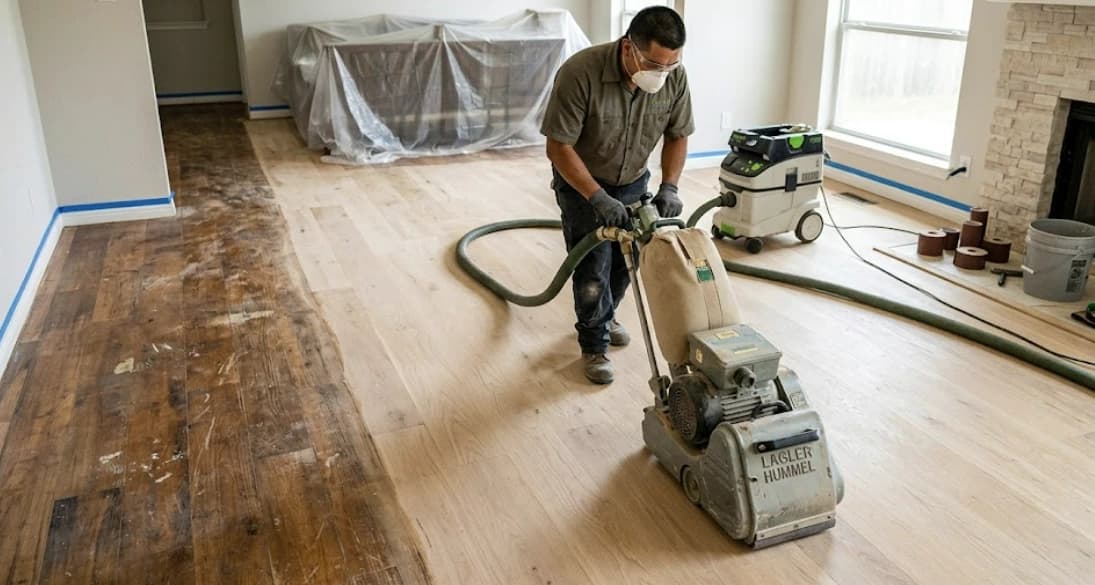
Dustless sanding on an original oak floor in Montgomery County. Surface damage is almost always a refinishing job.
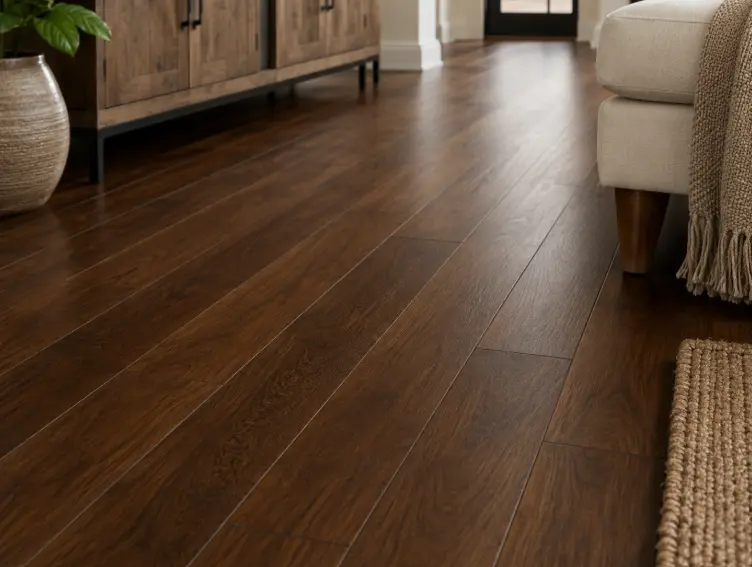
Mullican Oakmont hand-sculpted walnut in Colonial. A sound original floor with wear layer still in it finishes to this kind of depth once it is sanded back and resealed, which is the whole argument for restoring before replacing.
Can a Floor Be Too Old to Refinish?
How thin is too thin?
Age is not the deciding factor. Remaining wear layer is. Every pass in the grit sequence takes wood off the top, and the floor runs out when the boards get close to their fasteners.
How the floor was fastened sets that ceiling. A blind-nailed floor hides its cleats in the tongue, which leaves the full surface available. A face-nailed floor, common in the oldest houses in the county, has fasteners driven through the face, and they surface first. Visible warning signs are exposed nail or staple heads, cracking along board edges, and boards that sound hollow underfoot.
Species changes the arithmetic as well. Hickory at 1820 on the Janka scale gives up its surface far more slowly than red oak at 1290, so two floors of the same age can hold very different amounts of life. Construction matters most of all: solid hardwood has several sandings in it, while engineered hardwood is limited by the thickness of its wood veneer. We take a moisture meter reading before quoting either one, because a floor reading high still has a water source behind it.
When Repairing Beats Replacing
The middle case, and the one most owners do not know to ask for.
Repair plus refinish is the right call when there are a few damaged boards, localized water damage, or gaps where a wall was removed. The preservation principle is simple: do not discard good material because part of it needs work.
Hardwood floor repair covers board replacement, lace-in work at former wall lines, and spot repairs around radiators, thresholds and pet-stain damage. If the boards are cupped or crowned, start with our guide to cupping repair, because the moisture source has to be corrected before any sanding.
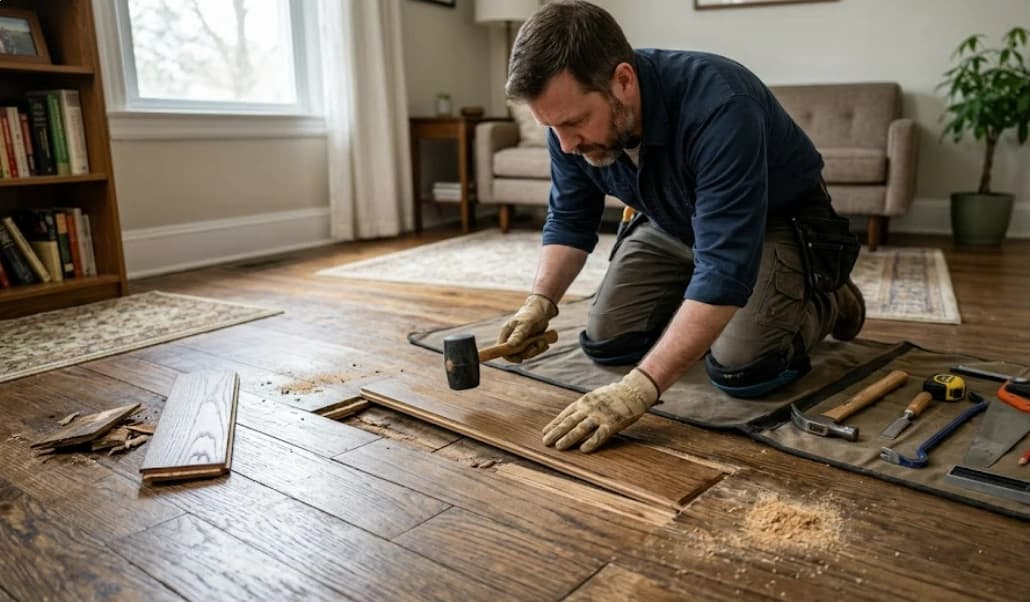
New boards laced into an original floor. Once the whole area is sanded and finished together, the repair disappears.
Matching New Hardwood to Old
Species, width, thickness, grade, grain, finish. In roughly that order.
Say you take out the wall between a Bethesda kitchen and dining room. The dining room has original hardwood, the kitchen does not, and “use the same color oak” is not a specification. Width and grade decide whether the seam disappears. Undertone decides whether the stain lands the same on both sides.
New boards also have to acclimate before they go down. We deliver material into the room and let it come to the home’s relative humidity, because wood laid at the wrong moisture content shrinks or cups after the floor is finished, and no amount of careful matching survives that. The four lines we most often match against original county floors are further down, with the replacement section.
Stairs are their own project. Original treads, risers and railings rarely match a newly refinished floor without deliberate work, and they are priced per step. We cover re-treading, refinishing and railing restoration under hardwood stairs and railings.
When Replacement Really Is the Better Choice
Not every old floor should be saved.
Replacement is the better investment when there is widespread water damage, structural failure, very little usable wood left, or when you simply want a different floor. What matters is that replacement comes out of an evaluation rather than being the default because the floor is old.
Four solid lines we carry, and the variable each one settles
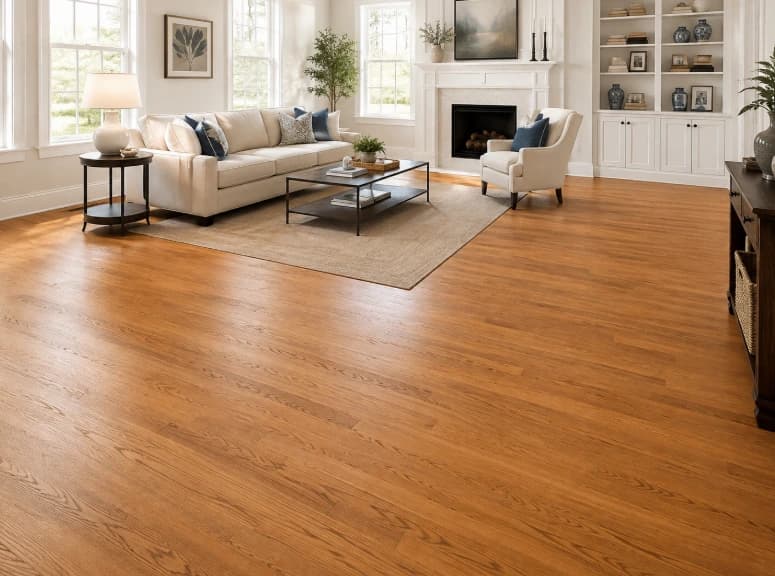
Gunstock
The narrowest solid we carry, and the closest thing to the strip oak laid in prewar and early postwar houses. Beveled edges and ends define each board the way an original floor does.
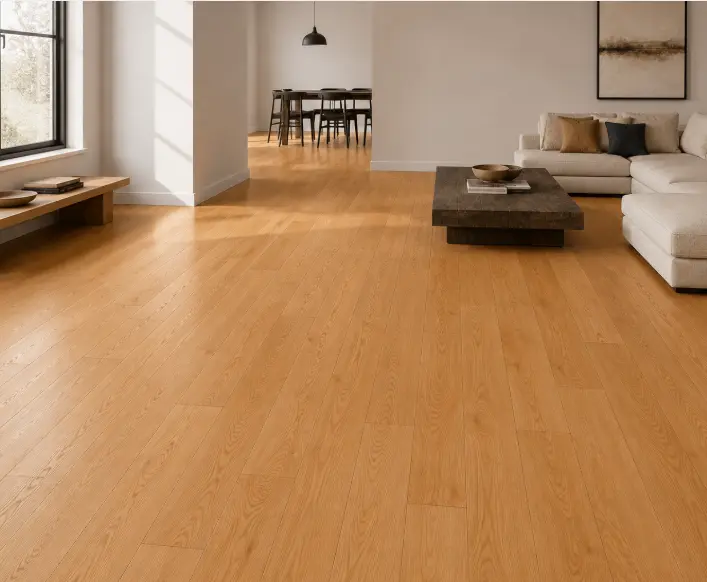
Natural
Red oak at 1290 Janka in a traditional 3.25" width, which is what most Montgomery County originals actually are. Solid through all 19mm, so it sands on the same schedule as the floor it joins.

First Frost
White oak has a cooler undertone and tighter grain, so it takes grey and bleached stains cleanly where red oak turns ruddy. This is why "match the oak" is not a specification.
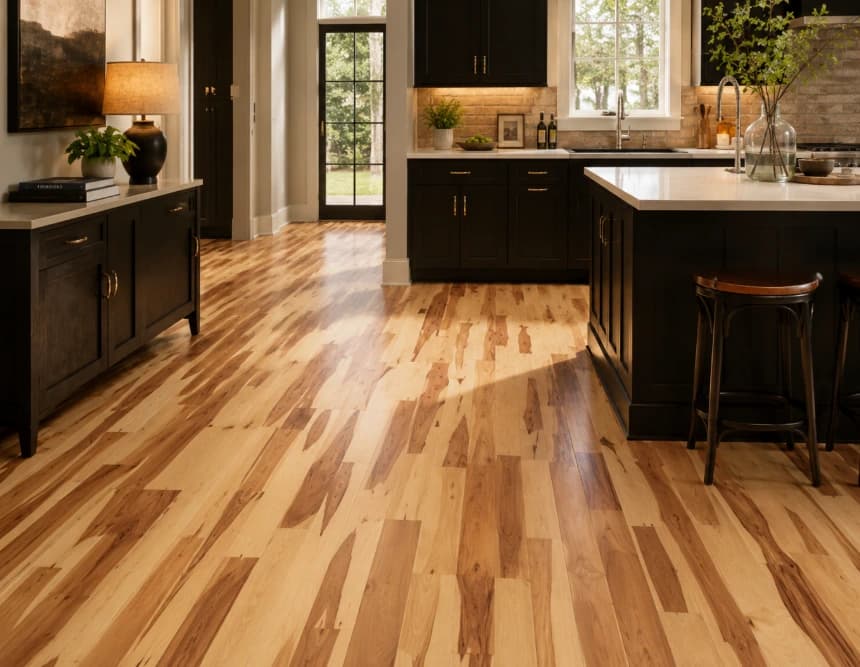
Natural
Hickory carries far more grain variation than oak, and beveled edges and ends read the seams the way a traditional floor reads them. A good fit for older houses, a poor one beside smooth-edge oak.
Every line above is solid through its full thickness, so a lace-in sands and refinishes on the same schedule as the original floor around it. If you are replacing rather than matching, a wider plank is the usual departure from the narrow strip oak it succeeds, and the whole range sits on our hardwood flooring pages.
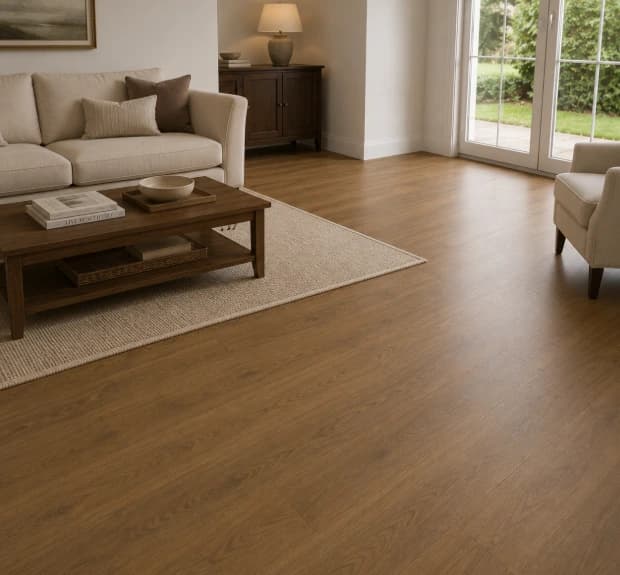
Mullican Belleme 7.5" European white oak in Cheverny, a wide-plank replacement floor for a Montgomery County home.
What Is Under the Carpet?
The cheapest diagnostic in the entire project.
If you have just bought an older home with carpet in it, find out what is underneath before you spend anything. A small exploratory lift can turn up hardwood worth refinishing, boards needing minor repair, or several different floors between rooms.
How the carpet comes out matters as much as what is under it, because pad staples, tack strips and old adhesive are what damage an original floor when the job is rushed. Professional carpet removal and disposal takes all of it out together and hauls it away, so the wood is exposed cleanly and can be evaluated the same day. The worst outcome is paying for a new floor and finding out afterwards that a repairable original was already there.
Do Not Ignore the Subfloor
An old hardwood floor is only as stable as what sits below it.
Your house may have original board subfloors in one section and newer plywood in a remodeled one. That mix produces squeaks, movement and height differences at the transitions, and covering it with new flooring does not resolve any of it, particularly if you want a whole level to read as one continuous surface. If squeaks are the main complaint, our guide to fixing squeaky floors separates what can be corrected from above, what needs access from below, and what is telling you something structural.
Basements Need Their Own Decision
A slab below grade is a different environment from a wood-framed floor above it.
Treating the basement as an extension of the upstairs project is a common and expensive mistake. Slab moisture and relative humidity have to be measured before anything new goes down, and the right product for the living room is rarely right for the lower level. We keep basement flooring as a separate conversation for that reason, and our guide to the best waterproof flooring for a basement sorts DMV basements into water-exposure tiers before it picks a product.
Be Careful With Old Flooring Layers
Demolition in an older house can uncover more than hardwood.
Vintage resilient tile and old adhesives turn up under carpet and under newer flooring. Some of those materials can contain asbestos, and appearance alone is not a reliable indicator. Houses built before 1978 may also carry lead-based paint on baseboards and stair parts, which matters the moment sanding starts. A good contractor knows when a straightforward job has stopped being straightforward, and says so before the demolition continues.
The EPA’s Renovation, Repair and Painting program sets the ground rules for pre-1978 homes, and the National Wood Flooring Association publishes the sanding and finishing standards we work to.
Old Floor Patterns Across Montgomery County
Seven conditions we see over and over, and where in the county they cluster.
Montgomery County grew enormously in the mid-twentieth century. Most of what came out of that boom never gets called historic: everyday brick Colonials, Cape Cods, ramblers and split-levels, now standing 60, 70 or 80 years, most of them remodeled more than once. A 1955 house can hold original wood, 1970s kitchen vinyl, 1980s bedroom carpet, a 1990s finished basement, and a wall that came out in 2015. Five generations of flooring at one address is normal here.
House age is the single best clue to what you will find. These are patterns rather than guarantees, and each one changes what the evaluation should look for.
Prewar pine and heart pine
Takoma Park, Washington Grove
Where the housing runs to the early twentieth century, an old wood floor is often not strip oak at all. Pine and heart pine are common, they are softer than oak, they dent differently, and they take a patina that many owners want kept rather than sanded away. They also want a gentler grit sequence, and matching replacement boards is harder. Identify the species before any demolition, and read our notes on solid construction if you are not sure what you have.
A good old floor with gaps where walls used to be
Chevy Chase, Kensington, Garrett Park
Prewar houses in these communities get remodeled constantly. Kitchens are enlarged, walls disappear, additions meet original rooms, and the floor ends up sound everywhere except at the old architecture. That is a lace-in job rather than a tear-out: compatible flooring is woven into the missing areas and the whole level is sanded as one surface. We handle a lot of it around Chevy Chase.
Original hardwood under a floor plan that changed
Bethesda, including Wyngate and Alta Vista
A 1940s or 1950s house renovated several times over raises a question most owners do not anticipate: can the original hardwood stay while everything around it changes? Usually yes. The result depends on matching species, width, thickness, grade, grain and finish, which is the technical work behind most of the hardwood projects we take on in Bethesda.
Hardwood hiding under wall-to-wall carpet
Silver Spring and Wheaton: Forest Glen, Four Corners, Woodmoor, Glenmont
Postwar housing here hides a lot of intact wood. An owner sees carpet, assumes there is no hardwood, and orders something new. Then a corner comes up over a floor that only needs sanding, or one carrying stains, patches and squeaks that change the answer. Worth checking before you buy anything, and worth reading what refinishing a Silver Spring floor actually involves.
Three flooring environments in one house
Rockville: Twinbrook, Hungerford
Split-levels put wood in the bedrooms and living areas, carpet in the lower family room, and a concrete slab in the basement, all under one roof. The right answer is often to refinish one part, repair another, and choose a moisture-tolerant product for the slab. Treating every level the same way is an expensive mistake, and it is the most common one we correct in Rockville.
Sun-faded mid-century floors across several levels
North Bethesda, Aspen Hill, Potomac
Ramblers, split-levels and mid-century-modern houses can have excellent wood, but they bring multiple elevations, open stairways, additions built over different subfloors, and years of strong light that has changed the color unevenly from room to room. They should not be renovated as though they were new construction, which is a point we make on almost every Potomac estimate.
Older exceptions inside newer subdivisions
Gaithersburg, Olney and the outer county
Housing out here is newer on average, but averages hide the exceptions. Washington Grove sits surrounded by newer Gaithersburg development, and individual farmhouses and older subdivisions turn up everywhere, all of them worth a restoration-first look before anything gets torn out. See what that involves for a Gaithersburg hardwood floor.
The same evaluation applies out to Olney, Germantown, Burtonsville and Cabin John, and the full list of communities we cover is on our areas we serve page.
How We Evaluate an Older Floor
Seven checks, in this order, before we recommend anything.
1. Identify the existing floor
Species, board dimensions and construction. Solid or engineered, strip or plank, oak or heart pine. Everything downstream depends on this answer.
2. Measure the usable wood
We check what is left above the tongue and look for the sanding history, including whether the floor is blind-nailed or face-nailed. That sets the ceiling on how many refinishes it has left.
3. Separate cosmetic damage from structural
Scratches and gray traffic lanes are a finish problem. Cupping, crowning, black staining and soft boards are a moisture problem, and they get fixed in a different order.
4. Take a moisture meter reading
A floor reading high still has a water source behind it. Sanding before that is dealt with is how a project gets paid for twice.
5. Decide what can be repaired
A small quantity of new wood, laced in properly, can save hundreds of square feet of original floor. We identify what has to come out before assuming any of it does.
6. Look underneath
Squeaks and movement usually point at the subfloor or the fasteners rather than the finished floor. A new floor over an unresolved subfloor buys the same problem twice.
7. Ask what the owner actually wants
Restoration is not automatically right. Sometimes the goal is preserving character, sometimes a modern continuous floor across a whole level. Both are legitimate, and they lead to different scopes.
Old Wood Floor FAQs
What Montgomery County homeowners ask us most about old wood floors.
Have It Looked At Before You Tear It Out
Old floors can look worse, or better, than they really are. We measure the wear layer, take a moisture reading, check the subfloor, and tell you which of the three directions your floor is actually in. Serving Montgomery County and the wider DMV from our showroom on Nicholson Lane in North Bethesda.

Written by
Jason Brown
Flooring Specialist
Jason Brown has 14 years of flooring sales and installation experience across the DC, Maryland, and Virginia area.