Carpet Stair Guide · 2020 Flooring · DC · Maryland · Northern Virginia
When you carpet a staircase, the material is only half the decision — how the carpet is wrapped over each step changes the look, the price, and how well the stairs hold up. (If you are still choosing the carpet itself, start with our guide to the best carpet for stairs — fibre, pile height, density and the cushion underneath — then come back here for the wrap.) The two methods you'll be quoted are waterfall and Hollywood (sometimes called upholstered or contoured). After thousands of stair installations across the DMV, here is exactly how they differ, what each costs locally, and how to pick the right one for your stairs.


The 30-second answer
Waterfall vs. Hollywood, in one breath
Waterfall
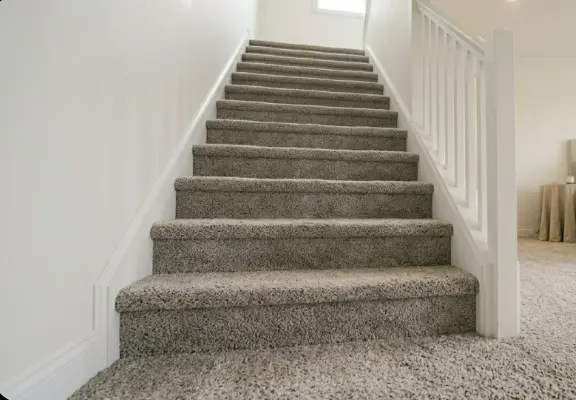
Carpet rolls over the rounded nose of each step and falls straight down the riser. Faster, uses less material, costs less, and looks clean on straight, boxed-in stairs. The trade-off: a slightly looser, more casual edge that can wear at the nosing.
Hollywood
Carpet is hand-contoured and tucked tight into every angle of every step. More labor and more material, but a tailored, custom look that wears evenly and is the right method for open-sided, curved, or high-end staircases.
Most DMV homeowners with a standard straight staircase choose waterfall to save money; those with open sides, a winder turn, or a design-forward home choose Hollywood. If you just want the carpet picked and installed correctly, our carpet stair installation team will tell you on-site which method your stairs actually call for.
See the difference
The cross-section that explains everything
Look at the front edge (the nosing) of each step. That single detail is the entire difference between the two methods — and it's where stair carpet either looks crisp for fifteen years or starts to crush in three.
Installer's note: on a closed staircase you often can't tell the two apart from the top of the stairs — the difference reads from the side and at the nose. That's why waterfall is so common on boxed-in stairs: you pay less and rarely see the compromise. On open stairs, the side is visible, and a waterfall drape looks unfinished — Hollywood (or a bound runner) becomes the right answer.
Method one
Waterfall carpet stairs
Waterfall is the default in most production and tract homes across Montgomery County, Fairfax County, and the District for a simple reason: it's the fastest way to get a clean, finished staircase. The installer wraps the carpet over the nose of the tread and lets it fall straight to the next step — no contouring the riser, no tucking the back corner. On a standard 13- or 14-step staircase, an experienced two-person crew can complete a waterfall install in a couple of hours.
Best for: straight, closed (boxed) staircases; rental and resale turnovers; basement stairs; budget-conscious whole-home carpet projects. Watch-outs: the nose carries the load and can crush or fuzz first, and patterned carpet can look slightly off where the drape breaks. The fix is a firmer pad and a denser, higher-twist fiber — the same advice the Carpet and Rug Institute gives for any high-traffic stair application.
Method two
Hollywood (upholstered) carpet stairs
Hollywood — also called the upholstered or contoured method — wraps the carpet over the nose and then tucks it tightly into the joint where each riser meets the next tread, following the exact shape of the step. Every stair is fitted by hand, which is why it takes meaningfully longer and uses more carpet. The payoff is a sharp, tailored line that reads as custom work, especially on a stained or painted open side where the wrap is on display.
Best for: open-sided and “cap” stairs; curved staircases and winder (pie-shaped) steps; higher-end homes in Potomac, Bethesda, McLean, and Great Falls where finish quality is scrutinized. Watch-outs: it costs more, and it's only worth paying for when the stairs justify it — a plain boxed staircase rarely needs it. Design editors at Architectural Digest consistently favor the tighter, tailored wrap (or a bound runner) on feature staircases for exactly this reason.
Head to head
Side-by-side comparison
| Factor | Waterfall | Hollywood |
|---|---|---|
| Look | Clean, casual, modern | Tailored, custom, traditional |
| Labor per stair | Lower (fast drape) | Higher (hand-contoured) |
| Carpet used | Less | 10–20% more |
| Best stair type | Straight & closed/boxed | Open-sided, curved, winders |
| Nosing wear | Concentrated at the nose | More evenly distributed |
| Patterned carpet | Can break at the drape | Holds the pattern crisply |
| Typical DMV labor | $25–$45 / stair | $40–$75+ / stair |
| Resale impression | Standard / expected | Upscale / premium |
Labor ranges reflect typical 2026 installed pricing across the DC/MD/VA market and exclude carpet and pad material. Curved stairs, winders, and open sides push the Hollywood figure higher.
Local pricing
What carpet stairs actually cost in the DMV
Stair carpet is priced per step, not per square foot — a straight box stair and an open curved stair use similar square footage but take wildly different amounts of labor. For a common DMV staircase of about 13 to 15 steps, here is how the math usually lands once you add a mid-grade nylon carpet and a quality pad:
Waterfall, 14 steps
$650–$1,250
Installed, carpet + pad + labor. The economical choice for straight, closed staircases and rental turnovers.
Hollywood, 14 steps
$1,050–$2,100+
Installed. The premium covers hand-contouring, extra carpet, and the finish quality that open and curved stairs demand.
Three things move these numbers in our market: stair shape (winders and curves add per-step labor either way), open sides (which essentially require the Hollywood wrap or a bound runner), and carpet grade — a builder-grade polyester and a 50-oz wool will bracket the material cost dramatically. You can see full residential pricing context on our carpet installation page, and if the stairs are part of an office, gym, or multi-unit building, the specs and pricing shift toward our commercial carpet installation standards (heavier face weight, glue-assist, fire ratings).
The long game
Durability, safety, and the Mid-Atlantic factor
Stairs are the single hardest-working surface in a home — every trip up and down concentrates on the nosing. That's why the wrap method and the materials underneath it matter more on stairs than anywhere else. A tightly tucked Hollywood wrap spreads foot pressure across the nose and riser, so it tends to hold its edge longer. A waterfall drape puts more of that load on the rounded nose, which is why we're picky about pad and fiber when we quote one.
The Mid-Atlantic adds its own wrinkle: our humid summers and dry, heated winters cause carpet and pad to expand and contract through the year. On stairs, that seasonal movement can let a loosely installed waterfall edge relax over time. The defenses are the same ones the This Old House stair guides emphasize: a firm, dense pad (we spec 8-lb rebond or firmer on stairs), a high-twist nylon cut pile, and tight, properly powered tucking at every step. Skip the ultra-soft, high-pile “cloud” carpets on stairs — they feel great in a bedroom and crush fast on a tread.
On safety: both methods are slip-comparable when installed correctly, but the firm-pad, tight-wrap combination gives the most secure footing — worth keeping in mind for homes with young kids or aging parents. If you're weighing carpet against bare wood on the stairs at all, our carpet vs. hardwood comparison breaks down the safety and noise trade-offs in detail.
Decision guide
Which method should you choose?
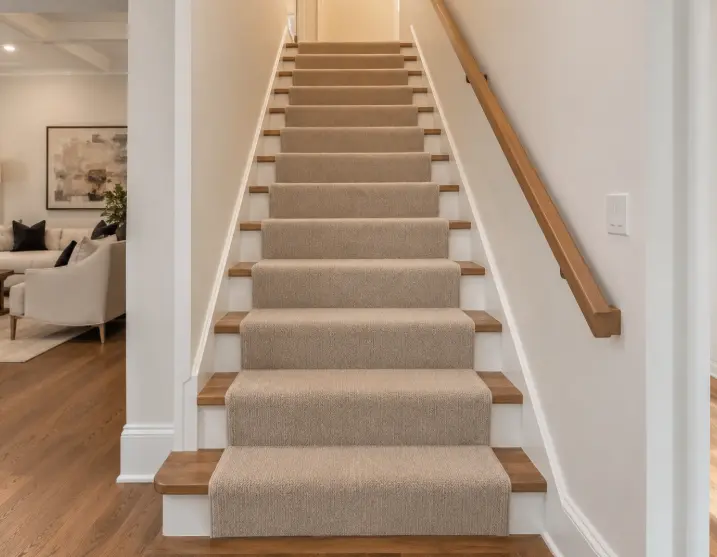
Still on the fence? A runner is the quiet third option — bound carpet down the middle with finished wood treads showing on either side. It splits the difference on cost and keeps the look light, which is why it's popular in renovated row homes in DC and Old Town Alexandria. We'll show you all three on-site.
Real local project
Case study: a Gaithersburg townhome staircase
Location
Kentlands, Gaithersburg, MD
Stairs
16 steps, open side + 3 winders
Method
Hollywood wrap
A Kentlands townhome owner came to us mid-renovation set on a waterfall install to save money. The problem: their main staircase had an exposed open side and three winder steps turning onto the landing — exactly the geometry where a waterfall drape looks unfinished and collects gaps on the pie-shaped treads. We walked the stairs with them, showed the cross-section difference at the nosing (the same diagram above), and recommended the Hollywood method on the open side and winders, with a standard wrap on the straight run to keep cost in check.
We installed a 48-oz solution-dyed nylon cut pile over an 8-lb rebond pad. The hand-tucked winders took the better part of a day on their own, but the finished line around the open side reads as built-in custom work — and two years on, the high-traffic nosings show no crushing. It's a textbook example of why the right wrap is a stair-by-stair decision, not a whole-house default. This is the kind of judgment our Gaithersburg carpet installation crews make on-site every week.
We see the same patterns across the region: split-levels in Silver Spring with closed stairs that are perfect waterfall candidates, and open-riser contemporary stairs in Arlington that almost always call for a contoured wrap or a bound runner. The neighborhood doesn't decide the method — the staircase does.
Good questions
Waterfall vs. Hollywood FAQs
What is the difference between waterfall and Hollywood carpet on stairs?
A waterfall installation drapes the carpet over the rounded nose of each tread and lets it drop straight down the riser to the next step, so the carpet is not pushed into the angle where the riser meets the tread. A Hollywood (also called upholstered or contoured) installation pulls and tucks the carpet tightly into every angle, wrapping snugly around the nosing and into the back corner of each step. Waterfall is faster and cheaper; Hollywood looks more tailored and tends to wear better at the nosing.
Is waterfall or Hollywood carpet better for stairs?
Neither is universally "better" — it depends on your stairs and budget. Waterfall is the right call for straight, closed (boxed-in) staircases where you want a clean look at the lowest cost. Hollywood is worth the extra labor on open-sided stairs, curved or winder steps, and high-end homes where the tight contour shows craftsmanship and protects the nosing from premature wear.
How much more does Hollywood carpet installation cost?
In the DC, Maryland, and Northern Virginia market, Hollywood (upholstered) stair installation typically runs 40–80% more in labor than a waterfall install because each step is hand-contoured and tucked. Expect roughly $25–$45 per stair for waterfall labor versus $40–$75+ per stair for Hollywood, plus 10–20% more carpet to allow for the tighter wrap.
Does waterfall carpet wear out faster?
It can at the nosing. Because the carpet rounds loosely over the front edge instead of being tucked tight, the nose takes the most foot traffic and is the first place a waterfall stair shows crushing or fraying. Choosing a dense, high-twist nylon cut pile and a firm pad slows this down considerably. A tightly tucked Hollywood wrap distributes wear more evenly across the nose and riser.
Can you put a Hollywood wrap on open-sided stairs?
Yes — and it is where Hollywood shines. On open or "cap" stairs (where one or both sides of the steps are exposed), the carpet has to be cut, wrapped, and tucked around the finished edge. A waterfall drape looks unfinished on an open side, so installers almost always recommend the contoured Hollywood method, or a runner with bound edges, for open staircases.
What carpet is best for stairs in a busy DMV home?
For stairs that get daily traffic, we steer most DC, Maryland, and Virginia homeowners toward a solution-dyed nylon cut pile with a face weight of 40+ oz and a tighter twist. Avoid thick, soft, high-pile "saxony" styles and loose Berber loops on stairs — they crush at the nose and can snag. A 7/16-inch, 8-pound rebond pad (or firmer) keeps the carpet from flexing over the edge.
Not sure which wrap your stairs need?
That's the right question to bring to a free in-home measure. We'll look at your stair geometry, show you waterfall, Hollywood, and runner options on the actual steps, and quote the method that fits — never upsell a contour your stairs don't need. Explore our carpet stair installation service, or get a free quote for any home or business across DC, Maryland, and Northern Virginia.

Written by
Jason Brown
Flooring Specialist
Jason Brown has 14 years of flooring sales and installation experience across the DC, Maryland, and Virginia area.