Carpet Buying Guide · 2020 Flooring · DC · Maryland · Northern Virginia
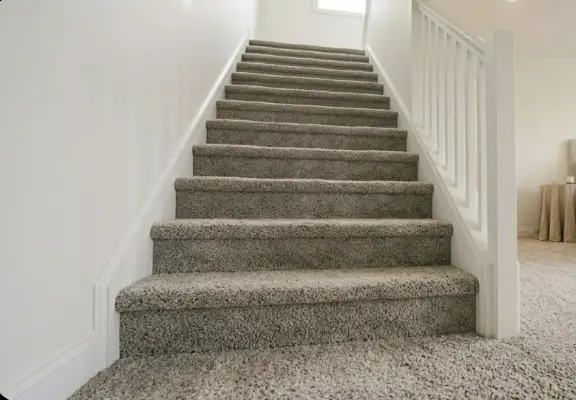
The short answer is a dense, low- to medium-pile textured nylon. That is what we install on most staircases across the DMV, and it is what still looks right when we come back years later for a different room in the same house. But fibre is the least important part of the decision. When stair carpet fails early, it is almost never because someone picked the wrong fibre — it is pile that was too high, cushion that was too thick, or a carpet that was never rated for stairs in the first place.
The short answer
What we install, and why
Fibre
Textured nylon for most homes. Wool where the staircase is the first thing anyone sees. Triexta where spills are the daily reality.
Construction
Dense and low beats thick and plush. Judge a sample by how fast it springs back, never by how soft it feels in your hand.
Cushion
Firmer and thinner than the pad in your bedrooms. Excess cushion lets the carpet move over the nosing, and movement is what fails.
Choosing the carpet is one half of a stair job. The other half is how it is wrapped over each step, which changes the price and the look as much as the product does — we compare the two methods in waterfall vs. Hollywood carpet stairs. Get both right and a staircase lasts fifteen years. Get either one wrong and you see it at the nosing within three.
The physics of a step
Why stairs are not just floors on an angle
Every footstep on a staircase lands on the nosing — the front edge of the tread. That narrow strip carries the weight of everyone in the house on a few inches of carpet, and it does something no floor does: it bends the fibre over an edge at the same moment it compresses it.
Carpet in a bedroom takes straight-down pressure. Carpet on a nosing gets pressed and folded. Fibres that recover from one do not always recover from the other, which is why the nosing line goes flat and shiny long before the rest of the tread shows anything at all. When a client tells us their stairs "look worn," they are pointing at that line every single time.
Installer's note: the dashed arc is where every footstep lands. It is roughly two inches of a staircase doing most of the work, which is why the spec that matters on stairs is the one measured at that arc — density and recovery — and not the one you feel with your hand on a showroom sample.
Fibre by fibre
Which fibre belongs on a staircase
| Fibre | Durability | Stain resistance | Cost | Best for |
|---|---|---|---|---|
| Nylon | Excellent | Very good | $$ – $$$ | Most staircases, most households |
| Wool | Excellent | Good, with maintenance | $$$$ | Statement runners on stairs people see |
| Triexta | Very good | Excellent | $$ – $$$ | Young kids, dogs, frequent spills |
| Polyester (PET) | Fair to good | Very good | $ – $$ | Basement and secondary flights only |
Nylon
Nylon springs back — that is the entire argument for it. Bend it over a nosing a hundred thousand times and it recovers better than anything else at the same price. Ask for a solution-dyed nylon at 40 oz or heavier with a tight twist, and the fibre stops being the thing that limits how long your stairs look new.
Choose a dense textured nylon rather than the softest sample on the rack. Soft usually means finer filaments and a taller pile, and both of those work against you on a stair.
Wool
Wool earns its price on staircases people look at. A woven wool runner on a Capitol Hill or Petworth rowhouse stair changes the whole entry, and it wears beautifully — wool crimp is natural spring, which is exactly what a nosing asks for.
It costs more and it wants specific cleaning. If your staircase is the first thing a guest sees, that trade is usually worth making. If it goes down to the laundry room, it is not.
Triexta
A strong pick for households managing spills. The stain resistance is built into the fibre rather than sprayed onto it, so it does not wash away over years of cleaning — the same reason it comes up so often in our hypoallergenic and non-toxic carpet guide.
Still check density and the stair rating. A thin triexta will lose to a good nylon on a staircase, because on stairs construction outranks chemistry.
Polyester
Polyester photographs beautifully and prices attractively. It also crushes sooner than the other three, and crushing is the specific way stair carpet fails.
We do install it — on basement flights, guest wings and secondary stairs where the traffic is light. We talk people out of it on the main staircase of a busy house, because we are the ones who get called back.
If you want the fibre-construction vocabulary in more depth before you shop, the Carpet and Rug Institute publishes the density and twist guidance the whole industry works from.
The spec that decides it
Pile height, density and the cushion under it
Denser and lower beats thicker and plusher on stairs. Every time. Two samples can feel identical in your hand and behave completely differently once they are wrapped over a nosing, because your hand is testing softness and the stair is testing recovery.
Do this in the showroom: press your thumb into the sample and let go. If the pile takes its time coming back, it will not come back on a stair either.
Four questions to ask about any sample
- Is this product specifically rated by the manufacturer for stair installation?
- Does the warranty stay valid when it is installed on stairs?
- What cushion does the manufacturer specify for stair use?
- How quickly does the pile recover after pressure?
Thicker cushion is not better here, and this is the single most common mistake we correct on stairs installed by someone else. Too much pad lets the carpet shift over the nosing, and movement is what undoes a stair installation. We run a firmer, thinner pad on stairs than we do in bedrooms — typically an 8-pound rebond at 3/8 inch on the stairs against 7/16 inch in the bedrooms of the same house — and we check the carpet maker's own stair specification before anything is ordered.
Construction
Cut pile or loop
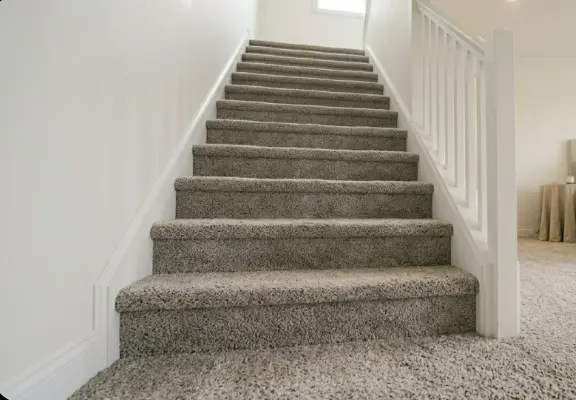
Textured cut pile
The safer choice for most homes. The texture hides footprints, vacuum marks and the first signs of nosing wear, and there is no loop for a claw to catch.
Loop
A sharper, more tailored look, and it performs well. The catch is pets: one pulled loop on a stair tread is visible from across the room and cannot be tucked back in.
If your dog takes the stairs at a run, take the textured cut pile. We have replaced enough otherwise-perfect loop runners over a single snagged tread to make that our default advice in any house with a dog.
Households with dogs
Stair carpet that survives pets
Three things, in order: tight construction, a resilient fibre, and a mid-tone colour.
Colour is the one homeowners underrate. Dark solids show light fur, pale solids show dirt, and a medium tone with flecking or a heather hides both between vacuums. It is the cheapest way to make stair carpet look better for longer, and it costs nothing at the point of sale. If pets are driving the whole flooring decision, our pet-friendly flooring page covers what we recommend elsewhere in the house.
Coverage
Runner or full carpet
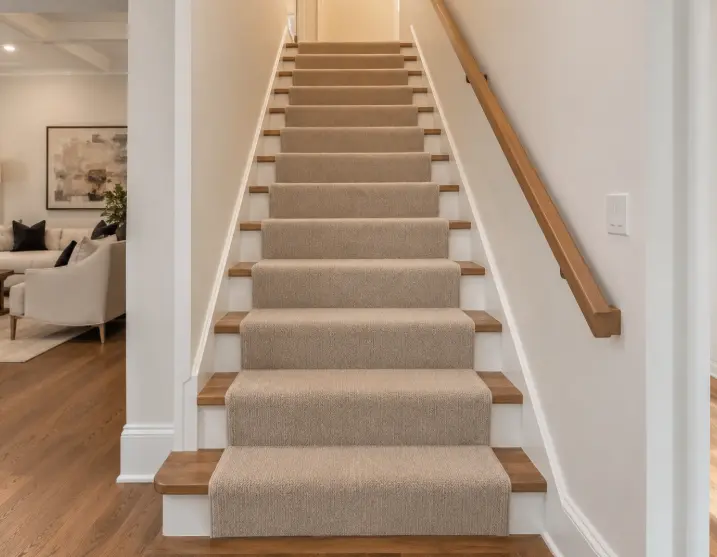
If the wood underneath deserves to be seen, run a runner. If it does not, carpet the whole width. That settles it for most houses — and where the treads themselves are worth saving, hardwood stairs and railings is the other side of the same conversation.
The harder question is the installation. A runner has to stay centred flight after flight, and on a staircase with a turn or winders "centred" stops being a fixed measurement — the tread is a wedge, so the runner has to be balanced by eye against two edges that are not parallel. Patterned runners are harder again, because the installer has to decide where the repeat lands on every tread and riser before a single cut is made.
Ask this before you approve the material: show me where the pattern lands at the turn. If nobody can answer that in front of your actual stairs, you have learned something useful about the installation you are about to buy.
Local insight
Three DMV staircases, three different answers
We measure stairs from Capitol Hill to Loudoun County out of our showroom on Nicholson Lane in North Bethesda, and the housing stock around here sorts itself into three recognisable cases. Which one you live in changes the answer more than any brand comparison will.
Case one
DC rowhouses
Older rowhouse stairs are narrow and almost always visible from the front door. Both facts push toward a runner with the original treads showing at the edges.
Narrow also changes which patterns work. A geometric that reads as subtle on a large sample board turns busy once it is cut to runner width and wrapped over a dozen treads. Smaller repeats, fine stripes and textured neutrals scale down better. And most rowhouse staircases turn somewhere, usually with winders — plan the pattern around the turn, not the straight run, because the turn is where a mis-planned repeat becomes obvious. Our Washington DC flooring crews measure the winders first for exactly that reason.
Case two
Northern Virginia townhomes
In the three- and four-level townhomes across Arlington, Alexandria and Falls Church, the stairs are not a feature — they are hallways. Garage to kitchen, kitchen to bedrooms, bedrooms to the top floor. The traffic count on those flights is nothing like a single-storey home, and density matters more here than anywhere else in the region.
The flight off the garage or front entry takes grit, winter road salt and summer humidity, and Beltway-area brine is genuinely hard on a pale carpet. Put your most forgiving colour on that flight. A light solid on a garage-level stair will disappoint you inside a year — we have seen it enough times to say it plainly. If you are weighing carpet against something harder for that lower flight, our carpet vs. LVP comparison works through the trade, and Arlington and Alexandria homeowners can start from our local pages.
Case three
Maryland basements
Always ask where the stairs lead before choosing anything. Main stairs from living space to bedrooms can be decorative. Stairs down to a finished basement, a walkout or a utility area have to be cleanable first.
One rule we do not bend anywhere in Montgomery or Prince George's County: if there is moisture in the basement, it gets addressed before we carpet the stairs. Carpet over a damp slab does not fix a water problem, it hides it until it is worse and more expensive. Split-levels in Silver Spring and Rockville are where we see this most — a lower flight that has been re-carpeted twice because nobody dealt with what was coming through the wall. Our basement flooring guide covers what to do about that first.
Colour
The colours that keep looking right
Medium neutrals with visible texture. Warm beige, greige, mid gray, heathered multi-tones, small geometrics and fine stripes all age well on a staircase because they have something for dirt to disappear into.
Warm beige
Forgiving in low-light rowhouse stairwells
Greige
The safest all-round DMV stair colour
Mid gray
Hides both light fur and grey road grit
Heathered taupe
Fleck breaks up footprints between vacuums
Soft moss
Reads neutral, hides dry mud from the yard
Deep bronze
For garage-level flights that take real abuse
Look at the sample in your own hallway, at the time of day you actually use the stairs. Showroom lighting is not neutral, and stair carpet is usually seen in low light near a landing. This is the main reason we bring samples to the house rather than asking anyone to decide standing under our lights.
Where jobs are won or lost
Why installation decides the outcome
Good carpet installed badly on stairs will fail. Average carpet installed properly will not. Stairs are the hardest surface in a house to install: the carpet has to stay tight through constant changes of angle, and any slack that exists anywhere shows up first at the nosing. Landings, winders and turns each add their own problem.
Measurement, tread and riser dimensions, nosing profile, cushion selection, attachment method, runner width and centring, pattern placement and the finished edges are all decisions made on the stairs themselves, not in an office. Our installers are in-house crews — long-tenured, licensed, insured and background-checked employees rather than day-rate subcontractors — which is the only reason those decisions come out the same way on every job. That employment model is also why tipping is never expected on our jobs.
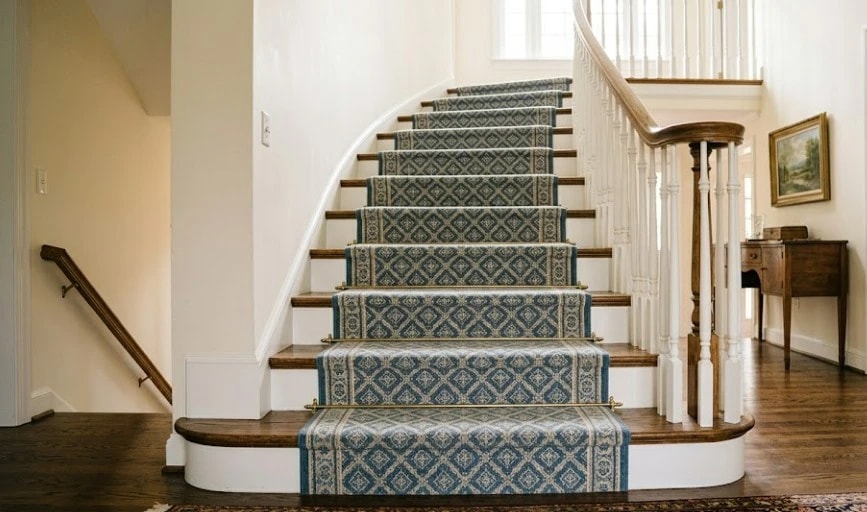
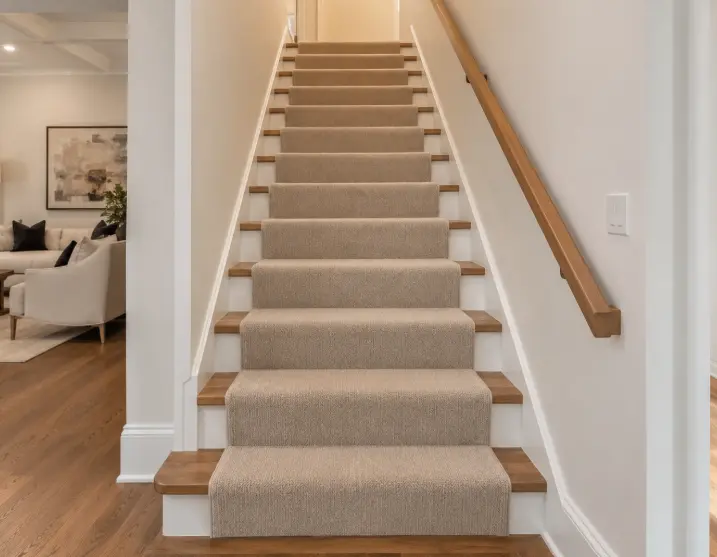
If you want the detail on how the carpet is wrapped over each step — and what the two methods cost per stair in this market — that is the whole subject of our waterfall vs. Hollywood guide. The product page for the work itself is carpet stair installation.
Before you buy
The seven-point stair carpet checklist
- 1Confirm the product is rated for stairs and that the warranty still applies to stair installation.
- 2Compare density and recovery, not softness. Press your thumb in and watch how fast it returns.
- 3Keep the pile low to medium. Plush belongs in a bedroom, not on a nosing.
- 4Spec the cushion to the stair, not the bedroom: firmer and thinner, never the thickest pad offered.
- 5Look at samples in your own stairwell, at the hour you actually use the stairs.
- 6Account for what walks in from the garage or the front door on that particular flight.
- 7Ask exactly how the pattern lands on the turn or the winders before approving the material.
Print that list and take it to whichever showroom you visit, ours included. Every item on it is something a salesperson can answer in thirty seconds if the product is right for stairs, and cannot answer at all if it is not.
Good questions
Stair carpet FAQs
What is the most durable carpet for stairs?
A dense, low- to medium-pile textured nylon is the most durable choice for the majority of staircases. Nylon recovers from being bent over a nosing better than similarly priced fibres, and construction quality — face weight, density and twist — matters as much as the fibre name on the label. For most DC, Maryland and Northern Virginia homes we specify a solution-dyed nylon cut pile at 40 oz or heavier with a tight twist.
Is thick, plush carpet better for stairs?
No. Thick pile folds over the nosing instead of standing up to it, and it crushes faster than a denser, lower pile. On stairs, dense and low outperforms thick and soft every time. The same is true of the cushion: too much pad lets the carpet move over the front edge, and movement is what loosens a stair installation.
What cushion should go under stair carpet?
A firmer, thinner pad than you would use in a bedroom. We typically run an 8-pound rebond at 3/8 inch on stairs against a 7/16 inch pad in bedrooms, and we check the carpet manufacturer’s own stair specification before ordering. Over-padded stairs are one of the most common problems we are called in to correct on work done by others.
Runner or fully carpeted stairs?
If the wood underneath is worth showing, run a runner and finish the exposed sides. If it is not, carpet the full width. That decision covers most homes. The harder part is the installation: a runner has to stay centred flight after flight, and on stairs with a turn or winders, centred is not a fixed measurement.
What carpet colour hides dirt best on stairs?
Mid-tone neutrals with visible texture or flecking. Very dark solids show light pet hair and lint, very pale solids show every bit of dirt, and both make a stair look tired faster than a heathered greige, beige or mid gray that breaks up what lands on it.
What is the best stair carpet for dogs?
A resilient, stain-resistant, tightly constructed textured cut pile rather than a loop. A claw can pull a loop, and one pulled loop on a stair tread is visible from across the room. Solution-dyed nylon and triexta both hold up well; add a mid-tone with flecking so shedding does not read on every step.
Can I use the same carpet on basement stairs as on my main stairs?
Usually not, and in Maryland basements the reason is often moisture rather than traffic. Main stairs from living space to bedrooms can be chosen for looks. Basement, walkout and utility stairs need to be cleanable first, and if there is moisture in the basement it gets solved before we carpet anything — carpet over a damp surface hides a water problem until it becomes a bigger one.
See samples on your own stairs
Stair carpet is hard to judge from a showroom display, because what you are really assessing is how the pile behaves over an edge that is not there. We bring samples to your home, look at your actual staircase, measure the treads and nosings, and tell you which products we would install and which we would avoid. Come see us at 5550-F Nicholson Lane in North Bethesda, explore carpet installation, or book a free in-home consultation anywhere in DC, Maryland and Northern Virginia.

Written by
Jason Brown
Flooring Specialist
Jason Brown has 14 years of flooring sales and installation experience across the DC, Maryland, and Virginia area.