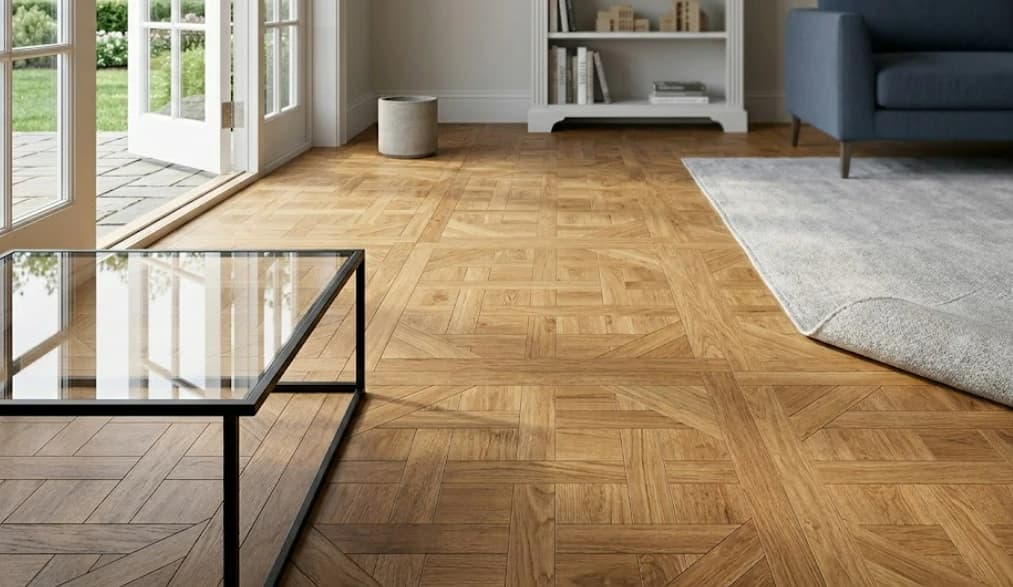
Parquet flooring is a wood floor made of small pieces of solid or engineered hardwood arranged in repeating geometric patterns — most commonly herringbone, chevron, or square basket-weave — instead of parallel planks. Because the wood grain runs in alternating directions, parquet creates a decorative, textile-like surface that has been prized since it debuted at the Palace of Versailles in 1684.
Quick Parquet Floor Summary · 2020 Flooring · Serving DC, MD & VA Since 1997 ·
- - Parquet flooring is a type of wood floor made from small pieces of wood arranged in patterns.
- - Common patterns are herringbone, chevron, and square basket-weave.
- - It is different from regular wood floors because the pieces are arranged in different directions.
- - Parquet floors have been around since the 1600s in France.
- - Today, many people in Maryland, DC, and Virginia are using parquet flooring for their natural elegance.
- - Parquet floors are made of real wood and look bold and premium with their unique patterns.
What Is Parquet Flooring?
The word, the patterns, and why it looks different from every other wood floor.
The word parquet comes from the Old French parchet, meaning “a small compartment” and is a reference to the way individual wood pieces are arranged into self-contained geometric sections. Unlike strip or plank flooring, where boards run parallel across the room, parquet flooring assembles shorter wood pieces at varying angles to form a repeating pattern across the floor surface.
The result is a floor that reads almost like a textile: full of movement, depth, and visual rhythm. The three most common parquet patterns are:
Herringbone
Rectangular planks laid at 90° angles to each other, creating a classic V-shaped zigzag. The most popular parquet pattern today and a staple of French and English manor houses.
Chevron
Similar to herringbone, but planks are cut at an angle so their ends meet in a continuous point by creating a cleaner, more graphic arrow pattern than herringbone.
Square / Basket-Weave
Groups of parallel slats are rotated 90° between blocks, creating a woven or checkerboard effect. The classic 12×12 parquet tile format uses this design.
Less common but equally striking patterns include Versailles (interlocking squares within a border frame), Brick (offset rectangles like a brick wall), and Windmill (a square center tile surrounded by four rectangular slats). Each pattern has a distinct visual weight, for example herringbone and chevron feel dynamic and directional, while basket-weave and Versailles read as formal and symmetrical.
History of Parquet Floors
From the Palace of Versailles to modern day Maryland homes.
Parquet flooring has one of the most storied histories of any architectural material. While geometric wood inlay floors date back to ancient Rome and Renaissance Italy, the modern concept of parquet as a complete flooring system was formalized in 17th-century France.
Versailles, 1684
“Large diagonal squares known as parquet de Versailles were introduced in 1684 as parquet de menuiserie (‘woodwork parquet’) to replace the marble flooring that required constant washing ”
Source: Wikipedia | Parquet
The Versailles pattern, a complex arrangement of oak parquet squares with diagonal inlays, became the defining floor of European aristocracy. It spread through English manor houses, German palaces, and Scandinavian estates throughout the 18th and 19th centuries. By the Victorian era, parquet was a marker of wealth and refined taste in both Europe and the United States.
Parquet reached true mass-market adoption in postwar America. The 1950s and 1960s housing boom made parquet accessible to middle-class homeowners through factory-produced 12×12 tile panels, typically in oak or walnut. These pre-finished tiles could be glued directly to concrete or plywood subfloors without the specialized craftsmanship of earlier installations, making them ideal for the era’s suburban tract homes.
By the 1970s, parquet was everwhere combined with the era’s heavy amber lacquer finishes, eventually gave it a "older" reputation. The 1990s and 2000s favored long, straight hardwood planks, and parquet fell out of mainstream popularity.
The revival began around 2012-2015 as herringbone and chevron patterns appeared in high-end European interiors and quickly spread via social media and design publications. Today, parquet, particularly herringbone white oak with a matte or oil finish, is one of the most requested patterns at our Rockville showroom, sought by homeowners across Maryland, DC, and Northern Virginia who want a floor that makes a design statement.
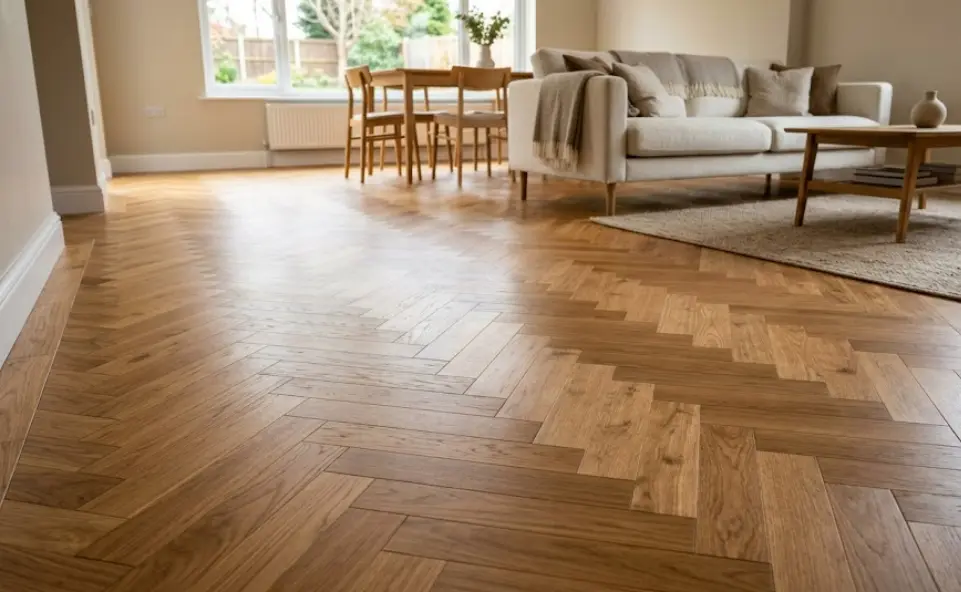
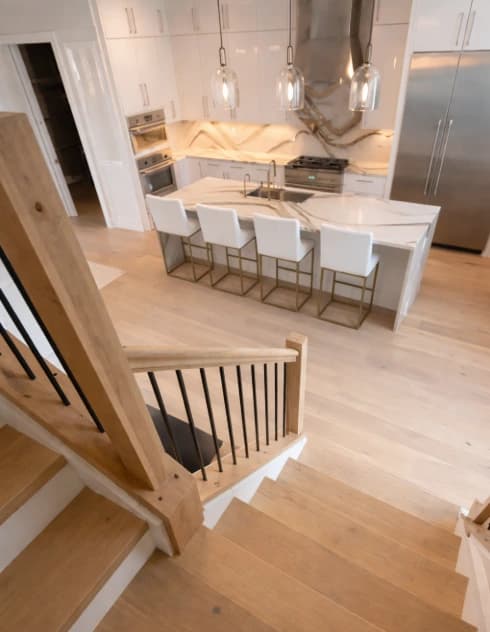
Modern white oak herringbone parquet installed by 2020 Flooring in a Bethesda, MD home.
What Is Parquet Flooring or Parquet Squares Made Of?
Solid hardwood, engineered wood, and everything in between.
Parquet flooring is made from real hardwood, the same species used in standard strip and plank flooring, arranged into geometric patterns. The two main construction types are solid parquet and engineered parquet.
Solid Hardwood Parquet
Traditional parcay floor tiles and finger strips are cut from solid hardwood and a single piece of wood milled to consistent dimensions. Oak (both red and white) dominates the market because of its stability, hardness (Janka 1,290-1,360 lbf), and ability to hold a range of stains and finishes. Walnut, maple, cherry, and exotic species like teak and wenge are also used for premium installations.
Solid parquet is typically 5/16” to 3/4” thick. Thicker tiles allow refinishing which is an important consideration because parquet is a premium flooring choice that homeowners want to maintain for decades. Most solid parquet comes unfinished and is sanded and sealed on-site for a seamless surface.
Engineered Parquet
Engineered parquet has a real hardwood veneer (the species you see) bonded over a plywood or HDF core. This construction dramatically reduces seasonal expansion and contraction, making it suitable for installations over concrete slabs, in basements, and over radiant heat systems where solid hardwood would be at risk of warping or gapping.
The hardwood veneer on engineered parcay flooring ranges from a thin 0.6mm (too thin to refinish) to 4mm or thicker (which allows one full sand-and-refinish cycle). For a long-term investment like parquet, we recommend a minimum 2mm wear layer from ideally 3mm or more, so the floor can be refinished as needed over its lifetime.
| Feature | Solid Parquet | Engineered Parquet |
|---|---|---|
| Construction | Single piece of hardwood throughout | Real wood veneer over plywood core |
| Thickness | 5/16" to 3/4" | 3/8" to 3/4" total; 0.6-4mm+ veneer |
| Subfloor | Plywood or wood subfloor (above grade) | Concrete, plywood, or wood (all levels) |
| Moisture Tolerance | Low : expands / contracts with humidity | High : cross-ply core resists warping |
| Refinishing | 3-5+ times depending on thickness | 1-2 times with 3mm+ wear layer |
| Best For | Above-grade rooms over wood subfloors | Basements, concrete slabs, radiant heat |
| Cost (materials) | $6-$15+ per sq ft | $4-$12+ per sq ft |
Not sure which construction is right for your home? Our parquet flooring installation team will assess your subfloor, room conditions, and long-term goals to recommend the right construction type. Or browse our expert guide on hardwood 101 to learn more about species, hardness ratings, and finish options.
What Is Parquet Flooring Laid On?
Subfloor requirements, preparation, and installation methods for solid and engineered parquet.
Parquet flooring can be laid on a variety of subfloor types depending on the construction method. Proper subfloor preparation is the most critical step in a long-lasting parquet installation, an uneven or insufficiently flat subfloor will cause tiles to rock, crack, or come loose over time.
Plywood Subfloor (Nail-Down or Glue-Down)
The most common subfloor for solid parquet. Plywood must be at least 3/4" thick, structurally sound, and flat to within 3/16" over 10 feet. Solid parquet can be either nailed (with a pneumatic flooring nailer) or glued directly to the plywood. Nail-down is preferred for thicker solid tiles; glue-down provides a quieter result and is better over subfloors with slight imperfections.
Concrete Slab (Glue-Down: Engineered Only)
Engineered parquet can be glued directly to a concrete slab using a moisture-tolerant urethane adhesive. The slab must be flat (within 3/16" over 10 feet), dry (moisture content below 3 lbs per 1,000 sq ft per 24 hours for most adhesives), and free of paint, sealers, or contamination. Solid parquet should never be laid directly on concrete.
Existing Tile or Vinyl (Engineered, Glue-Down)
If the existing surface is firmly bonded, flat, and free of wax or sealers, engineered parquet can sometimes be glued over existing hard-surface flooring. This approach saves the cost of demolition but adds floor height and requires a careful flatness check. We assess on a case-by-case basis during our free pre-installation consultation.
Over Radiant Heat (Engineered Only)
Parquet can be installed over hydronic or electric radiant heat systems when engineered construction is used. The system must be ramped up and down slowly (no faster than 1.5°C/day) before and after installation to acclimate the flooring. Solid parquet should not be used over radiant heat due to the risk of excessive drying and gapping.
Acclimation is essential. All parquet flooring, solid or engineered, must be acclimated to your home’s temperature and humidity for 48-72 hours before installation. In the DMV area, where seasonal humidity swings between dry winters and humid summers, proper acclimation prevents gapping and cupping after installation. Our installation team handles acclimation as a standard part of every parquet project.
What Are Parquet Floor Tiles?
How parquet tiles are assembled, sized, and what to look for when choosing them.
Parquet floor tiles (also called parquet panels or parquet blocks) are pre-assembled units of hardwood arranged in a geometric pattern and held together by a backing material. They are the modular building blocks of a parquet floor, instead of laying individual finger strips one by one (traditional artisan parquet), tiles allow for faster, more consistent installation.
Common Tile Formats
12x12 inch
The classic postwar format. Fast to install, widely available, works well in both traditional and contemporary spaces. Contains 4-9 finger block groups depending on finger width.
18x18 inch
A mid-size format that feels more expansive than 12×12 without the installation complexity of very large panels. Popular for open-plan spaces.
24x24 inch and larger
Found in high-end residential and commercial installations. Large-format parquet creates a bold, luxurious effect but demands a perfectly flat subfloor.
Strip / Finger Block
Individual finger strips (typically 2 1/4" x 9" or similar) laid in herringbone or chevron patterns. Not pre-assembled into a tile — requires on-site pattern layout. The most time-intensive but most flexible format.
Backing Types
Parquet tiles are held together by one of three backing systems:
- Mesh-backed: A fiberglass mesh adhered to the underside of the tile. Common in engineered parquet panels. The mesh allows some flex and compensates for minor subfloor irregularities.
- Spline-backed: A thin wooden spline holds individual strips in place. Traditional solid parquet often uses this system, which provides rigidity and allows for nail-down installation.
- Self-adhesive (peel-and-stick): Budget tiles come with a pre-applied adhesive on the back. Not recommended for permanent installations — adhesive degrades over time and tiles can lift. Suitable only for very temporary applications.
What Are Parquet Floor Costs?
Material costs, installation labor, and the total investment for a parquet floor in the DC, Maryland, and Virginia area.
Parquet flooring is a premium product, and its cost reflects the material quality, pattern complexity, and skilled labor required for installation. Here is what Maryland, DC, and Virginia homeowners can expect to invest in 2026.
| Cost Component | Budget Range | Mid-Range | Premium |
|---|---|---|---|
| Engineered Parquet (materials) | $4-$7 / sq ft | $7-$11 / sq ft | $11-$18+ / sq ft |
| Solid Hardwood Parquet (materials) | $6-$9 / sq ft | $9-$14 / sq ft | $14-$22+ / sq ft |
| Installation — Standard Tile Pattern | $4-$6 / sq ft | $5-$7 / sq ft | $7-$10 / sq ft |
| Installation — Herringbone / Chevron | $7-$10 / sq ft | $9-$13 / sq ft | $12-$18+ / sq ft |
| Subfloor Prep (if needed) | $1-$2 / sq ft | $2-$4 / sq ft | $4-$8+ / sq ft |
| Total Installed (typical range) | $10-$15 / sq ft | $14-$22 / sq ft | $20-$35+ / sq ft |
DMV area estimates. Prices vary by room size, subfloor condition, and species. Get a precise quote with our free in-home measurement.
What Drives Parquet Cost Higher?
- Pattern complexity — herringbone and chevron require many angled cuts and precise alignment, adding 30-60% to labor costs versus a straight basket-weave tile.
- Species selection — white oak and red oak are the most affordable hardwood options. Walnut, maple, and exotic species (teak, wenge, Brazilian cherry) carry a significant premium.
- Room size and shape — larger rooms benefit from economies of scale, but irregular room shapes increase waste and cutting time.
- Subfloor condition — an unlevel concrete slab or damaged plywood subfloor must be remediated before parquet can be installed.
- Site finishing — parquet that arrives unfinished and is sanded and finished on-site produces a superior result but adds $2-$4 per square foot in labor and materials.
Ready to get a real number for your home? Get your free custom hardwood installation estimate from 2020 Flooring. We serve Maryland, Washington DC, and Northern Virginia with free in-home measurements and no-obligation quotes.
Thinking About Parquet for Your Home?
Visit the 2020 Flooring showroom in Rockville: open 7 days a week to see parquet patterns, species, and finishes in person. Our parquet flooring installation team brings 30+ years of experience to every project across Maryland, DC, and Virginia.
Frequently Asked Questions About Parquet Flooring
Answers to the most common questions our customers ask about parquet flooring.

Written by
Jason Brown
Flooring Specialist
Jason Brown has 14 years of flooring sales and installation experience across the DC, Maryland, and Virginia area.