Commercial guide · 2020 Flooring · Serving DC, MD & VA since 1997
The best flooring for most hair salons and barber shops is commercial glue-down LVT with a square edge on the service floor, with heat-welded sheet vinyl or epoxy-grouted porcelain at the colour bar and shampoo bowls. Nail salons lean to porcelain or a resinous floor because of acetone. This guide covers every salon type, zone by zone, plus hair, dye, chemicals, comfort, Maryland sanitation rules and 2026 installed costs in the DMV.
A salon floor gets a harder life than almost any other retail floor of the same size.
It is swept dozens of times a day. It takes drips of permanent colour and lightener, splashes from the shampoo bowls, hairspray overspray, and the occasional dropped curling iron. Barber chairs weighing well over a hundred pounds are bolted into it. Stylists stand on it for eight or ten hours. And in Maryland, the State Board of Cosmetologists requires that salon floor coverings “be washed and kept clean” and that hair and nail debris be “removed from the floor without delay.”
So the question is not which floor looks best on opening day. It is which floor still sweeps clean, resists stains and feels right underfoot in year five.
At 2020 Flooring, we have been installing commercial floors across Maryland, Washington DC and Northern Virginia since 1997, with in-house crews licensed and insured in all three jurisdictions. Below is what we actually recommend for hair salons, barber shops, nail salons, beauty and lash studios, med spas and tattoo parlors, and why.
The Best Salon Flooring by Business Type
The right floor depends on what your clients and your chemicals do to it.
| Business | Our first choice | Why |
|---|---|---|
| Hair salon | Commercial glue-down LVT on the floor; heat-welded sheet vinyl or porcelain with epoxy grout at the colour bar and shampoo bowls | Sweeps clean, quiet, comfortable, and the wet and dye zones get a seamless or stain-proof surface |
| Barber shop | Commercial glue-down LVT or sheet vinyl; resinous flake for an industrial look | Fine clippings all day, heavy bolted chairs, and constant sweeping |
| Nail salon | Large-format porcelain tile with epoxy grout, or a chemical-resistant resinous floor | Acetone, monomer and polish spills, plus standing water at pedicure chairs |
| Beauty, lash, brow & esthetics studio | Commercial glue-down LVT throughout | Low spill risk, a warmer look, and an easy surface to clean between clients |
| Med spa & treatment rooms | Heat-welded sheet vinyl or commercial LVT, specified like a clinic | Clinical cleaning chemistry, rolling equipment and procedure-room hygiene |
| Tattoo & piercing parlor | Sheet vinyl or resinous floor with a coved base in procedure areas | Smooth, non-absorbent and easy to disinfect, with no seams at the wall |
A starting point, not a specification. Your slab, your lease and your service menu can all change the answer.
One theme runs through every row: commercial goods, fully adhered. The floating click floors sold in most home-improvement showrooms are designed for homes. A salon is a commercial space and needs commercial product.
Opening, expanding or refreshing a salon, barber shop or beauty studio in Maryland, Washington DC or Northern Virginia? We measure, test the slab and schedule the install around your closed days.
Get a Salon Flooring QuoteWhat a Salon Floor Has to Survive
Six things break salon floors. Every recommendation below answers at least one of them.
1. Hair, all day
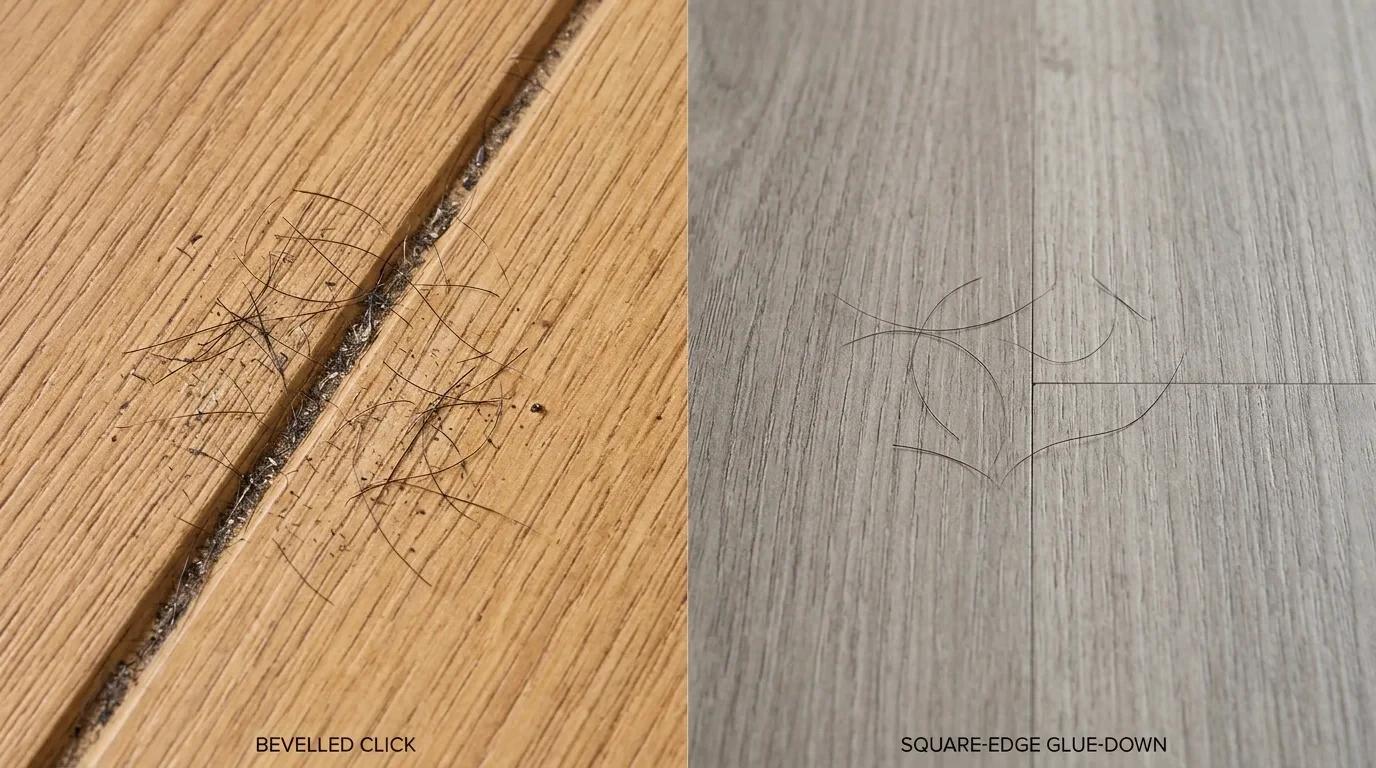
Cut hair is fine, static-prone and endless. It collects in bevelled seams, in deep wood-grain embossing and in grout joints. The single most useful spec for a salon or barber shop floor is an edge and texture that let a broom clear hair in one pass.
2. Hair colour and lightener
Permanent hair colour is designed to bond with a porous surface, and lighteners are built on hydrogen peroxide. A dye drip can stain vinyl if it sits, and lightener can bleach cement grout, even dark grout. The colour bar and the area around each chair during colour services need the most stain-resistant surface in the building.
3. Solvents: acetone, monomer and hairspray
Nail salons handle acetone, acrylic monomer, polish and removers, and OSHA lists methacrylate compounds and toluene among the chemicals in common salon products. Acetone can soften or dull vinyl wear layers and many factory finishes. Hairspray overspray leaves a sticky film that makes some floors slippery and collects grit.
4. Water
Shampoo bowls, pedicure chairs, mopping and the laundry all put water on the floor. Waterproof planks are not the same as a waterproof floor: on a floating floor, water finds the seams and the perimeter gap.
5. Heavy chairs, rolling stools and hot tools
Hydraulic barber and styling chairs are heavy and usually bolted to the slab. Rolling stools and colour trolleys pivot on the same few square feet all day. Flat irons and curling irons commonly run up to about 450°F, which is enough to scorch or melt vinyl if one is dropped face down.
6. Long hours standing
Stylists, barbers and nail technicians spend most of a shift on their feet. The Canadian Centre for Occupational Health and Safety notes that prolonged standing on hard floors contributes to fatigue and discomfort, and recommends resilient floors or mats where people stand to work. Comfort is a staff-retention issue, not a luxury.
1. Commercial Glue-Down LVT: The All-Round Winner
The right answer for most salon and barber shop service floors, if you buy the commercial version.
Commercial luxury vinyl tile (LVT) and plank (LVP) are the same family; the industry uses the names loosely. What matters for a salon is the installation method: glue-down (dryback) product, fully adhered to a prepared slab.
- No floating, no expansion gap. A glued floor does not shift under rolling stools, and there is no perimeter gap to collect hair and water.
- Chairs bolt straight through. Anchoring a heavy chair through a floating floor pins it at that point, and the floor buckles or separates elsewhere as it moves. Through a glued floor, it is routine.
- Square or micro-bevel edges. Specify product with no painted bevel. Square-edged planks read as one flat surface and sweep clean.
- 20 mil or thicker wear layer with a factory-applied urethane coating. For how wear layers are rated and what the number does and does not tell you, see our linoleum vs. LVP vs. LVT comparison.
- Replaceable. If a hot iron scorches a plank, one plank can be cut out and replaced. That is hard to do with sheet goods or a resinous floor.
Its weakness is chemistry. LVT handles a dye drip that is wiped up quickly, but acetone and lightener left to sit will mark it. That is why we pair LVT on the styling floor with a tougher surface at the colour bar.
See our commercial vinyl and LVT installation page for the products we fit, and the luxury vinyl collections to see decors in person.
2. Heat-Welded Sheet Vinyl: Best for Colour Bars and Wet Zones
Welded seams and a coved base: nowhere for dye, water or hair to go.
Commercial sheet vinyl comes in 6 ft or 12 ft rolls. The seams are routed and heat-welded with a vinyl rod, and the sheet can be turned up the wall as an integral coved base. The result is a floor with no joint for dye or water to enter.
It is the floor we recommend for colour bars, dispensaries, shampoo areas and laundries, and it is a strong choice for the whole floor in a barber shop or a busy, colour-heavy salon. It is also the clinical default, which is why med spas and tattoo parlors often specify it for treatment rooms.
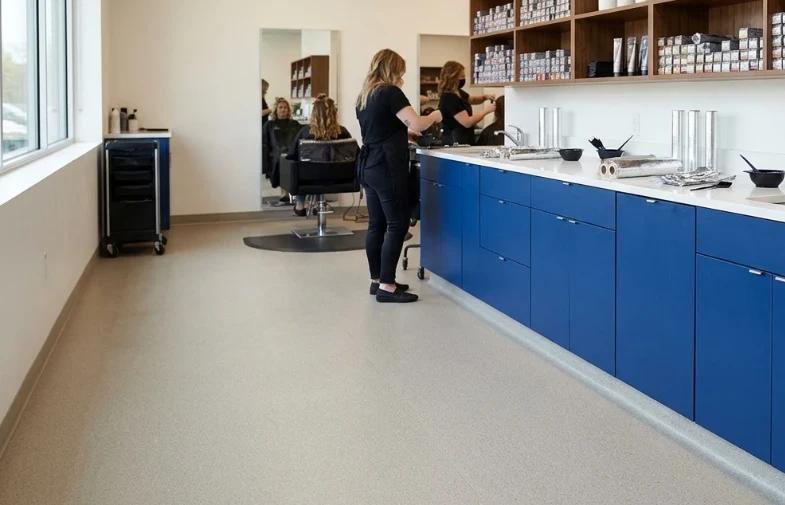
The trade-off is that sheet vinyl is installer-dependent. A poor weld or a cove that is not fully supported will fail. Read more on our commercial sheet vinyl installation page, or browse patterns on the sheet vinyl collections page.
3. Porcelain Tile with Epoxy Grout: Best for Nail Salons
The tile is fine. The grout is the decision.
Porcelain is close to indestructible. Acetone, dye, lightener and standing water do not harm it, and a dropped hot tool will not scorch it. For a nail salon, it is often the best floor in the building.
The problem is the grout. Light cement grout darkens with dirt, and cement grout of any colour absorbs dye and can be lightened by bleach. The fix is specific:
- Epoxy grout, not cement grout. It is non-porous and resists staining and chemicals.
- Large-format tile (24" x 24" or larger) with narrow joints, so there is less grout to start with.
- A matte or textured finish rated for wet areas. Polished porcelain is slippery with water and product on it.
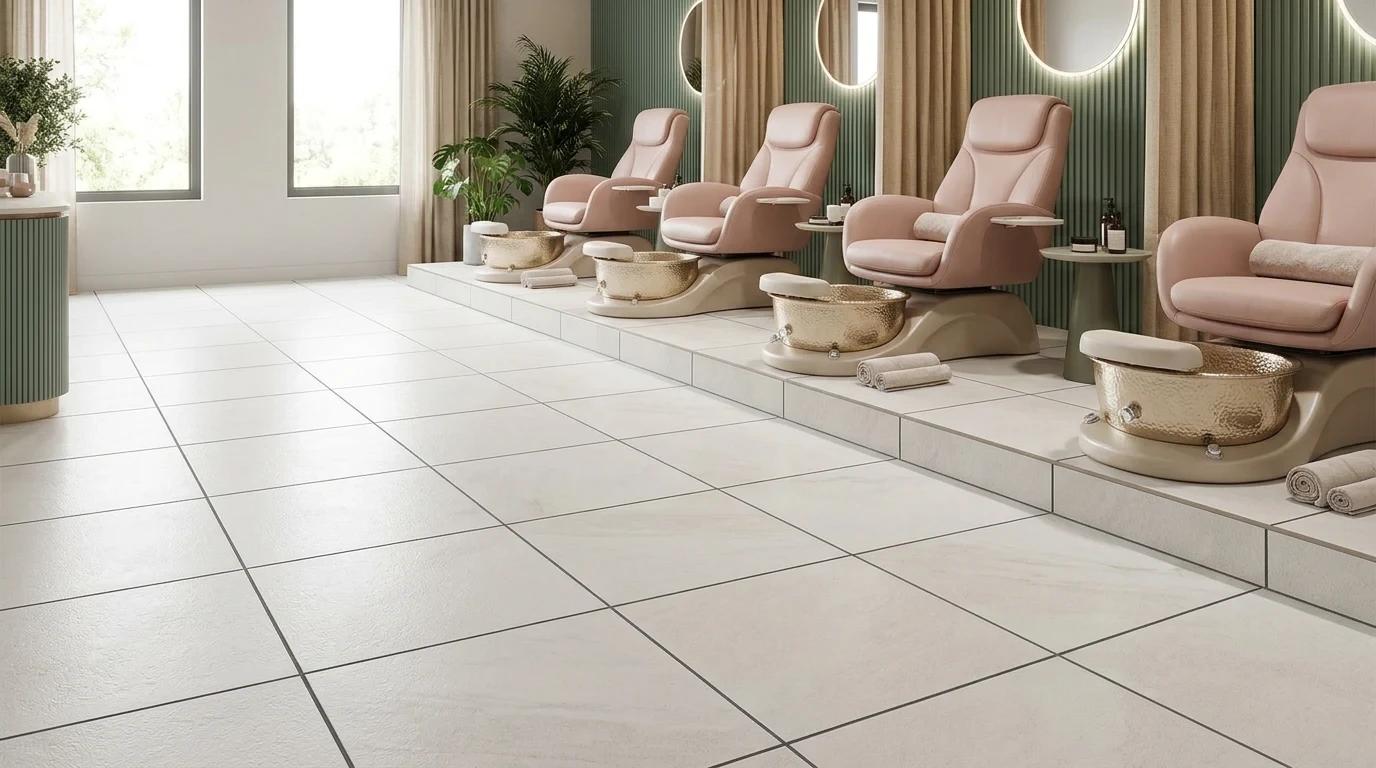
The other trade-off is comfort. Tile is the hardest floor on this list to stand on. In a hair salon, we usually keep porcelain to the colour bar, shampoo area and restrooms, and put a more resilient floor at the stations. See commercial tile installation.
4. Epoxy and Resinous Floors: Best for Industrial-Style Barber Shops
Seamless and tough, with one important detail in the topcoat.
A resinous floor (an epoxy base with a decorative flake or quartz broadcast, sealed with a urethane or polyaspartic topcoat) is poured in place. It is seamless, coves up the wall and gives a barber shop or tattoo parlor a clean industrial look.
- Ask about the topcoat. Plain epoxy can yellow under UV, which matters in a storefront with big south-facing windows. A UV-stable urethane or polyaspartic topcoat holds its colour.
- Ask for the chemical-resistance chart. Confirm resistance to acetone, hydrogen peroxide and the disinfectants you use.
- Ask for a slip-resistant texture. A flake or quartz broadcast adds grip. A smooth, high-gloss resin floor is slippery when wet.
- Plan for cure time. Resinous floors need a slab moisture test and longer downtime than LVT.
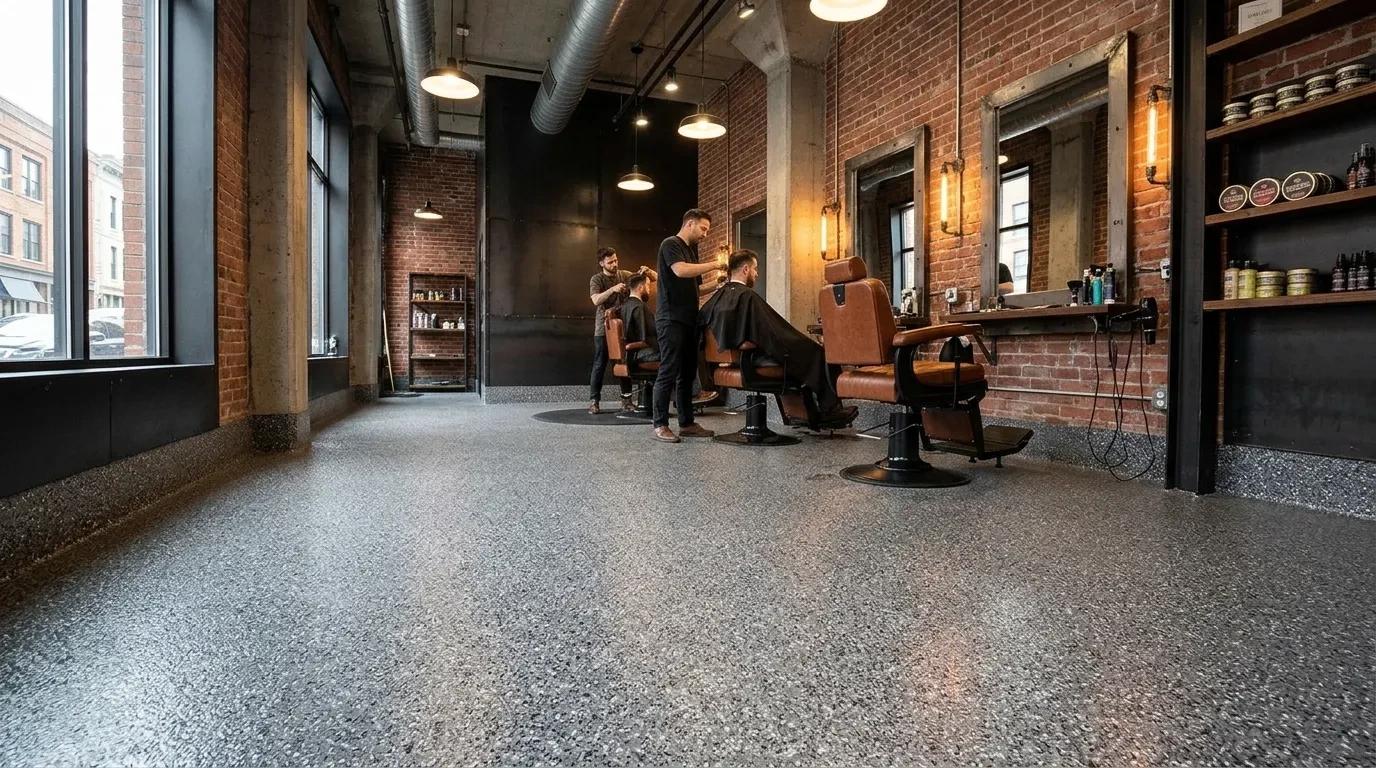
Learn more on our epoxy floor coating page.
5. Commercial Rubber: Best for Comfort at Stations and Shampoo Bowls
The most comfortable floor to stand on, and the one hospitals use for that reason.
Commercial rubber sheet and tile (nora is the best-known maker) is widely used in healthcare because it is resilient underfoot, durable and easy to clean. For a salon, its main appeal is comfort for staff who stand all day, without the trip edge of a loose mat.
Rubber has a narrower design range than LVT, costs more, and has a short-lived new-product odour. Some solvents and dyes can mark it, so ask for the maker's chemical-resistance data and test a sample with your own colour line and remover before you commit.
Salon Flooring Compared
How the five floors, and the one we steer clients away from, compare on what matters in a salon.
| Floor | Sweeping hair | Dye & lightener | Acetone & solvents | Water | Standing comfort |
|---|---|---|---|---|---|
| Commercial glue-down LVT | Excellent (square edge) | Good if wiped fast | Fair: acetone dulls it | Very good | Good |
| Heat-welded sheet vinyl | Excellent | Good if wiped fast | Fair to good | Excellent | Good |
| Porcelain tile, epoxy grout | Very good | Excellent | Excellent | Excellent | Poor: hard underfoot |
| Resinous (epoxy / urethane) | Excellent | Very good | Very good (topcoat-dependent) | Excellent | Fair |
| Commercial rubber | Very good | Fair: test first | Fair: test solvents | Very good | Excellent |
| Residential click LVP | Poor (bevelled seams) | Good if wiped fast | Fair | Fair: seams, not the plank, fail | Good |
Ratings are our installer's judgement for salon use, not manufacturer test results. Always check the specific product's data sheet.
Flooring for Each Type of Salon and Studio
Same principles, different priorities.
Hair salons
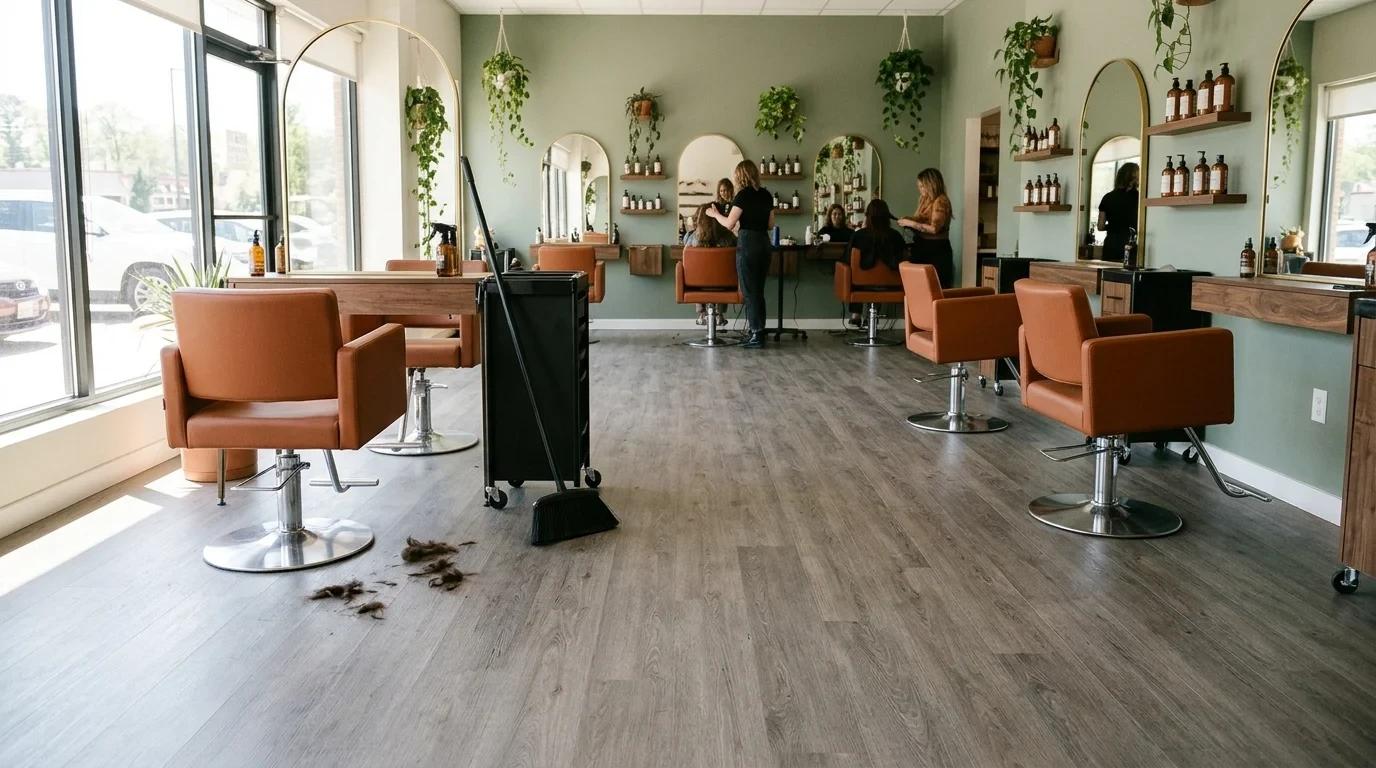
Commercial glue-down LVT across the styling floor, heat-welded sheet vinyl or epoxy-grouted porcelain at the colour bar and shampoo bowls, and a short run of walk-off carpet tile inside the entrance. A mid-tone, low-texture decor hides the day's traffic but still shows hair so it gets swept.
Barber shops
Barbers cut more often and shorter, so the floor sees a constant drift of fine clippings. Choose a light-to-mid tone (short dark hair vanishes on a dark floor), square edges and a fully adhered floor that can take heavy, bolted barber chairs. Glue-down LVT and sheet vinyl are the safe choices; a resinous flake floor suits the industrial look many shops want.
Nail salons
Acetone and pedicure water decide this one. Large-format porcelain with epoxy grout or a chemical-resistant resinous floor, at least around the manicure tables and pedicure chairs. Check the plumbing and any floor drains at pedicure stations before the floor goes down, and make sure ventilation work is complete first: OSHA identifies ventilation as the most effective way to lower chemical levels in nail salons, and ductwork for ventilated tables often runs at floor level.
Beauty, lash, brow and esthetics studios
These rooms see little water and few heavy chemicals, so commercial LVT throughout is usually the right answer, with a warmer wood or stone look. In Maryland, esthetics services carry their own sanitation rules on top of the general salon rules, so keep every surface easy to wipe down between clients.
Med spas and treatment rooms
Treat these like a clinic: heat-welded sheet vinyl or properly specified glue-down LVT, with cleaning chemistry checked against the floor. Our dental office flooring guide covers clinical specification room by room, and most of it applies directly.
Tattoo and piercing parlors
Procedure areas should have a smooth, non-absorbent floor that is easy to disinfect, with a coved base and no seams at the wall. Sheet vinyl or a resinous floor fits best. Rules differ between Maryland counties, DC and Virginia, so confirm the current requirements with your local health department or licensing board before you finalize the floor.
Blow-dry bars and beauty parlors
Low chemical exposure and lots of hot tools. Commercial LVT is the practical choice; keep the tool holsters mounted at every station so a hot iron lands in a holster, not on the floor.
Zone-by-Zone Salon Floor Plan
One salon, several floors. This is where the budget is best spent.
| Zone | Floor | Watch for |
|---|---|---|
| Styling and cutting stations | Commercial glue-down LVT, square or micro-bevel edge | Chairs bolted through the finished floor, never through a floating one |
| Colour bar and dispensary | Heat-welded sheet vinyl with coved base, or porcelain with epoxy grout | The highest dye and lightener exposure in the building |
| Shampoo and backbar | Sheet vinyl, rubber, or porcelain with epoxy grout | Standing water and long standing shifts |
| Pedicure and manicure (nail salons) | Porcelain with epoxy grout or resinous floor | Acetone and water together; check plumbing and drains first |
| Reception and retail | Commercial LVT; walk-off carpet tile at the door | Grit and winter salt come in here |
| Restroom and laundry | Porcelain or sheet vinyl with coved base | Washer leaks and mopping water |
Transitions between zones should be flush or very close to it. Under the ADA, changes in level on an accessible route of up to 1/4 inch may be vertical, and from 1/4 to 1/2 inch must be bevelled, so plan the floor build-ups together rather than one material at a time.
What the Trade Agrees On
What working flooring installers tell salon owners.
A long-running r/Flooring thread on hair salon flooring started with a salon owner weighing LVP and worrying it would be hard to sweep. The installers who answered landed in the same place we do:
- Glue it down. An installer who had “done a ton of barber shops” recommended glue-down LVT with no tongue and groove. Click flooring is largely a DIY product and is the wrong choice in a commercial space.
- Buy commercial goods. Most flooring stores stock residential product. Commercial product costs more because it is tested and warranted for commercial traffic.
- No bevel. A square-edged plank sweeps clean; a bevel holds hair.
- Grout is the weak point of tile. Bleach-based lightener can lighten even dark grout, a problem one salon owner said they had experienced.
- Sheet vinyl, rubber and epoxy all work, if they are commercial grade and installed by someone experienced with that system.
Floors and Details to Avoid
Each of these looks reasonable in a showroom and causes trouble in a salon.
Carpet or carpet tile on the service floor
Hair works into the pile, dye stains it permanently, and Maryland requires floor coverings to be washed and kept clean. Keep carpet tile to walk-off zones and back offices.
Hardwood and laminate
Standing water at shampoo bowls swells the edges, and chemical spills etch the finish. Beautiful in a lobby, wrong at the station.
Residential click LVP with a bevelled edge
Fine hair packs into the V-grooves, and a heavy bolted chair pins a floating floor so it buckles elsewhere.
Light cement grout
It absorbs dye and is lightened by bleach. Even dark cement grout spots where lightener lands.
Deep embossed or wire-brushed textures
The texture that looks realistic is the texture that holds hair after sweeping.
High-gloss finishes
They show every scuff and become slippery with water, product residue and hairspray overspray.
Cleaning, Sanitation Rules and Slip Safety
The floor has to make the sanitation rules easy to follow every day.
In Maryland, COMAR 09.22.02.04 sets the sanitation rules for beauty salons. Several of them land directly on the floor:
- Every salon “shall be well lighted, heated, and ventilated, and shall be kept in a clean and sanitary condition.”
- “The walls, curtains, and floor coverings in a salon shall be washed and kept clean.”
- “All hair, nail service debris, cotton, or other waste material shall be removed from the floor without delay and deposited in a closed container and removed from the premises frequently.”
- “Objects dropped on the floor may not be used until they are cleansed and disinfected.”
Barber shops in Maryland, and salons and shops in DC and Virginia, answer to their own boards, but the expectations are similar: a floor that can be swept continuously and washed properly. A smooth, non-absorbent, low-texture floor makes that a two-minute job.
For employers, OSHA's walking-working surfaces standard requires floors to be kept clean and, as far as feasible, dry, and free of hazards such as spills. Where wet processes are used, as at shampoo bowls and pedicure stations, it calls for drainage and dry standing places such as mats or platforms where feasible.
- Use the cleaner the floor maker approves. Harsh strippers, solvent cleaners and the wrong disinfectant dilution can strip a vinyl floor's factory coating.
- Wipe dye and lightener immediately, not at closing time.
- Put a walk-off mat at the door. In a DMV winter, grit and road salt do more damage to a salon floor than anything used inside.
- Use felt or rubber caster wheels sized for hard floors on stools and trolleys.
Comfort for Stylists, Barbers and Nail Techs
A floor that keeps stylists comfortable helps keep stylists.
CCOHS recommends floors with some give, such as wood, cork or rubber, for people who stand to work, and mats over hard floors such as concrete. It also warns that mats must not become a tripping hazard, and that very soft, thick mats can add to fatigue rather than reduce it.
In practice, that gives salon owners three options, in order of comfort: rubber flooring at stations and shampoo bowls; commercial LVT, which has a little give over a smooth slab; or porcelain with low-profile anti-fatigue mats with bevelled edges at each station. Avoid stacking a thick mat on a hard floor where clients walk past.
Choosing Colour and Texture
Pick the colour for the hair your clients have, not just the brand palette.
- Mid-tones work hardest. Very dark floors show dust, lint and light hair; very light floors show every scuff and dye drip.
- Match contrast to your clients. A barber shop cutting mostly short dark hair benefits from a lighter floor so clippings are seen and swept.
- A subtle pattern hides wear between sweeps: a soft concrete or stone look, or a low-contrast wood grain.
- Low sheen, low texture. Matte, lightly textured surfaces give grip without holding hair.
Bring a handful of your actual clippings and your darkest colour to our North Bethesda showroom, and test them on samples. It takes ten minutes and settles the question.
Installation: Slab, Plumbing, Chairs and Scheduling
Salon floors fail from the slab up. Most of the work is invisible.
- Test the slab for moisture. Most DMV salons sit in strip centres and ground-floor retail on concrete slabs. Glue-down and resinous floors need a slab moisture test before installation. Moisture is the most common cause of adhesive failure.
- Flatten the slab. Glue-down LVT shows every hump and dip. Grinding and patching are part of the job, not an extra.
- Plumb before you floor. Shampoo bowls and pedicure chairs need water and drain lines set first. Rough-ins and floor penetrations are sealed into the floor.
- Floor first, then chairs. Barber and styling chairs are anchored through the finished floor into the slab.
- Check your lease. Many leases set out what the landlord will accept and what must be removed at lease end, and some buildings limit noisy or dusty work to certain hours.
- Work around your closed days. Many salons close on Mondays. A small salon in glue-down LVT can often be done over a closed day; tile and resinous floors need longer.
If an old floor needs to come out first, see our floor removal service. In Maryland, most like-for-like floor replacement does not need a building permit, but structural or plumbing changes can; our Maryland flooring permit guide explains when one applies.
Opening, expanding or refreshing a salon, barber shop or beauty studio in Maryland, Washington DC or Northern Virginia? We measure, test the slab and schedule the install around your closed days.
Book a Free Site VisitHow Much Does Salon Flooring Cost?
2026 installed planning ranges for commercial work in Maryland, DC and Northern Virginia.
| Floor | Installed, per sq ft | Watch for |
|---|---|---|
| Commercial glue-down LVT (20 mil wear layer or more) | $7 to $13 | Needs a flat slab and the adhesive the maker specifies |
| Commercial sheet vinyl, heat-welded, coved base | $9 to $16 | Welding and coving are skilled labour, not an upgrade line |
| Large-format porcelain tile with epoxy grout | $14 to $28 | Epoxy grout costs more to buy and to install than cement grout |
| Resinous system (epoxy flake or quartz, urethane or polyaspartic topcoat) | $9 to $20 | Slab moisture and the topcoat decide how it ages |
| Commercial rubber sheet or tile | $10 to $18 | Narrower design range; check the chemical chart |
| Old floor removal and slab preparation | $1 to $5 extra | Tile and glued-down layers sit at the top of the range |
Planning ranges, not quotes. Product choice, slab condition, after-hours work and project size all move the price.
As a worked example, a 1,200 sq ft salon in commercial glue-down LVT plans at roughly $8,400 to $15,600 installed before slab preparation. Swapping 150 sq ft at the colour bar and shampoo area for heat-welded sheet vinyl usually adds little to the total, and it protects the part of the floor most likely to fail. For a full walkthrough of commercial pricing and how to compare contractor bids, see our commercial office flooring guide.
Salon Flooring Checklist
Take this to any flooring showroom or contractor.
- Commercial product, not residential
- Glue-down (dryback) or seamless, not floating click
- Square or micro-bevel edges; low, matte texture
- 20 mil or thicker wear layer on vinyl
- Stain-proof surface at the colour bar and shampoo bowls
- Epoxy grout if you choose tile
- Chemical-resistance data checked for acetone, peroxide and your disinfectant
- Slab moisture test and flatness prep in the quote
- Plumbing roughed in before flooring
- Chairs anchored through the finished floor
- Flush transitions between zones
- Walk-off mat at the entrance
- Install scheduled around your closed days
Salon & Barber Shop Flooring FAQs
What salon, barber shop and nail salon owners ask us most.
What is the best flooring for a hair salon?
For most hair salons, commercial glue-down luxury vinyl tile or plank (LVT) with a square or micro-bevelled edge and a 20 mil or thicker wear layer is the best all-round floor for the styling area. Put heat-welded sheet vinyl, or porcelain tile with epoxy grout, at the colour bar and shampoo bowls where dye, lightener and water land.
Is luxury vinyl plank (LVP) good for a salon?
Yes, if it is commercial glue-down product and not residential click flooring. Glue-down LVT stays put under rolling and heavy chairs, has no expansion gap to collect hair, and can be bought with square edges that sweep clean. Click LVP with bevelled edges traps hair in the seams and should not have barber or styling chairs bolted through it.
What is the best flooring for a barber shop?
Commercial glue-down LVT or heat-welded sheet vinyl in a light-to-mid tone, so short clippings are easy to see and sweep. A resinous epoxy flake floor is a good alternative for an industrial look. Anchor barber chairs through the finished floor into the slab.
What flooring is best for a nail salon?
Large-format porcelain tile with epoxy grout, or a chemical-resistant resinous floor. Nail salons use acetone, monomer and polish, and pedicure stations add standing water. Acetone can soften or dull vinyl wear layers and many factory finishes, so vinyl is a weaker choice around manicure tables.
Will hair dye stain vinyl flooring?
It can. Most resilient flooring manufacturers list hair dye among the agents that can stain permanently. The defence is a stain plan: a seamless sheet floor or epoxy-grouted porcelain at the colour bar, a floor mat under the mixing station, and wiping drips immediately rather than at closing.
Is tile a good choice for a hair salon?
Porcelain is nearly indestructible, but the grout is the weak point. Cement grout absorbs dye and is lightened by bleach. If you choose tile, use large-format porcelain with narrow joints and epoxy grout, and plan anti-fatigue support for stylists, because tile is hard to stand on all day.
Is epoxy flooring good for a salon or barber shop?
Yes. A resinous floor is seamless, coves up the wall and resists water. Choose a system with a UV-stable urethane or polyaspartic topcoat, because plain epoxy can yellow in a sunny storefront, and confirm the topcoat is rated for the solvents you use.
How much does salon flooring cost in Maryland, DC and Virginia?
Planning ranges for 2026 installed work in the DMV: commercial glue-down LVT about $7 to $13 per square foot, heat-welded sheet vinyl $9 to $16, porcelain with epoxy grout $14 to $28, resinous systems $9 to $20, and rubber $10 to $18. Removal and slab preparation typically add $1 to $5 per square foot.
Can you install flooring without closing the salon?
Usually the work is scheduled around your closed days. Many DMV salons close on Monday, so a small salon can often be done across a Sunday evening and Monday. Glue-down LVT can take foot traffic the same day in most systems; resinous floors and tile need more cure time.
The Bottom Line
Choose by zone, buy commercial, and glue it down.
For most hair salons and barber shops, the best floor is commercial glue-down LVT with a square edge, with sheet vinyl or epoxy-grouted porcelain where colour and water land. Nail salons are better served by porcelain or a resinous floor, and treatment rooms in med spas and tattoo parlors by sheet vinyl with a coved base.
Whatever the material, the outcome depends on the slab, the adhesive and the installer.
Talk to a Salon Flooring Contractor
2020 Flooring installs commercial floors for salons, barber shops, nail salons, beauty studios and med spas across Maryland, Washington DC and Northern Virginia. We measure, test the slab, plan each zone and schedule the work around your closed days.
Call (301) 881-1115 or visit 5550-F Nicholson Lane, North Bethesda, to see commercial LVT, sheet vinyl, rubber and porcelain samples in person.
Related reading and services: commercial vinyl and LVT, commercial sheet vinyl installation, commercial tile, epoxy floor coating, waterproof flooring, and our guides to dental office flooring, commercial office flooring, carpet vs. LVT and linoleum vs. LVP vs. LVT.
Sources & standards
- COMAR 09.22.02.04, Sanitation Requirements (Maryland State Board of Cosmetologists): B(1) ventilation and sanitary condition, B(2) floor coverings washed and kept clean, B(6) hair and nail debris removed from the floor without delay, B(32) objects dropped on the floor.
- OSHA 29 CFR 1910.22, Walking-Working Surfaces: General Requirements: floors kept clean and, as far as feasible, dry; drainage and dry standing places where wet processes are used.
- OSHA, Health Hazards in Nail Salons: Chemical Hazards: chemicals in salon products and ventilation as the most effective control.
- CCOHS, Working in a Standing Position: Basic Information: resilient floors and mats for prolonged standing work.

Written by
Jason Brown
Flooring Specialist
Jason Brown has 14 years of flooring sales and installation experience across the DC, Maryland, and Virginia area.